Looking for classes? Ksquare Career Institute, Bengaluru →

Physics
Laws of Motion
72 questions from 37 papers, each with its answer.
- 72 questions
- 37 papers
- 4.08% of Physics
Friction on an Inclined Plane
-
There are two inclined surfaces of equal length ($L$) and same angle of inclination $45^\circ$ with the horizontal. One of them is rough and the other is perfectly smooth. A given body takes 2 times as much time to slide down on rough surface than on the smooth surface. The coefficient of kinetic friction ($\mu_k$) between the object and the rough surface is close to:
Using $t_r = 2 t_s \implies a_r = a_s / 4$, we get $\mu_k = \left(1 - \frac{1}{n^2}\right) \tan\theta = \left(1 - \frac{1}{4}\right) \tan 45^\circ = 0.75$.
Acceleration on a smooth incline: $a_s = g \sin 45^\circ$. Acceleration on a rough incline: $a_r = g (\sin 45^\circ - \mu_k \cos 45^\circ)$. Since $L = \frac{1}{2} a t^2$, time taken is $t = \sqrt{2L/a}$. Given $t_r = 2 t_s$, we have $\sqrt{a_s / a_r} = 2 \implies a_r = a_s / 4$. Therefore, $g \sin 45^\circ - \mu_k g \cos 45^\circ = \frac{g \sin 45^\circ}{4} \implies \mu_k \cos 45^\circ = \frac{3}{4} \sin 45^\circ \implies \mu_k = \frac{3}{4} \tan 45^\circ = 0.75$.
Impulse and Momentum
-
A ball of mass $0.5\text{ kg}$ is dropped from a height of $40\text{ m}$. The ball hits the ground and rises to a height of $10\text{ m}$. The impulse imparted to the ball during its collision with the ground is (Take $g = 9.8\text{ m/s}^2$):
Impulse is $J = m(v_f + v_i) = 0.5(14 + 28) = 21\text{ N s}$.
Velocity just before hitting the ground: $v_i = \sqrt{2gh_1} = \sqrt{2 \times 9.8 \times 40} = \sqrt{784} = 28\text{ m/s}$ (downward). Rebound velocity to reach $10\text{ m}$: $v_f = \sqrt{2gh_2} = \sqrt{2 \times 9.8 \times 10} = \sqrt{196} = 14\text{ m/s}$ (upward). Taking upward as positive: Impulse $J = \Delta p = m(v_f - (-v_i)) = m(v_f + v_i) = 0.5 \times (14 + 28) = 0.5 \times 42 = 21\text{ N s}$. -
A body of mass M hits normally a rigid wall with velocity V and bounces back with the same velocity. The impulse experienced by the body isImpulse = change in momentum = final momentum − initial momentum.
Take the direction of rebound as positive. Initial momentum = −MV (towards the wall).
Final momentum = +MV (away from the wall, same speed).
Impulse = MV − (−MV) = 2MV
So the magnitude of the impulse experienced by the body is 2 MV.
Circular Motion and Tension
-
A bob is whirled in a horizontal plane by means of a string with an initial speed of $\omega$ rpm. The tension in the string is $T$. If speed becomes $2\omega$ while keeping the same radius, the tension in the string becomes;Centripetal force $F_c = mr\omega^2 = T$ Now $T' = mr(2\omega)^2 = 4mr\omega^2$ $T' = 4T$
Conservation of Momentum
-
A bomb of mass 30 kg at rest explodes into two pieces of masses 18 kg and 12 kg. The velocity of 18 kg mass is 6 m s$^{-1}$. The kinetic energy of the other mass is :The bomb is at rest, so its initial momentum is zero. By conservation of momentum the two pieces have equal and opposite momenta.
Momentum of the 18 kg piece $= 18 \times 6 = 108$ kg m/s
So the 12 kg piece also has momentum $p = 108$ kg m/s (in the opposite direction).
Kinetic energy: $KE = \dfrac{p^2}{2m}$
$KE = \dfrac{(18 \times 6)^2}{2 \times 12} = \dfrac{11664}{24}$
$KE = 486$ J
(The velocity of the 12 kg piece is $\dfrac{108}{12} = 9$ m/s, and $\dfrac{1}{2} \times 12 \times 9^2 = 486$ J.)
Linear momentum
-
The distance covered by a body of mass 5 g having linear momentum 0.3 kg m/s in 5 s is:$p=mv \Rightarrow 0.3=\frac{5}{1000}\times v \Rightarrow v=60$ m/s. Distance travelled in 5 s $=60\times5=300$ m.
Conservation of linear momentum
-
A stationary particle explodes into two particles of masses $m_1$ and $m_2$ which move in opposite directions with velocities $v_1$ and $v_2$. The ratio of their kinetic energies $\dfrac{E_1}{E_2}$ is :The particle is initially at rest, so its momentum is zero. By conservation of momentum, the two fragments have equal and opposite momenta:
$m_1v_1 = m_2v_2$, i.e. $p_1 = p_2 = p$
Kinetic energy in terms of momentum: $E = \dfrac{p^2}{2m}$
$\dfrac{E_1}{E_2} = \dfrac{p^2/2m_1}{p^2/2m_2} = \dfrac{m_2}{m_1}$
So the lighter fragment carries more kinetic energy, and $\dfrac{E_1}{E_2} = \dfrac{m_2}{m_1}$.
Pseudo force in accelerated frames
-
A truck is stationary and has a bob suspended by a light string, in a frame attached to the truck. The truck suddenly moves to the right with an acceleration of a. The pendulum will tilt:In the truck frame a pseudo force $ma$ acts to the left, so the bob tilts left. $\tan\theta=\frac{ma}{mg}=\frac{a}{g} \Rightarrow \theta=\tan^{-1}\left(\frac{a}{g}\right)$.
Banking of roads
-
A car travels on a circular racetrack of radius 50 m, which is banked at an angle $\theta$. If the car travels at a speed 10 ms$^{-1}$, then the wear and tear on its tyres is minimum. Taking the acceleration due to gravity to be 10 ms$^{-2}$, the value of $\theta$ is:Wear and tear is minimum when no friction is needed: $\tan\theta=\frac{v^2}{Rg}=\frac{(10)^2}{50\times10}=\frac{1}{5} \Rightarrow \theta=\tan^{-1}\left(\frac{1}{5}\right)$.
-
A car of mass 1000 kg negotiates a banked curve of radius 90 m on a frictionless road. If the banking angle is $45^\circ$, the speed of the car isOn a frictionless banked road: $\tan\theta = \frac{v^2}{rg}$
$v = \sqrt{rg\tan\theta} = \sqrt{90\times10\times\tan45^\circ}$
$v = \sqrt{900} = 30$ m/s
Friction – laws and coefficient of friction
-
Which one of the following statements is incorrect?
μ is a ratio of two forces and hence dimensionless.
Coefficient of sliding friction has no dimension. $f = \mu_s N \Rightarrow \mu_s = \frac{f}{N}$ (ratio of two forces) So the statement that the coefficient of sliding friction has dimensions of length is incorrect.
Dynamics of uniform circular motion
-
One end of string of length l is connected to a particle of mass 'm' and the other end is connected to a small peg on a smooth horizontal table. If the particle moves in circle with speed 'v', the net force on the particle (directed towards center) will be (T represents the tension in the string)
On a smooth horizontal table, tension alone supplies the centripetal force.
The centripetal force $\left(\frac{mv^2}{l}\right)$ is provided by the tension, so the net force towards the centre is equal to the tension, i.e. T.
Connected bodies and contact force
-
Three blocks A, B and C, of masses 4 kg, 2 kg and 1 kg, respectively, are in contact on a frictionless surface, as shown. If a force of 14 N is applied on the 4 kg block, then the contact force between A and B is
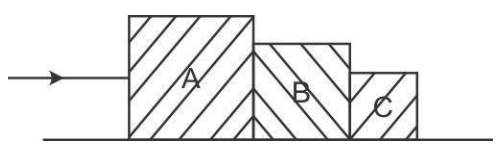 Acceleration of the system: $a = \frac{F_{net}}{M_{total}} = \frac{14}{4+2+1} = 2$ m/$s^2$
The contact force between A and B moves the 2 kg and 1 kg blocks together with this acceleration.
$F = (2 + 1)\times 2 = 6$ N
Circular motion
-
Two stones of masses m and 2m are whirled in horizontal circles, the heavier one in a radius $\frac{r}{2}$ and the lighter one in radius r. The tangential speed of lighter stone is n times that of the value of heavier stone when they experience same centripetal forces. The value of n is:$(F_C)_{heavier} = (F_C)_{lighter}$
$\frac{2mV^2}{r/2} = \frac{m(nV)^2}{r} \Rightarrow n^2 = 4 \Rightarrow n = 2$
Impulse
-
The force 'F' acting on a particle of mass 'm' is indicated by the force-time graph shown below. The change in momentum of the particle over the time interval from zero to 8 s is:
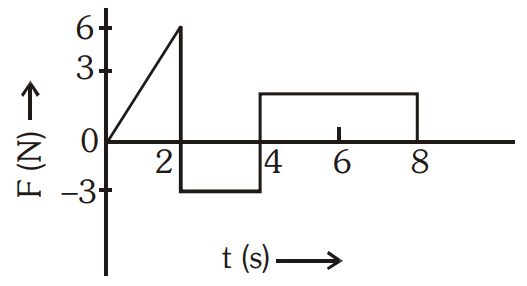 Change in momentum $\Delta p = \int F\,dt$ = area under the F–t graph
$= \frac{1}{2}\times 2\times 6 - 3\times 2 + 4\times 3 = 12$ N s
Newton's second law
-
A body, under the action of a force $\vec{F} = 6\hat{i} - 8\hat{j} + 10\hat{k}$, acquires an acceleration of 1 m/$s^2$. The mass of this body must beMagnitude of the force: $|\vec{F}| = \sqrt{6^2 + (-8)^2 + 10^2} = \sqrt{36 + 64 + 100} = \sqrt{200}$
$|\vec{F}| = 10\sqrt{2}$ N
Newton's second law: $F = ma$, so $m = \frac{F}{a}$
$m = \frac{10\sqrt{2}}{1}$
$m = 10\sqrt{2}$ kg
Newton's first law
-
Three blocks with masses m, 2m and 3m are connected by strings, as shown in the figure. After an upward force F is applied on block m, the masses move upward at constant speed v. What is the net force on the block of mass 2m? (g is the acceleration due to gravity)
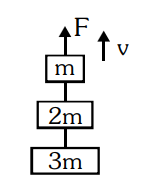 The block of mass 2m moves with constant velocity, so the net force on it is zero.
Circular motion on a level road
-
A car of mass m is moving on a level circular track of radius R. If $\mu_s$ represents the static friction between the road and tyres of the car, the maximum speed of the car in circular motion is given byOn a level road the centripetal force is provided by static friction: $\frac{mv^2}{R} \le \mu_sN = \mu_smg$
$v^2 \le \mu_sRg$
$v_{max} = \sqrt{\mu_sRg}$
Friction
-
A block B is pushed momentarily along a horizontal surface with an initial velocity $V$. If $\mu$ is the coefficient of sliding friction between B and the surface, block B will come to rest after a time
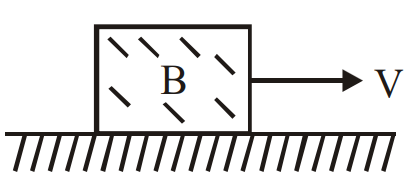 After the push, friction is the only horizontal force on the block; it is the retarding force.
Normal reaction: $R = mg$
Friction: $F = \mu R = \mu mg$
$F = ma \Rightarrow ma = \mu mg \Rightarrow a = \mu g$ (retardation)
From the first equation of motion: $v = u - at$
The block comes to rest, so $0 = V - \mu g \times t$
$t = \dfrac{V}{\mu g}$ -
A block of mass 10 kg placed on rough horizontal surface having coefficient of friction µ = 0.5, if a horizontal force of 100 N acting on it then acceleration of the block will be : -Maximum friction: $f_{max} = \mu N = \mu Mg = 0.5 \times 10 \times 10 = 50$ N (taking g = 10 m/s$^2$).
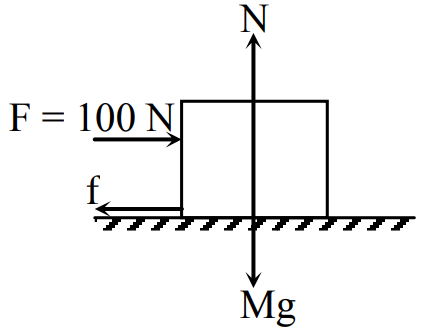
The applied force 100 N is greater than 50 N, so the block slides and friction acting is 50 N.
$a = \dfrac{\text{net force}}{\text{mass}} = \dfrac{100 - 50}{10}$
$a = 5$ m/s$^2$
Motion in a lift
-
A person of mass 60 kg is inside a lift of mass 940 kg and presses the button on control panel. The lift starts moving upwards with an acceleration 1.0 m/$s^2$. If g = 10 m $s^{-2}$, the tension in the supporting cable isTotal mass supported by the cable = mass of lift + mass of person = 940 + 60 = 1000 kg.
Forces on the system: tension T upward and weight $(M + m)g$ downward.
The lift accelerates upward, so $T - (M + m)g = (M + m)a$
$T = (M + m)(g + a)$
$T = 1000\times(10 + 1) = 11000$ N -
The mass of a lift is 2000 kg. When the tension in the supporting cable is 28000 N, then its acceleration isForces on the lift: tension T = 28000 N upward and weight mg = 2000 × 10 = 20000 N downward (taking g = 10 m $s^{-2}$).
The tension is greater than the weight, so the net force and the acceleration are upward.
$T - mg = ma$
$a = \frac{T - mg}{m} = \frac{28000 - 20000}{2000}$
a = 4 m $s^{-2}$ upwards
Circular motion and friction
-
A gramophone record is revolving with an angular velocity $\omega$. A coin is placed at a distance r from the centre of the record. The static coefficient of friction is $\mu$. The coin will revolve with the record ifFor the coin to go round with the record, it needs a centripetal force $mr\omega^2$ towards the centre.
This force is provided by static friction, whose maximum value is $\mu mg$.
The coin does not slip as long as the required force does not exceed the maximum friction: $mr\omega^2 \leq \mu mg$
$r\omega^2 \leq \mu g$
$r \leq \frac{\mu g}{\omega^2}$
Static Friction
-
The coefficient of static friction, $\mu_s$, between block A of mass 2 kg and the table as shown in the figure is 0.2. What would be the maximum mass value of block B so that the two blocks do not move ? The string and the pulley are assumed to be smooth and massless. (g = 10 m/s$^2$)
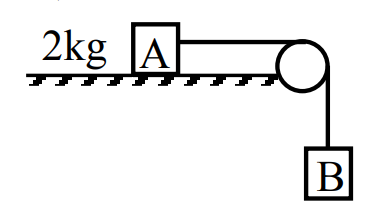 For the blocks not to move, the tension T in the string must balance the weight of B, and the friction on A must balance T.
For block B: $T = m_Bg$
For block A, the maximum static friction available is $f_{max} = \mu_s N = \mu_s m_A g$.
For the maximum value of $m_B$ (blocks just on the verge of moving): $T = m_Bg = \mu_s(m_Ag)$
$\Rightarrow m_B = \mu_s m_A = 0.2 \times 2 = 0.4$ kg
So the maximum mass of block B is 0.4 kg.
Newton's Second Law: Tension in a Rope
-
A monkey of mass 20 kg is holding a vertical rope. The rope will not break when a mass of 25 kg is suspended from it but will break if the mass exceeds 25 kg. What is the maximum acceleration with which the monkey can climb up along the rope ? (g = 10 m/s$^2$)Maximum tension the rope can bear: $T_{max} = 25g = 25 \times 10 = 250$ N
When the monkey climbs up with acceleration a, the forces on it are the tension T (upward, the rope's reaction to its pull) and its weight mg (downward).
$T - mg = ma \Rightarrow T = m(g + a)$
For the maximum acceleration: $T_{max} - mg = ma$
$250 - 20 \times 10 = 20a \Rightarrow a = \dfrac{50}{20} = 2.5$ m/s$^2$
(Equivalently $ma = T_{max} - mg = 25g - 20g = 5g$, so $a = \dfrac{5g}{20} = \dfrac{g}{4} = \dfrac{10}{4} = 2.5$ m/s$^2$.)
Apparent Weight in a Lift
-
A man weighs 80 kg. He stands on a weighing scale in a lift which is moving upwards with a uniform acceleration of 5 m/s$^2$. What would be the reading on the scale ? (g = 10 m/s$^2$)The scale reads the normal reaction N exerted on the man.
For the man moving up with acceleration a: $N - mg = ma$
Reading of weighing scale $= N = m(g + a)$
$= 80(10 + 5) = 80 \times 15 = 1200$ N
So the scale reads 1200 N (more than his true weight of 800 N).
Newton's Second Law: Tension
-
A lift of mass 1000 kg which is moving with acceleration of 1 m/s$^2$ in upward direction, then the tension developed in string which is connected to lift is : -Forces on the lift: tension T upward and weight mg downward. Net force gives the upward acceleration a:
$T - mg = ma \Rightarrow T = m(g + a)$
$T = 1000(9.8 + 1) = 1000 \times 10.8$
$T = 10,800$ N
Impulse and Newton's Second Law
-
A cricketer catches a ball of mass 150 gm in 0.1 second moving with speed 20 m s$^{-1}$. Then he experiences force of : -Impulse = change in momentum, and average force $F = \dfrac{\Delta P}{\Delta t}$.
The ball comes to rest, so $\Delta P = mv = 150 \times 10^{-3} \times 20 = 3$ kg m/s
$F = \dfrac{3}{0.1} = 30$ N
Connected Bodies: Atwood Machine
-
Two masses as shown are suspended from a massless pulley. Calculate the acceleration of the system when masses are left free :
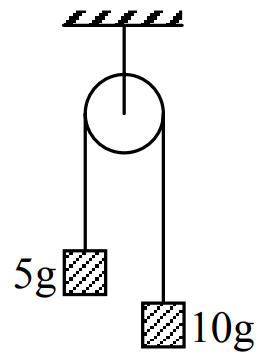 The heavier 10 kg mass moves down and the 5 kg mass moves up with the same acceleration a. Let T be the tension in the string.
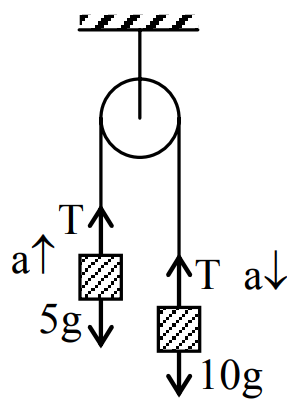
For the 10 kg mass: $10g - T = 10a$
For the 5 kg mass: $T - 5g = 5a$
Adding: $5g = 15a$
$a = \dfrac{g}{3}$
(In general $a = \dfrac{(m_1 - m_2)g}{m_1 + m_2}$.)
Vertical Circular Motion
-
A mass is performing vertical circular motion (see figure). If the average velocity of the particle is increased, then at which point the string will break :
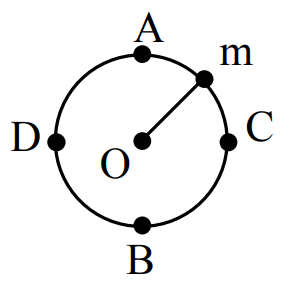 At the lowest point B: $T_B - mg = \dfrac{mv_B^2}{r} \Rightarrow T_B = mg + \dfrac{mv_B^2}{r}$
At the highest point A: $T_A + mg = \dfrac{mv_A^2}{r} \Rightarrow T_A = \dfrac{mv_A^2}{r} - mg$
At B, the tension has to support the weight as well as provide the centripetal force, and the speed is also maximum there. So the tension in the string is maximum at the lowest position B.
So if the speed is increased, the string will break at B.
That is every question in Laws of Motion for this filter.
Want a score?
Answers here are not saved. Practise as a test to be marked and see your progress.
Practise as a test