Looking for classes? Ksquare Career Institute, Bengaluru →

Physics
Motion in a Straight Line
45 questions from 30 papers, each with its answer.
- 45 questions
- 30 papers
- 2.55% of Physics
Non-Uniform Motion and Calculus
-
In some appropriate units, time ($t$) and position ($x$) relation of a moving particle is given by $t = x^2 + x$. The acceleration of the particle is:
Differentiating gives $v = \frac{1}{2x+1}$. Then $a = v \frac{dv}{dx} = \frac{1}{2x+1} \left(-\frac{2}{(2x+1)^2}\right) = -\frac{2}{(2x+1)^3}$.
Given $t = x^2 + x$. Differentiating with respect to $x$: $\frac{dt}{dx} = 2x + 1$. Velocity $v = \frac{dx}{dt} = \frac{1}{2x + 1}$. Acceleration is $a = \frac{dv}{dt} = \frac{dv}{dx} \frac{dx}{dt} = v \frac{dv}{dx}$. Computing $\frac{dv}{dx}$: $\frac{d}{dx}(2x + 1)^{-1} = -2(2x + 1)^{-2}$. Therefore, $a = \left(\frac{1}{2x + 1}\right) \left(-\frac{2}{(2x + 1)^2}\right) = -\frac{2}{(2x + 1)^3}$.
Average Speed and Average Velocity
-
A vehicle travels half the distance with speed $v$ and the remaining distance with speed $2v$. Its average speed is:
Average speed = total distance / total time = $\frac{4v}{3}$.
Average speed $=\frac{\text{total distance}}{\text{total time}}=\frac{2d}{\frac{d}{v}+\frac{d}{2v}}$ $=\frac{4v^2}{3v}=\frac{4v}{3}$
Motion under Gravity
-
The ratio of the distance traveled by a freely falling body in the $1^{st}$, $2^{nd}$, $3^{rd}$ and $4^{th}$ second :Distance in the $n^{th}$ second: $S_n = u + \frac{a}{2}(2n - 1)$ For free fall from rest, u = 0: $S_n = \frac{g}{2}(2n - 1) \propto (2n - 1)$ $S_1 : S_2 : S_3 : S_4 = [2(1)-1] : [2(2)-1] : [2(3)-1] : [2(4)-1]$ $= 1 : 3 : 5 : 7$
-
A boy standing at the top of a tower of 20 m height drops a stone. Assuming g = 10 m $s^{-2}$, the velocity with which it hits the ground isThe stone is dropped, so initial velocity u = 0; height fallen h = 20 m; g = 10 m $s^{-2}$.
Using $v^2 = u^2 + 2gh$
$v^2 = 0 + 2\times10\times20 = 400$
$v = \sqrt{400} = 20$ m/s -
A ball is thrown vertically upward. It has a speed of 10 m/sec when it has reached one half of its maximum height. How high does the ball rise? Take $g = 10$ m/s$^2$ -Let the maximum height be $h$. At the top the speed is zero.
Consider the motion from the half-way point (speed 10 m/s) to the top, a further height of $\dfrac{h}{2}$.
Using $v^2 = u^2 - 2gs$: $0 = (10)^2 - 2 \times 10 \times \dfrac{h}{2}$
$10^2 = 2(g)\left(\dfrac{h}{2}\right) = 10h$
$h = \dfrac{100}{10} = 10$ m
So the ball rises to a maximum height of 10 m. -
A particle is thrown vertically upward. Its velocity at half of the height is 10 m/s. Then the maximum height attained by it : - (g = 10 m/s$^2$)Let the maximum height be h. At the top the velocity is zero.

Consider the motion from the half-height point (speed 10 m/s) to the top (speed 0), a distance $\dfrac{h}{2}$:
$v^2 = u^2 - 2g\dfrac{h}{2}$
$0 = (10)^2 - 10h$
$h = 10$ m
Position-Time Graphs
-
The displacement time graphs of two moving particle make angles of $30^\circ$ and $45^\circ$ with the x-axis as shown in the figure. The ratio of their respective velocity is :
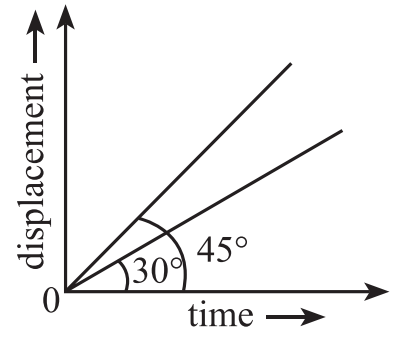 Velocity = slope of the displacement-time graph: $v = \frac{dx}{dt} = \tan\theta$ $\frac{v_1}{v_2} = \frac{\tan 30^\circ}{\tan 45^\circ} = \frac{1/\sqrt{3}}{1} = \frac{1}{\sqrt{3}}$ So $v_1 : v_2 = 1 : \sqrt{3}$
-
The position-time (x-t) graph for positive acceleration is:Positive acceleration means $\frac{dv}{dt}>0$, i.e. velocity (slope of the x-t graph) keeps increasing. So the x-t graph is a curve that bends upward (concave up).
-
A particle shows distance-time curve as given in this figure. The maximum instantaneous velocity of the particle is around the point :
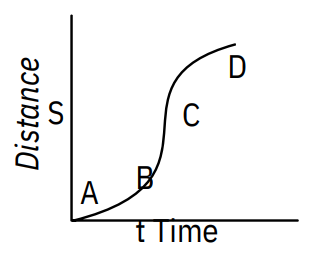 In a distance-time graph, the instantaneous speed at any instant is given by the slope of the curve at that instant: $v = \dfrac{ds}{dt}$.
So the instantaneous velocity is maximum where the curve is steepest.
Near A and B the curve is almost flat, so the slope (speed) is small.
Near D the curve flattens again, so the slope is small.
The curve rises most steeply around the point C, so the slope is maximum there.
Hence the maximum instantaneous velocity of the particle is around the point C.
Kinematic Equations – Motion under Gravity
-
A ball is thrown vertically downward with a velocity of 20 m/s from the top of a tower. It hits the ground after some time with a velocity of 80 m/s. The height of the tower is: ($g=10\ m/s^2$)$v^2 = u^2 + 2gh$, with u = 20 m/s (downward) and v = 80 m/s $h = \frac{v^2 - u^2}{2g} = \frac{6400 - 400}{20} = 300$ m
Relative motion - free fall in a moving frame
-
A person standing on the floor of an elevator drops a coin. The coin reaches the floor in time $t_1$ if the elevator is at rest and in time $t_2$ if the elevator is moving uniformly. Then:A uniformly moving elevator is an inertial frame, so in both cases the coin falls freely relative to the floor: $t_1=t_2=\sqrt{\frac{2h}{g}}$.
Average velocity
-
A person travelling in a straight line moves with a constant velocity v1 for certain distance 'x' and with a constant velocity v2 for next equal distance. The average velocity v is given by the relation$v_{avg}=\frac{x+x}{\frac{x}{v_1}+\frac{x}{v_2}} \Rightarrow \frac{2}{v}=\frac{1}{v_1}+\frac{1}{v_2}$.
Average velocity and average speed
-
A car runs at a constant speed on a circular track of radius 100 m, taking 62.8 seconds for every circular lap. The average velocity and average speed for each circular lap respectively is :After one complete lap the car returns to its starting point, so the displacement is zero.
Average velocity $= \dfrac{\text{Displacement}}{\text{Time taken}} = \dfrac{0}{62.8} = 0$
Distance covered in one lap $= 2\pi r$
Average speed $= \dfrac{\text{Distance}}{\text{Time taken}} = \dfrac{2\pi r}{T} = \dfrac{(2\pi)(100)}{62.8}$
$= \dfrac{628}{62.8} = 10$ m s$^{-1}$
So the average velocity is 0 and the average speed is 10 m/s.
Relative velocity
-
Preeti reached the metro station and found that the escalator was not working. She walked up the stationary escalator in time $t_1$. On other days, if she remains stationary on the moving escalator, then the escalator takes her up in time $t_2$. The time taken by her to walk up on the moving escalator will be
Speeds add, so reciprocals of times add.
Velocity of girl w.r.t. escalator $v_{ge} = \frac{d}{t_1}$ Velocity of escalator w.r.t. ground $v_{eG} = \frac{d}{t_2}$ Velocity of girl w.r.t. ground: $\vec{v}_{gG} = \vec{v}_{ge} + \vec{v}_{eG}$ $\frac{d}{t} = \frac{d}{t_1} + \frac{d}{t_2} \Rightarrow \frac{1}{t} = \frac{1}{t_1} + \frac{1}{t_2}$ $t = \frac{t_1t_2}{(t_1 + t_2)}$ -
A bus is moving with a speed of 10 m $s^{-1}$ on a straight road. A scooterist wishes to overtake the bus in 100 s. If the bus is at a distance of 1 km from the scooterist, with what speed should the scooterist chase the bus?Let the speed of the scooterist be v. Relative to the bus, the scooterist approaches with speed (v − 10) m/s.
Initial separation = 1 km = 1000 m; this gap must be closed in 100 s.
Relative speed = $\frac{\text{separation}}{\text{time}}$: $v - 10 = \frac{1000}{100} = 10$
$v = 20$ m $s^{-1}$
Check: in 100 s the bus moves 1000 m and the scooterist moves 2000 m = 1000 m gap + 1000 m.
Kinematics using integration
-
If the velocity of a particle is $v = At + Bt^2$, where A and B are constants, then the distance travelled by it between 1 s and 2 s is
Integrate v(t) between the limits.
$v = \frac{dx}{dt} \Rightarrow x = \int_1^2(At + Bt^2)dt = \left[\frac{At^2}{2} + \frac{Bt^3}{3}\right]_1^2$
$x = \frac{4A}{2} + \frac{8B}{3} - \frac{A}{2} - \frac{B}{3}$
$x = \frac{3A}{2} + \frac{7B}{3}$
Velocity from position–time relation
-
Two cars P and Q start from a point at the same time in a straight line and their positions are represented by $x_P(t) = at + bt^2$ and $x_Q(t) = ft - t^2$. At what time do the cars have the same velocity?
Differentiate both positions and equate.
$v_P = a + 2bt$ and $v_Q = f - 2t$
As $v_P = v_Q$: $a + 2bt = f - 2t$
$\Rightarrow t = \frac{f - a}{2(1 + b)}$
Free fall
-
A stone falls freely under gravity. It covers distances $h_1$, $h_2$ and $h_3$ in the first 5 seconds, the next 5 seconds and the next 5 seconds respectively. The relation between $h_1$, $h_2$ and $h_3$ is:$h_1 = \frac{1}{2}g(5)^2$, $h_1 + h_2 = \frac{1}{2}g(10)^2$ and $h_1 + h_2 + h_3 = \frac{1}{2}g(15)^2$
So $h_1 : h_2 : h_3 = 1 : 3 : 5$, i.e. $h_1 = \frac{h_2}{3} = \frac{h_3}{5}$ -
Two bodies, A (of mass 1 kg) and B (of mass 3 kg), are dropped from heights of 16 m and 25 m respectively. The ratio of the time taken by them to reach the ground is :-For a body dropped from rest: $h = \dfrac{1}{2}gt^2 \Rightarrow t = \sqrt{\dfrac{2h}{g}}$
The time of fall does not depend on the mass of the body, so the masses 1 kg and 3 kg play no role.
$\dfrac{t_1}{t_2} = \sqrt{\dfrac{h_1}{h_2}}$
$= \sqrt{\dfrac{16}{25}}$
$= \dfrac{4}{5}$
Instantaneous velocity and acceleration
-
The motion of a particle along a straight line is described by equation: $x = 8 + 12t - t^3$ where x is in metre and t in second. The retardation of the particle when its velocity becomes zero, is$v = \frac{dx}{dt} = 12 - 3t^2$
v = 0: $12 - 3t^2 = 0 \Rightarrow t = 2$ s
$a = \frac{d^2x}{dt^2} = -6t$
At t = 2 s: $a = -12$ $ms^{-2}$, i.e. a retardation of 12 $ms^{-2}$ -
Motion of a particle is given by equation $S = (3t^3 + 7t^2 + 14t + 8)$ m. The value of acceleration of the particle at t = 1 sec is :$v = \dfrac{ds}{dt} = \dfrac{d}{dt}(3t^3 + 7t^2 + 14t + 8) = 9t^2 + 14t + 14$
$a = \dfrac{dv}{dt} = 18t + 14$
At t = 1 s: $a = 18 + 14 = 32$ m s$^{-2}$
Average speed
-
A particle covers half of its total distance with speed $v_1$ and the rest half distance with speed $v_2$. Its average speed during the complete journey isLet the total distance be 2S, so each half is S.
Time for the first half: $t_1 = \frac{S}{v_1}$; time for the second half: $t_2 = \frac{S}{v_2}$
Average speed = $\frac{\text{total distance}}{\text{total time}} = \frac{2S}{\frac{S}{v_1} + \frac{S}{v_2}}$
$= \frac{2S}{S\left(\frac{v_1 + v_2}{v_1v_2}\right)}$
$= \frac{2v_1v_2}{v_1 + v_2}$ -
A car moves from X to Y with a uniform speed $v_u$ and returns to X with a uniform speed $v_d$. The average speed for this round trip isAverage speed $= \dfrac{\text{total distance travelled}}{\text{total time taken}}$
Let $s$ be the distance from X to Y.
Time for the forward journey: $t_1 = \dfrac{s}{v_u}$
Time for the return journey: $t_2 = \dfrac{s}{v_d}$
Average speed $= \dfrac{s + s}{t_1 + t_2} = \dfrac{2s}{\dfrac{s}{v_u} + \dfrac{s}{v_d}}$
$= \dfrac{2s}{s\left(\dfrac{v_d + v_u}{v_u v_d}\right)}$
$= \dfrac{2 v_u v_d}{v_d + v_u}$
This is the harmonic mean of the two speeds, which always applies when equal distances are covered at two different speeds.
Uniformly accelerated motion
-
A particle starts its motion from rest under the action of a constant force. If the distance covered in first 10 seconds is $S_1$ and that covered in the first 20 seconds is $S_2$, thenA constant force gives a constant acceleration a; the particle starts from rest, so u = 0.
$S = ut + \frac{1}{2}at^2 = \frac{1}{2}at^2$, so $S \propto t^2$
$S_1 = \frac{1}{2}a(10)^2 = 50a$
$S_2 = \frac{1}{2}a(20)^2 = 200a$
$\frac{S_2}{S_1} = \frac{200a}{50a} = 4$
$S_2 = 4S_1$
Distance Travelled in the nth Second
-
The distance travelled by a particle starting from rest and moving with an acceleration $\dfrac{4}{3}$ m s$^{-2}$, in the third second is -Distance covered in the $n$th second: $S_n = u + \dfrac{a}{2}(2n - 1)$
Here $u = 0$, $a = \dfrac{4}{3}$ m s$^{-2}$ and $n = 3$.
$S_3 = 0 + \dfrac{1}{2} \times \dfrac{4}{3} \times (2 \times 3 - 1)$
$S_3 = \dfrac{1}{2} \times \dfrac{4}{3} \times 5$
$S_3 = \dfrac{10}{3}$ m
Check: distance in 3 s $= \dfrac{1}{2}\cdot\dfrac{4}{3}\cdot 9 = 6$ m and in 2 s $= \dfrac{1}{2}\cdot\dfrac{4}{3}\cdot 4 = \dfrac{8}{3}$ m; the difference is $6 - \dfrac{8}{3} = \dfrac{10}{3}$ m.
Equations of Motion
-
A particle moves in a straight line with a constant acceleration. It changes its velocity from 10 m s$^{-1}$ to 20 m s$^{-1}$ while passing through a distance 135 m in $t$ second. The value of $t$ is -For constant acceleration: $v^2 = u^2 + 2as$
$(20)^2 = (10)^2 + 2 \times a \times 135$
$400 - 100 = 270\,a$
$a = \dfrac{300}{270} = \dfrac{10}{9}$ m s$^{-2}$
Now use $v = u + at$:
$20 = 10 + \dfrac{300}{270}\,t$
$10 = \dfrac{300}{270}\,t$
$t = \dfrac{10 \times 270}{300} = 9$ s
Check with average velocity: $s = \dfrac{u + v}{2}\,t \Rightarrow 135 = 15\,t \Rightarrow t = 9$ s.
That is every question in Motion in a Straight Line for this filter.
Want a score?
Answers here are not saved. Practise as a test to be marked and see your progress.
Practise as a test