Looking for classes? Ksquare Career Institute, Bengaluru →

Physics
System of Particles and Rotational Motion
100 questions from 38 papers, each with its answer.
- 100 questions
- 38 papers
- 5.67% of Physics
Conservation of Angular Momentum
-
The Sun rotates around its centre once in $27\text{ days}$. What will be the period of revolution if the Sun were to expand to twice its present radius without any external influence? Assume the Sun to be a sphere of uniform density.
Conservation of angular momentum gives $I_1 \omega_1 = I_2 \omega_2$. Since $I \propto R^2$, $T_2 = T_1 (R_2/R_1)^2 = 27 \times 4 = 108\text{ days}$.
In the absence of external torque, angular momentum is conserved: $L = I_1 \omega_1 = I_2 \omega_2$. For a uniform sphere, $I = \frac{2}{5} M R^2$. When the radius doubles ($R_2 = 2 R_1$), the moment of inertia becomes $I_2 = \frac{2}{5} M (2R_1)^2 = 4 I_1$. Since $\omega = \frac{2\pi}{T}$, we have $I_1 \left(\frac{2\pi}{T_1}\right) = (4 I_1) \left(\frac{2\pi}{T_2}\right) \implies T_2 = 4 T_1 = 4 \times 27\text{ days} = 108\text{ days}$. -
A solid sphere is rotating freely about its symmetry axis in free space. The radius of the sphere is increased keeping its mass same. Which of the following physical quantities would remain constant for the sphere?
No external torque, so angular momentum is conserved.
$\tau_{ext} = 0$ So, $\frac{dL}{dt} = 0$, i.e. L = constant So angular momentum remains constant. -
A thin circular ring of mass M and radius r is rotating about its axis with constant angular velocity $\omega$. Two objects each of mass m are attached gently to the opposite ends of a diameter of the ring. The ring now rotates with angular velocity given byThe objects are attached gently, so no external torque acts; angular momentum is conserved: $I_1\omega_1 = I_2\omega_2$
Initial moment of inertia of the ring: $I_1 = Mr^2$
After attaching the two masses at distance r from the axis: $I_2 = Mr^2 + 2mr^2 = (M + 2m)r^2$
$Mr^2\omega = (M + 2m)r^2\omega'$
$\omega' = \frac{M\omega}{M + 2m}$ -
A thin circular ring of mass M and radius R is rotating in a horizontal plane about an axis vertical to its plane with a constant angular velocity $\omega$. If two objects each of mass m be attached gently to the opposite ends of a diameter of the ring, the ring will then rotate with an angular velocityThe objects are attached gently, so no external torque acts and angular momentum is conserved: $I_1\omega_1 = I_2\omega_2$
Initial moment of inertia of the ring: $I_1 = MR^2$
After attaching two masses m at distance R from the axis: $I_2 = MR^2 + 2mR^2 = (M + 2m)R^2$
$MR^2\omega = (M + 2m)R^2\omega'$
$\omega' = \frac{\omega M}{M + 2m}$ -
A round disc of moment of inertia $I_2$ about its axis perpendicular to its plane and passing through its centre is placed over another disc of moment of inertia $I_1$ rotating with an angular velocity $\omega$ about the same axis. The final angular velocity of the combination of discs is :-No external torque acts on the system of two discs (the friction between them is internal). So angular momentum is conserved.
Initial angular momentum $= I_1\omega$ (the second disc is initially at rest).
Final angular momentum $= (I_1 + I_2)\omega'$, since both discs finally rotate together.
From conservation of angular momentum: $I_1\omega = (I_1 + I_2)\omega'$
$\Rightarrow \omega' = \dfrac{I_1\omega}{I_1 + I_2}$ -
A thin circular ring of mass M and radius 'r' is rotating about its axis with a constant angular velocity $\omega$. Four objects each of mass m, are kept gently to the opposite ends of two perpendicular diameters of the ring. The angular velocity of the ring will be -The objects are placed gently, so no external torque acts about the axis. Use the law of conservation of angular momentum.
Initial moment of inertia of the ring about its axis: $I_1 = Mr^2$
Each of the four objects is at distance r from the axis, so final moment of inertia: $I_2 = Mr^2 + 4mr^2$
$I_1\omega = I_2\omega'$
$Mr^2\omega = (Mr^2 + 4mr^2)\omega'$
$\Rightarrow \omega' = \dfrac{M\omega}{M + 4m}$
The angular velocity decreases because the moment of inertia has increased. -
A disc is rotating with angular speed $\omega$. If a child sits on it, what is conserved : -When the child sits on the disc, the forces between the child and the disc are internal to the system. No external torque acts about the axis of rotation.
So the angular momentum $L = I\omega$ is conserved. The moment of inertia increases, so the angular speed decreases: $I_1\omega_1 = I_2\omega_2$.
Kinetic energy $\dfrac{L^2}{2I}$ decreases, because some energy is lost as the child comes to rotate with the disc (friction).
So angular momentum is conserved.
Moment of Inertia of a Rod
-
The moment of inertia of a thin rod about an axis passing through its mid point and perpendicular to the rod, is 2400 g cm$^2$. The length of the 400 g rod is nearly:Moment of inertia of a thin rod about an axis through its mid-point, perpendicular to the rod: $I = \frac{ML^2}{12}$ $\frac{400 \times L^2}{12} = 2400$ $L^2 = \frac{12 \times 2400}{400} = 72$ $L = \sqrt{72} \approx 8.5$ cm
Rolling Motion
-
A disc is rolling, the velocity of its centre of mass is $V_{cm}$, then which one will be correct : -In rolling without slipping, each point has the velocity of the centre of mass $V_{cm}$ plus a rotational velocity $R\omega = V_{cm}$ tangent to the disc.
Top point: both are in the same direction, so $v = V_{cm} + R\omega = 2V_{cm}$.
Point of contact: they are in opposite directions, so $v = V_{cm} - R\omega = 0$ (no slipping).
So the highest point moves with $2V_{cm}$ and the point of contact is momentarily at rest.
Angular Velocity and Angular Acceleration
-
The angular acceleration of a body, moving along the circumference of a circle, is:
Angular acceleration lies along the axis of rotation.
The angular acceleration direction is given along angular velocity or opposite to angular velocity depending upon whether angular velocity magnitude is increasing or decreasing, and this direction remains along the axis of circular motion.
Centre of Mass
-
Two objects of mass 10 kg and 20 kg respectively are connected to the two ends of a rigid rod of length 10 m with negligible mass. The distance of the centre of mass of the system from the 10 kg mass is :Taking the 10 kg mass at the origin and the 20 kg mass at 10 m: $X_{CM} = \frac{10 \times 0 + 20 \times 10}{10 + 20} = \frac{200}{30} = \frac{20}{3}$ m
-
Two particles of mass 5 kg and 10 kg respectively are attached to the two ends of a rigid rod of length 1 m with negligible mass. The centre of mass of the system from the 5 kg particle is nearly at a distance of:Taking the 5 kg mass at the origin and the 10 kg mass at 100 cm: $x_{cm} = \frac{5 \times 0 + 10 \times 100}{5 + 10} = \frac{200}{3} = 66.66$ cm ≈ 67 cm
-
Two persons of masses 55 kg and 65 kg respectively, are at the opposite ends of a boat. The length of the boat is 3.0 m and weighs 100 kg. The 55 kg man walks up to the 65 kg man and sits with him. If the boat is in still water the centre of mass of the system shifts byThe men and the boat form one system; the forces between them are internal.
There is no external horizontal force on the system and it was initially at rest.
So the centre of mass of the system does not move: the shift is zero (the boat moves the other way to keep it fixed). -
Three masses are placed on the x-axis: 300 g at origin, 500 g at x = 40 cm and 400 g at x = 70 cm. The distance of the centre of mass from the origin is$x_{cm} = \frac{m_1x_1 + m_2x_2 + m_3x_3}{m_1 + m_2 + m_3}$
$= \frac{300\times0 + 500\times40 + 400\times70}{300 + 500 + 400}$
$= \frac{20000 + 28000}{1200} = \frac{48000}{1200} = 40$ cm -
Two particles which are initially at rest, move towards each other under the action of their internal attraction. If their speeds are v and 2v at any instant, then the speed of centre of mass of the system will beThe particles attract each other; these are internal forces of the system. There is no external force.
$\vec{F}_{ext} = M\vec{a}_{cm} = 0$, so the velocity of the centre of mass remains constant.
Initially both particles are at rest, so the velocity of the centre of mass is zero.
It therefore remains zero at every later instant, whatever the individual speeds (v and 2v) are.
Speed of the centre of mass = zero -
Two bodies of mass 1 kg and 3 kg have position vectors $\hat{i} + 2\hat{j} + \hat{k}$ and $-3\hat{i} - 2\hat{j} + \hat{k}$, respectively. The centre of mass of this system has a position vector$\vec{r}_{cm} = \frac{m_1\vec{r}_1 + m_2\vec{r}_2}{m_1 + m_2}$
$m_1\vec{r}_1 = 1(\hat{i} + 2\hat{j} + \hat{k}) = \hat{i} + 2\hat{j} + \hat{k}$
$m_2\vec{r}_2 = 3(-3\hat{i} - 2\hat{j} + \hat{k}) = -9\hat{i} - 6\hat{j} + 3\hat{k}$
Sum $= -8\hat{i} - 4\hat{j} + 4\hat{k}$
$\vec{r}_{cm} = \frac{-8\hat{i} - 4\hat{j} + 4\hat{k}}{4}$
$\vec{r}_{cm} = -2\hat{i} - \hat{j} + \hat{k}$ -
Consider a system of two particles having masses $m_1$ and $m_2$. If the particle of mass $m_1$ is pushed towards the mass centre of particles through a distance 'd', by what distance would the particle of mass $m_2$ move so as to keep the mass centre of particles at the original position :-
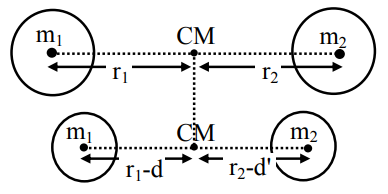
Let $r_1$ and $r_2$ be the distances of $m_1$ and $m_2$ from the centre of mass (CM). Taking moments about the CM:
$m_1r_1 = m_2r_2$ ...(1)
$m_1$ is moved a distance d towards the CM. For the CM to stay at the same place, $m_2$ must also move towards the CM by some distance $d'$:
$m_1(r_1 - d) = m_2(r_2 - d')$ ...(2)
Subtracting (2) from (1): $m_1 d = m_2 d'$
$\Rightarrow d' = \dfrac{m_1}{m_2}d$
So the particle of mass $m_2$ must move a distance $\dfrac{m_1}{m_2}d$ towards the centre of mass.
Moment of Inertia
-
The moment of inertia of a uniform circular disc is maximum about an axis perpendicular to the disc and passing through
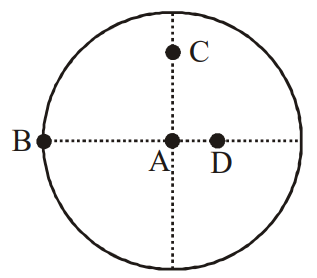 Parallel axis theorem: $I = I_{cm} + Md^2$, where d is the distance of the axis from the centre.
I is maximum for the point farthest from the centre.
B lies on the rim (d = R), while A, C and D are closer to the centre, so the moment of inertia is maximum about the axis through B. -
A circular disc is to be made by using iron and aluminium so that it acquires maximum moment of inertia about geometrical axis. It is possible with : -Moment of inertia: $I = \sum mr^2$. Mass placed farther from the axis contributes much more, since it is multiplied by $r^2$.
The density of iron (about 7.8 g/cm$^3$) is more than that of aluminium (about 2.7 g/cm$^3$).
So to make I maximum, the heavier material (iron) should be placed far from the axis, i.e. on the outer ring, and the lighter aluminium in the interior.
Putting iron sheets on the two flat faces does not move mass farther from the axis.
So the moment of inertia is maximum with aluminium at the interior and iron surrounding it.
Torque and Angular Momentum
-
A force $\vec F = \alpha\hat i + 3\hat j + 6\hat k$ is acting at a point $\vec r = 2\hat i - 6\hat j - 12\hat k$. The value of $\alpha$ for which angular momentum about origin is conserved is:Angular momentum is conserved if $\vec\tau = \vec r\times\vec F = 0$, i.e. $\vec F \parallel \vec r$.
$\frac{\alpha}{2} = \frac{3}{-6} = \frac{6}{-12} \Rightarrow \alpha = -1$
Rolling Motion – Kinetic Energy
-
A solid sphere is in rolling motion. In rolling motion a body possesses translational kinetic energy ($K_t$) as well as rotational kinetic energy ($K_r$) simultaneously. The ratio $K_t : (K_t + K_r)$ for the sphere is
Total KE of a rolling solid sphere is $\frac{7}{10}mv^2$.
$K_t = \frac{1}{2}mv^2$ $K_t + K_r = \frac{1}{2}mv^2 + \frac{1}{2}I\omega^2 = \frac{1}{2}mv^2 + \frac{1}{2}\left(\frac{2}{5}mr^2\right)\left(\frac{v}{r}\right)^2 = \frac{7}{10}mv^2$ So, $\frac{K_t}{K_t + K_r} = \frac{5}{7}$
Rotational kinetic energy
-
A solid sphere of mass m and radius R is rotating about its diameter. A solid cylinder of the same mass and same radius is also rotating about its geometrical axis with an angular speed twice that of the sphere. The ratio of their kinetic energies of rotation ($E_{sphere}/E_{cylinder}$) will be:
$\frac{(2/5)\omega^2}{(1/2)(4\omega^2)} = 1/5$.
$E_{sphere} = \frac{1}{2}I_s\omega^2 = \frac{1}{2}\times\frac{2}{5}MR^2\times\omega^2$
$E_{cylinder} = \frac{1}{2}I_c(2\omega)^2 = \frac{1}{2}\times\frac{MR^2}{2}\times4\omega^2$
$\frac{E_{sphere}}{E_{cylinder}} = \frac{1}{5}$
Kinematics of rotational motion
-
A wheel has angular acceleration of 3.0 rad/sec$^2$ and an initial angular speed of 2.00 rad/sec. In a time of 2 sec it has rotated through an angle (in radian) ofFor uniform angular acceleration: $\theta = \omega_0 t + \dfrac{1}{2}\alpha t^2$
Here $\alpha$ is the angular acceleration and $\omega_0$ is the initial angular speed.
$\omega_0 = 2$ rad/s, $\alpha = 3$ rad/s$^2$, $t = 2$ s
$\theta = 2 \times 2 + \dfrac{1}{2} \times 3 \times (2)^2$
$\theta = 4 + 6$
$\theta = 10$ rad
Rotational kinetic energy and moment of inertia
-
Three objects, A : (a solid sphere), B : (a thin circular disk) and C : (a circular ring), each have the same mass M and radius R. They all spin with the same angular speed $\omega$ about their own symmetry axes. The amounts of work (W) required to bring them to rest, would satisfy the relation
Work equals rotational KE, which is proportional to moment of inertia.
Work done required to bring them to rest $W = \Delta KE$ $W = \frac{1}{2}I\omega^2 \Rightarrow W \propto I$ for same $\omega$ $W_A : W_B : W_C = \frac{2}{5}MR^2 : \frac{1}{2}MR^2 : MR^2 = \frac{2}{5} : \frac{1}{2} : 1 = 4 : 5 : 10$ $\therefore W_C > W_B > W_A$
Torque and angular acceleration
-
A rope is wound around a hollow cylinder of mass 3 kg and radius 40 cm. What is the angular acceleration of the cylinder if the rope is pulled with a force of 30 N?
$\alpha = F/(MR)$ for a hollow cylinder.
$\tau = I\alpha$ $F\times R = MR^2\alpha$ $30\times0.4 = 3\times(0.4)^2\alpha$ $12 = 3\times0.16\,\alpha$ $\alpha = 25\ rad/s^2$ -
A wheel having moment of inertia 2 kg–m$^2$ about its vertical axis, rotates at the rate of 60 rpm about the axis. The torque which can stop the wheel's rotation in one minute would be :-Use $\tau = I\alpha$ and $\omega = \omega_0 + \alpha t$.
Here $\omega_0 = \dfrac{60 \times 2\pi}{60}$ rad/s $= 2\pi$ rad/s
Final $\omega = 0$ in $t = 60$ s, so the magnitude of angular retardation $\alpha = \dfrac{\omega_0}{t} = \dfrac{2\pi}{60}$ rad/s$^2$
$\tau = I\alpha = I\dfrac{\omega_0}{t} = 2 \times \dfrac{2\pi}{60}$
$\tau = \dfrac{\pi}{15}$ N–m
Rotational KE and angular momentum
-
Two rotating bodies A and B of masses m and 2m with moments of inertia $I_A$ and $I_B$ ($I_B > I_A$) have equal kinetic energy of rotation. If $L_A$ and $L_B$ be their angular momenta respectively, then:
$K = L^2/2I$; for equal K, larger I means larger L.
$K_A = K_B \Rightarrow \frac{L_A^2}{2I_A} = \frac{L_B^2}{2I_B}$
$\because I_B > I_A$, $\therefore L_A^2 < L_B^2 \Rightarrow L_A < L_B$
Moment of inertia of a two-particle system
-
A light rod of length l has two masses $m_1$ and $m_2$ attached to its two ends. The moment of inertia of the system about an axis perpendicular to the rod and passing through the centre of mass is:
$I = \mu l^2$ with reduced mass μ.
$r_1 = \frac{m_2l}{m_1 + m_2}$, $r_2 = \frac{m_1l}{m_1 + m_2}$
$I_{cm} = m_1r_1^2 + m_2r_2^2 = \frac{m_1m_2}{m_1 + m_2}l^2$
Equilibrium of a rigid body
-
The rod of weight W is supported by two parallel knife edges A and B and is in equilibrium in a horizontal position. The knives are at a distance d from each other. The centre of mass of the rod is at distance x from A. The normal reaction on A isFor rotational equilibrium, net moment about any point is zero.
Moments about B: $R_A d - W(d - x) - R_B\cdot 0 = 0$
$R_A = \frac{W(d-x)}{d}$
(Similarly, moments about A give $R_B = \frac{Wx}{d}$.)
Torque
-
If $\vec{F}$ is the force acting on a particle having position vector $\vec{r}$ and $\vec{\tau}$ be the torque of this force about the origin, thenTorque is defined as the cross product $\vec{\tau} = \vec{r}\times\vec{F}$
The cross product of two vectors is perpendicular to both of them, so $\vec{\tau}$ is perpendicular to $\vec{r}$ and also to $\vec{F}$.
The dot product of two perpendicular vectors is zero.
$\vec{r}\cdot\vec{\tau} = r\tau\cos90^\circ = 0$
$\vec{F}\cdot\vec{\tau} = F\tau\cos90^\circ = 0$
Hence $\vec{r}\cdot\vec{\tau} = 0$ and $\vec{F}\cdot\vec{\tau} = 0$.
Angular momentum
-
When a mass is rotating in a plane about a fixed point, its angular momentum is directed along:$\vec L = \vec r\times\vec p$
$\vec r$ and $\vec p$ both lie in the plane of rotation, and a cross product is perpendicular to both vectors.
So the angular momentum is directed along a line perpendicular to the plane of rotation.
Theorems of moment of inertia
-
The moment of inertia of a thin uniform rod of mass M and length L about an axis passing through its midpoint and perpendicular to its length is $I_0$. Its moment of inertia about an axis passing through one of its ends and perpendicular to its length isThe axis through the midpoint passes through the centre of mass, so $I_{CM} = I_0$.
The axis through one end is parallel to this axis and at a distance $h = \frac{L}{2}$ from it.
By the parallel axis theorem, $I = I_{CM} + Mh^2$
$I = I_0 + M\left(\frac{L}{2}\right)^2$
$I = I_0 + \frac{ML^2}{4}$
Rotational kinematics and torque
-
The instantaneous angular position of a point on a rotating wheel is given by the equation $\theta(t) = 2t^3 - 6t^2$. The torque on the wheel becomes zero atTorque $\tau = I\alpha$, so the torque is zero when the angular acceleration $\alpha$ is zero.
$\theta = 2t^3 - 6t^2$
Angular velocity $\omega = \frac{d\theta}{dt} = 6t^2 - 12t$
Angular acceleration $\alpha = \frac{d^2\theta}{dt^2} = 12t - 12$
Setting $\alpha = 0$: $12t - 12 = 0$
t = 1 s
Radius of Gyration
-
The ratio of the radii of gyration of a circular disc to that of a circular ring, each of same mass and radius, around their respective axes is -Radius of gyration $K$ is defined by $I = MK^2$.
For the circular disc about its axis: $MK_1^2 = \dfrac{MR^2}{2}$
$K_1 = \dfrac{R}{\sqrt{2}}$
For the circular ring about its axis: $MK_2^2 = MR^2$
$K_2 = R$
$\dfrac{K_1}{K_2} = \dfrac{R/\sqrt{2}}{R} = \dfrac{1}{\sqrt{2}}$
So $K_1 : K_2 = 1 : \sqrt{2}$.
Theorem of Parallel Axes
-
The moment of inertia of a uniform circular disc of radius '$R$' and mass '$M$' about an axis touching the disc at its diameter and normal to the disc is :-The axis is normal to the disc and passes through a point on its edge (the end of a diameter).
Moment of inertia of the disc about the axis through its centre and normal to its plane: $I_1 = \dfrac{1}{2}MR^2$
The required axis is parallel to this axis and at a distance $R$ from it.
By the theorem of parallel axes: $I_2 = I_1 + MR^2$
$I_2 = \dfrac{1}{2}MR^2 + MR^2$
$I_2 = \dfrac{3}{2}MR^2$ -
The moment of inertia of a uniform circular disc of radius 'R' and mass 'M' about an axis passing from the edge of the disc and normal to the disc is -Moment of inertia of the disc about the axis through its centre and normal to its plane: $I_{cm} = \dfrac{MR^2}{2}$
The required axis passes through the edge and is parallel to this axis, at a distance $d = R$ from it.
By the theorem of parallel axes: $I = I_{cm} + Md^2$
$I = \dfrac{MR^2}{2} + MR^2$
$I = \dfrac{3}{2}MR^2$
Angular Momentum and Rotational Kinetic Energy
-
Two bodies have their moments of inertia I and 2I respectively about their axis of rotation. If their kinetic energies of rotation are equal, their angular momenta will be in the ratio -Rotational kinetic energy: $K = \dfrac{1}{2}I\omega^2 = \dfrac{L^2}{2I}$, since $L = I\omega$
Given $K_1 = K_2$: $\dfrac{L_1^2}{2I_1} = \dfrac{L_2^2}{2I_2}$
$\dfrac{L_1^2}{2(I)} = \dfrac{L_2^2}{2(2I)}$
$\dfrac{L_1^2}{L_2^2} = \dfrac{1}{2}$
$\dfrac{L_1}{L_2} = \dfrac{1}{\sqrt{2}}$
So the angular momenta are in the ratio $1 : \sqrt{2}$.
That is every question in System of Particles and Rotational Motion for this filter.
Want a score?
Answers here are not saved. Practise as a test to be marked and see your progress.
Practise as a test