Looking for classes? Ksquare Career Institute, Bengaluru →

Physics
Mechanical Properties of Fluids
34 questions from 22 papers, each with its answer.
- 34 questions
- 22 papers
- 1.93% of Physics
Surface Tension
-
Consider a water tank shown in the figure. It has one wall at $x = L$ and can be taken to be very wide in the $z$ direction. When filled with a liquid of surface tension $S$ and density $\rho$, the liquid surface makes angle $\theta_{0} (\theta_{0} \ll 1)$ with the $x$-axis at $x = L$. If $y(x)$ is the height of the surface then the equation for $y(x)$ is:
(take $\theta(x) = \sin\theta(x) = \tan\theta(x) = \frac{dy}{dx}$, $g$ is the acceleration due to gravity)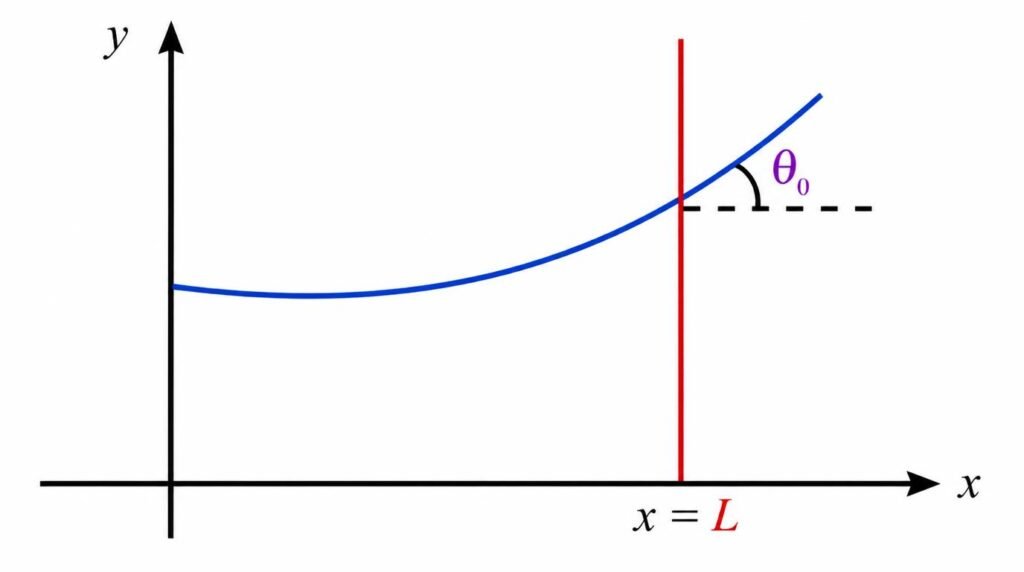
Balancing the vertical surface tension force component with the weight of the elevated liquid yields $\frac{d^2y}{dx^2} = \frac{\rho g}{S} y$.
For an element of width $dx$ and length $z$ along the surface: The net vertical force due to surface tension is $dF_y = S z \, d\theta = S z \left(\frac{d^2y}{dx^2}\right) dx$. In equilibrium, this balances the weight of the liquid column lifted above the zero level, which is $dW = (dx \cdot z \cdot y) \rho g$. Equating them gives $S z \left(\frac{d^2y}{dx^2}\right) dx = \rho g z y \, dx \implies \frac{d^2y}{dx^2} = \frac{\rho g}{S} y$. -
A thin flat circular disc of radius 4.5 cm is placed gently over the surface of water. If surface tension of water is 0.07 N m$^{-1}$, then the excess force required to take it away from the surface is;Excess force required $F = (2\pi R)T$ $= 2\pi \times 4.5 \times 10^{-2} \times 0.07$ $= 9\pi \times 7 \times 10^{-4} = \frac{63\pi}{10}$ mN $\approx 19.8$ mN
Surface Tension and Surface Energy
-
The amount of energy required to form a bubble of radius 2 cm from a soap solution is nearly: (surface tension of soap solution $=0.03\ N\,m^{-1}$)
A soap bubble has two surfaces, so energy $=8\pi R^2T\approx3.01\times10^{-4}\ J$.
Surface energy of a bubble = 2 × change in surface area × surface tension $=8\pi R^2\times T=8\times3.142\times4\times10^{-4}\times3\times10^{-2}\ J$ $=30.1\times10^{-5}\ J$
Viscosity and Terminal Velocity
-
A spherical ball is dropped in a long column of a highly viscous liquid. The curve in the graph shown which represents the speed of the ball ($v$) as a function of time ($t$) is:
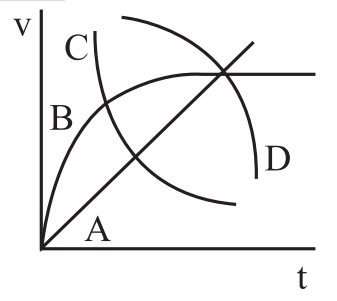 Initially the speed is zero; it then increases, and after some time it becomes constant (terminal velocity). The acceleration (slope of the v-t curve) first decreases and after some time becomes zero. So curve B represents the motion of the ball.
-
The velocity of a small ball of mass $M$ and density $d$, when dropped in a container filled with glycerine becomes constant after some time. If the density of glycerine is $\frac{d}{2}$, then the viscous force acting on the ball will be:Density of ball = d, density of glycerine = $\frac{d}{2}$; volume V, so Mg = Vdg Buoyant force $F_B = V\frac{d}{2}g = \frac{Mg}{2}$ At constant velocity, $F_{net} = 0$: $F_B + F_v = Mg$ $F_v = Mg - \frac{Mg}{2} = \frac{Mg}{2}$
Surface Tension – Excess Pressure in a Bubble
-
If a soap bubble expands, the pressure inside the bubble :Pressure inside a soap bubble: $P = P_0 + \frac{4T}{R}$ When the bubble expands, R increases, so the excess pressure $\frac{4T}{R}$ decreases. So the pressure inside the bubble decreases.
Surface Tension – Capillary Rise
-
A capillary tube of radius $r$ is immersed in water and water rises in it to a height $h$. The mass of the water in the capillary is 5 g. Another capillary tube of radius $2r$ is immersed in water. The mass of water that will rise in this tube is:The force of surface tension balances the weight of water in the tube: $2\pi rT\cos\theta = mg$ T and $\theta$ are constant, so $m \propto r$ $\frac{m_2}{5.0} = \frac{2r}{r} \Rightarrow m_2 = 10.0$ g
Bernoulli's Principle – Speed of Efflux (Torricelli's Law)
-
A small hole of area of cross-section $2\ mm^2$ is present near the bottom of a fully filled open tank of height 2 m. Taking $g=10\ m/s^2$, the rate of flow of water through the open hole would be nearly:Velocity of efflux: $u=\sqrt{2gh}$ Rate of flow $Q=au=a\sqrt{2gh}$ $Q=2\times10^{-6}\times\sqrt{2\times10\times2}\ m^3/s=2\times10^{-6}\times2\sqrt{10}$ $=2\times2\times3.14\times10^{-6}=12.56\times10^{-6}\ m^3/s$ $Q\approx12.6\times10^{-6}\ m^3/s$
Hydrostatic pressure with depth
-
A submarine is designed to withstand an absolute pressure of 100 atm. How deep can it go below the water surface? (Consider the density of water = $1000\ kg\,m^{-3}$, 1 atm = $1 \times 10^5$ Pa and gravitational acceleration $g = 10\ m/s^2$)Absolute pressure at depth h in water: $P = P_0 + h\rho g$ ($P_0$ = atmospheric pressure) $h = \frac{P - P_0}{\rho g} = \frac{(100 - 1) \times 10^5}{10^3 \times 10}$ h = 990 m
Bernoulli's principle
-
An ideal fluid is flowing in a non-uniform cross-sectional tube XY (as shown in the figure) from end X to end Y. If $K_1$ and $K_2$ are the kinetic energy per unit volume of the fluid at X and Y respectively, then the correct option is:
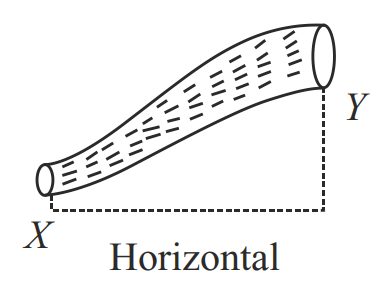 By Bernoulli's principle along the horizontal tube, $P+K+\rho g h=\text{constant}$. From the figure, the tube rises from X to Y so $P+K_1+\rho g(0)=P+K_2+\rho g h \Rightarrow K_1=K_2+\rho g h$, hence $K_1>K_2$.
-
A wind with speed 40 m/s blows parallel to the roof of a house. The area of the roof is 250 $m^2$. Assuming that the pressure inside the house is atmospheric pressure, the force exerted by the wind on the roof and the direction of the force will be ($\rho_{air} = 1.2$ kg/$m^3$)Let $P_1$, $v_1 = 0$ be the pressure and wind speed inside, and $P_2$, $v_2 = 40$ m/s outside (above the roof).
Bernoulli's theorem: $P_1 + \frac{1}{2}\rho v_1^2 = P_2 + \frac{1}{2}\rho v_2^2$
$\Delta P = P_1 - P_2 = \frac{1}{2}\rho v_2^2 = \frac{1}{2}\times 1.2\times 40^2 = 960$ Pa
$F = \Delta P\times A = 960\times 250 = 2.4\times 10^5$ N
Since $P_1 > P_2$ (pressure inside is greater than above the roof), the force acts upwards.
So the force is $2.4\times 10^5$ N, upwards.
Pressure measurement - barometer
-
A barometer is constructed using a liquid (density = 760 kg/m$^3$). What would be the height of the liquid column, when a mercury barometer reads 76 cm? (density of mercury = 13600 kg/m$^3$)At the same atmospheric pressure, $\rho_{Hg}gh_{Hg}=\rho_{liq}gh_{liq}\Rightarrow h_{liq}=h_{Hg}\times\dfrac{\rho_{Hg}}{\rho_{liq}}=0.76\times\dfrac{13600}{760}=13.6$ m.
Surface tension - angle of contact and wetting
-
A liquid does not wet the solid surface if angle of contact isA liquid does not wet a solid surface (non-wetting) when the angle of contact is obtuse, i.e. greater than $90^\circ$ (e.g. mercury on glass).
Scalar and vector physical quantities
-
Which of the following statement is not true?Pressure is actually a scalar quantity (force per unit area, with no associated direction), not a vector quantity — so the statement that pressure is a vector quantity is not true.
Stokes' law - viscous drag force
-
The viscous drag acting on a metal sphere of diameter 1 mm, falling through a fluid of viscosity 0.8 Pa s with a velocity of 2 m s$^{-1}$ is equal to:$F=6\pi\eta rv=(6)(3.14)\left(\dfrac{1\times10^{-3}}{2}\right)(0.8\times10^{-1})... $ Using $r=0.5\times10^{-3}$ m: $F=6\pi\times0.8\times0.5\times10^{-3}\times2=15\times10^{-3}$ N.
Viscosity - Stokes' law
-
The terminal velocity of a copper ball of radius 5 mm falling through a tank of oil at room temperature is 10 cm s$^{-1}$. If the viscosity of oil at room temperature is 0.9 kg m$^{-1}$s$^{-1}$, the viscous drag force is:$r=5\times10^{-3}$ m, $v_t=10\times10^{-2}$ m/s. $F=6\pi\eta r v_t=6\times\pi\times0.9\times5\times10^{-3}\times10\times10^{-2}=84.78\times10^{-4}\approx8.48\times10^{-3}$ N.
Terminal velocity
-
Two small spherical metal balls, having equal masses, are made from materials of densities $\rho_1$ and $\rho_2$ ($\rho_1=8\rho_2$) and have radii of 1 mm and 2 mm, respectively. They are made to fall vertically (from rest) in a viscous medium whose coefficient of viscosity equals $\eta$ and whose density is $0.1\rho_2$. The ratio of their terminal velocities would be:$v_T=\frac{2r^2g(\rho-\sigma)}{9\eta}$. $\frac{v_1}{v_2}=\left(\frac{1}{2}\right)^2\frac{8\rho_2-0.1\rho_2}{\rho_2-0.1\rho_2}=\frac{1}{4}\times\frac{7.9}{0.9}=\frac{79}{36}$.
Bernoulli's principle and equation of continuity
-
Water flows in a streamline motion through a horizontal pipe of circular cross-section as shown in the figure. The pressure difference of water between P and Q is 15 Nm$^{-2}$. The area of cross-section at P and Q are 40 cm$^2$ and 20 cm$^2$, respectively. The rate of flow of water through the pipe, in cm$^3$s$^{-1}$, is: [Take density of water = 1000 kg m$^{-3}$]
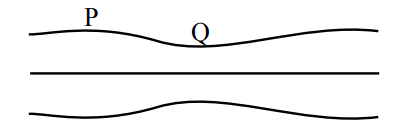 Equation of continuity: $A_1v_1=A_2v_2 \Rightarrow 40v_1=20v_2 \Rightarrow v_2=2v_1$. Bernoulli's principle: $P_1-P_2=\frac{1}{2}\rho[(2v_1)^2-v_1^2] \Rightarrow \frac{15\times2}{10^3}=3v_1^2 \Rightarrow v_1=0.1$ m/s. Rate of flow $=A_1v_1=40\times10^{-4}\times0.1=4\times10^{-4}$ m$^3$/s $=400$ cm$^3$/s.
Terminal velocity - Stokes' law
-
In the measurement of viscosity of liquids using terminal velocity experiment, spherical balls of same radius but having different densities are used. The variation of the terminal velocity (v) with the ratio of density of spherical ball ($\sigma$) to density of the liquid ($\rho$), is best represented by:Terminal velocity $v=\frac{2r^2}{9\eta}(\sigma-\rho)g=\frac{2r^2\rho g}{9\eta}\left(\frac{\sigma}{\rho}\right)-\frac{2r^2\rho g}{9\eta}$. This is a straight line with positive slope and a negative intercept; v = 0 when $\frac{\sigma}{\rho}=1$. So the graph starts from $\frac{\sigma}{\rho}=1$ and rises linearly.
Viscosity – Stokes' law and terminal velocity
-
A small sphere of radius 'r' falls from rest in a viscous liquid. As a result, heat is produced due to viscous force. The rate of production of heat when the sphere attains its terminal velocity, is proportional to
$P = Fv_T \propto r\cdot(r^2)^2 = r^5$.
Power $= 6\pi\eta rv_T\cdot v_T = 6\pi\eta rv_T^2$ $v_T \propto r^2$ $\Rightarrow$ Power $\propto r^5$
Pressure in liquids – U-tube manometer
-
A U tube with both ends open to the atmosphere, is partially filled with water. Oil, which is immiscible with water, is poured into one side until it stands at a distance of 10 mm above the water level on the other side. Meanwhile the water rises by 65 mm from its original level (see diagram). The density of the oil is
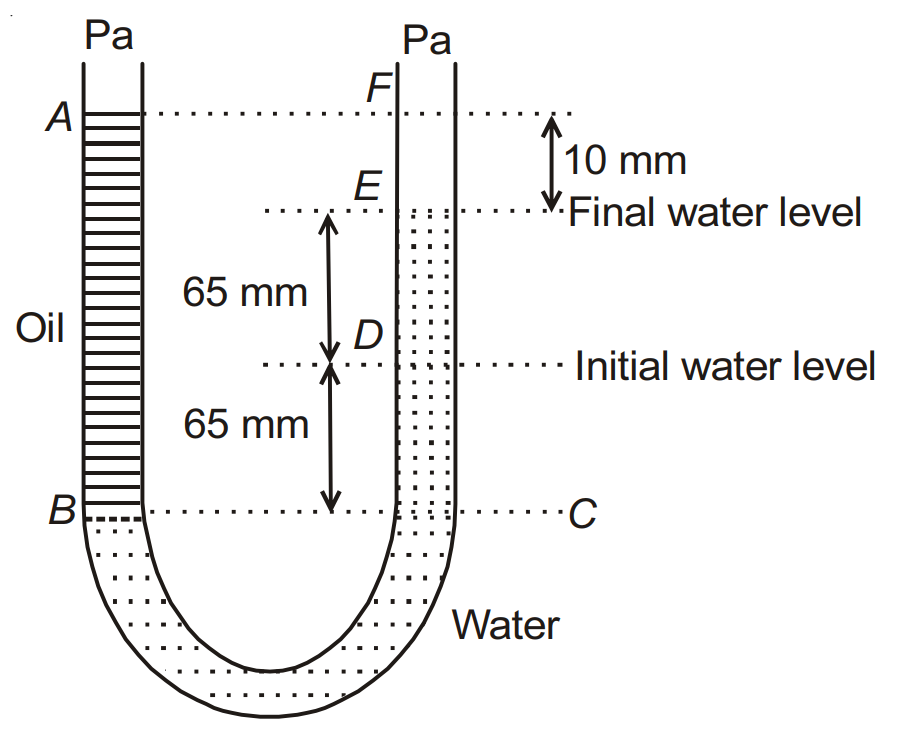
Equate the pressures at the oil–water interface level in both arms.
Oil column height = 65 + 65 + 10 = 140 mm; water column above the interface level = 130 mm. $h_{oil}\rho_{oil}g = h_{water}\rho_{water}g$ $140\times\rho_{oil} = 130\times\rho_{water}$ $\rho_{oil} = \frac{13}{14}\times1000\ kg/m^3$ $\rho_{oil} = 928\ kg\ m^{-3}$
Buoyancy – floating in two immiscible liquids
-
Two non-mixing liquids of densities $\rho$ and $n\rho$ (n > 1) are put in a container. The height of each liquid is h. A solid cylinder of length L and density d is put in this container. The cylinder floats with its axis vertical and length pL (p < 1) in the denser liquid. The density d is equal to
Total upthrust from both liquids balances the weight.
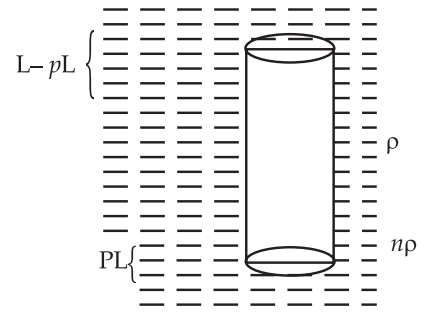
Let the cross-section area of the cylinder be A. By Archimedes' principle, upthrust = weight of cylinder:
$n\rho\times A\times pL\times g + A\times(L - pL)\rho g = LA\,dg$
$\Rightarrow LAg(n\rho p + \rho - p\rho) = LAgd$
$\Rightarrow d = \rho\{p(n - 1) + 1\} = \{1 + (n - 1)p\}\rho$
Capillary rise and angle of contact
-
Three liquids of densities $\rho_1$, $\rho_2$ and $\rho_3$ (with $\rho_1 > \rho_2 > \rho_3$), having the same value of surface tension T, rise to the same height in three identical capillaries. The angles of contact $\theta_1$, $\theta_2$ and $\theta_3$ obey:
Equal rise needs $\cos\theta \propto \rho$.
$h = \frac{2T\cos\theta}{\rho gr}$; as r, h and T are the same, $\frac{\cos\theta}{\rho}$ = constant
$\frac{\cos\theta_1}{\rho_1} = \frac{\cos\theta_2}{\rho_2} = \frac{\cos\theta_3}{\rho_3}$
As $\rho_1 > \rho_2 > \rho_3$: $\cos\theta_1 > \cos\theta_2 > \cos\theta_3 \Rightarrow \theta_1 < \theta_2 < \theta_3$
As the liquid rises, θ must be acute, so $0 \le \theta_1 < \theta_2 < \theta_3 < \frac{\pi}{2}$
Capillarity
-
Water rises to height 'h' in capillary tube. If the length of capillary tube above the surface of water is made less than 'h', thenCapillary rise: $h = \frac{2T\cos\theta}{r\rho g}$, so $hR$ = constant, where R is the radius of the meniscus.
When the tube is shorter than h, water reaches the top and the meniscus flattens (R increases) until $h'R' = hR$ is satisfied.
So the water rises to the top and stays there without overflowing.
Surface energy
-
A certain number of spherical drops of a liquid of radius 'r' coalesce to form a single drop of radius 'R' and volume 'V'. If 'T' is the surface tension of the liquid, then:The surface area decreases, so energy is released.
Released energy $= 4\pi R^2T[n^{1/3} - 1]$, where $R = n^{1/3}r$
$= 4\pi R^3T\left[\frac{1}{r} - \frac{1}{R}\right] = 3VT\left[\frac{1}{r} - \frac{1}{R}\right]$
That is every question in Mechanical Properties of Fluids for this filter.
Want a score?
Answers here are not saved. Practise as a test to be marked and see your progress.
Practise as a test