Looking for classes? Ksquare Career Institute, Bengaluru →

Physics
Motion in a Plane
56 questions from 29 papers, each with its answer.
- 56 questions
- 29 papers
- 3.17% of Physics
Uniform Circular Motion
-
The position vector of a particle $\vec R$ as a function of time is given by $\vec R = 4\sin(2\pi t)\,\hat i + 4\cos(2\pi t)\,\hat j$, where R is in meters, t is in seconds and $\hat i$ and $\hat j$ denote unit vectors along x and y-directions, respectively. Which one of the following statements is wrong for the motion of particle?$x^2 + y^2 = 16$, so the path is a circle of radius 4 m, and the acceleration is centripetal (along $-\vec R$) with magnitude $\frac{v^2}{R}$.
$\vec v = \frac{d\vec R}{dt} = 8\pi\cos 2\pi t\,\hat i - 8\pi\sin 2\pi t\,\hat j$
$|\vec v| = 8\pi$ m/s, not 8 m/s — so that statement is wrong.
Vectors – Change in Velocity
-
A football player is moving southward and suddenly turns eastward with the same speed to avoid an opponent. The force that acts on the player while turning is:
Change in velocity points north-east, so the force is along north-east.
Initial velocity $=-v\hat{j}$, final velocity $=v\hat{i}$ Change in velocity $=v\hat{i}-(-v\hat{j})=v(\hat{i}+\hat{j})$ Momentum gain is along $\hat{i}+\hat{j}$ $\Rightarrow$ force experienced is along $\hat{i}+\hat{j}$ $\Rightarrow$ force experienced is in North-East direction.
Projectile Motion
-
A ball is projected with a velocity, $10\ ms^{-1}$, at an angle of $60^\circ$ with the vertical direction. Its speed at the highest point of its trajectory will be :At the highest point, only the horizontal component of velocity remains. Angle with the horizontal $\theta = 90^\circ - 60^\circ = 30^\circ$ $u_x = u\cos\theta = 10\cos 30^\circ = 5\sqrt{3}\ ms^{-1}$
-
A projectile is fired from the surface of the earth with a velocity of 5 $ms^{-1}$ and angle $\theta$ with the horizontal. Another projectile fired from another planet with a velocity of 3 $ms^{-1}$ at the same angle follows a trajectory which is identical with the trajectory of the projectile fired from the earth. The value of the acceleration due to gravity on the planet is (in $ms^{-2}$) (given g = 9.8 $ms^{-2}$)Range $= \frac{u^2\sin2\theta}{g}$; for identical trajectories at the same angle, $g \propto u^2$.
$g_{planet} = \left(\frac{3}{5}\right)^2\times 9.8 = 3.5$ $ms^{-2}$ -
A projectile is fired at an angle of $45^\circ$ with the horizontal. Elevation angle of the projectile at its highest point as seen from the point of projection isAt the highest point the projectile is at height H and at horizontal distance $\frac{R}{2}$ from the point of projection.
$H = \frac{u^2\sin^2\theta}{2g}$ and $R = \frac{2u^2\sin\theta\cos\theta}{g}$
Elevation angle $\phi$: $\tan\phi = \frac{H}{R/2} = \frac{u^2\sin^2\theta/2g}{u^2\sin\theta\cos\theta/g}$
$\tan\phi = \frac{\tan\theta}{2}$
With $\theta = 45^\circ$: $\tan\phi = \frac{\tan45^\circ}{2} = \frac{1}{2}$
$\phi = \tan^{-1}\frac{1}{2}$ -
A particle of mass $m$ is projected with velocity $v$ making an angle of $45^\circ$ with the horizontal from level ground. When the particle lands on the level ground, the magnitude of the change in its momentum will be -Only the vertical component of velocity changes during projectile motion, so the change in momentum is in the vertical direction only.
Horizontal component of velocity: $v_x = v\cos 45^\circ$. It stays constant throughout the flight, so $\Delta p_x = 0$.
Vertical component at the time of projection: $v_{iy} = +v\sin 45^\circ$ (upward).
Vertical component when the particle lands on the same level: $v_{fy} = -v\sin 45^\circ$ (downward).
Initial vertical momentum: $p_{iy} = mv\sin 45^\circ$.
Final vertical momentum: $p_{fy} = -mv\sin 45^\circ$.
Change in momentum: $\Delta \vec{p} = (p_{fy} - p_{iy})\,\hat{j} = (-mv\sin 45^\circ - mv\sin 45^\circ)\,\hat{j} = -2mv\sin 45^\circ\,\hat{j}$
$|\Delta \vec{p}| = 2mv \times \dfrac{1}{\sqrt{2}} = \sqrt{2}\,mv$
The negative sign only shows that the change in momentum is directed vertically downward (along $-y$).
So the magnitude of the change in momentum is $\sqrt{2}\,mv$.
Relative Velocity in Two Dimensions
-
The speed of a swimmer in still water is 20 m/s. The speed of river water is 10 m/s and is flowing due east. If he is standing on the south bank and wishes to cross the river along the shortest path, the angle at which he should make his strokes w.r.t. north is given by:$\vec{V}_{SG}=\vec{V}_{SR}+\vec{V}_{RG}$, with $V_{SR}=20\ m/s$ and $V_{RG}=10\ m/s$ (due east). For the shortest path, the resultant velocity must be due north, so the swimmer must head at angle $\theta$ west of north such that $\sin\theta=\frac{V_{RG}}{V_{SR}}=\frac{10}{20}=\frac{1}{2}$ $\theta=30^\circ$ west
Velocity vector from position vector
-
The position of a particle is given by $\vec{r}(t)=4t\hat{i}+2t^2\hat{j}+5\hat{k}$ where t is in seconds and r in metre. Find the magnitude and direction of velocity v(t), at t = 1s, with respect to x-axis$\vec V=\dfrac{d\vec r}{dt}=4\hat i+4t\hat j+0\hat k$. At $t=1$ s, $\vec V=4\hat i+4\hat j$. $|\vec V|=\sqrt{4^2+4^2}=4\sqrt2$. $\tan\alpha=\dfrac{4}{4}=1\Rightarrow\alpha=45^\circ$.
Projectile motion - velocity at the highest point
-
A ball is projected from point A with velocity 20 m s$^{-1}$ at an angle $60^\circ$ to the horizontal direction. At the highest point B of the path (as shown in figure), the velocity v m s$^{-1}$ of the ball will be:
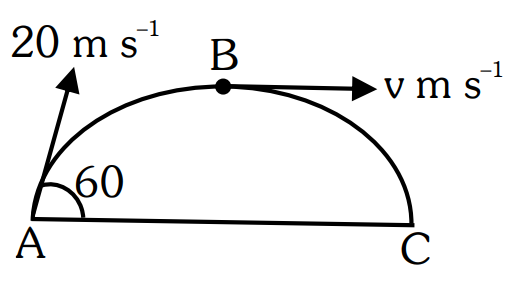 At the topmost point of its trajectory, the particle has only the horizontal component of velocity: $V_{top}=v\cos\theta=20\times\cos60^\circ=20\times\dfrac{1}{2}=10$ m/s.
Uniform circular motion - velocity and acceleration vectors
-
A particle is executing uniform circular motion with velocity $\vec{v}$ and acceleration $\vec{a}$. Which of the following is true?In uniform circular motion, the direction of both velocity and the (centripetal) acceleration changes continuously (even though their magnitudes stay constant), so neither $\vec v$ nor $\vec a$ is a constant vector.
Scalar and vector products of vectors
-
If $\vec{F}=2\hat{i}+\hat{j}-\hat{k}$ and $\vec{r}=3\hat{i}+2\hat{j}-2\hat{k}$, then the scalar and vector products of $\vec{F}$ and $\vec{r}$ have the magnitudes respectively as:$\vec{F}\cdot\vec{r}=2\times3+1\times2+(-1)(-2)=10$. $\vec{F}\times\vec{r}=\hat{i}(-2+2)-\hat{j}(-4+3)+\hat{k}(4-3)=\hat{j}+\hat{k}$, so $|\vec{F}\times\vec{r}|=\sqrt{2}$.
Horizontal projectile motion
-
Two bullets are fired horizontally and simultaneously towards each other from roof tops of two buildings 100 m apart and of same height of 200 m with the same velocity of 25 m/s. When and where will the two bullets collide. ($g=10$ m/s$^2$)Relative horizontal speed $=25+25=50$ m/s, so $t=\frac{100}{50}=2$ s. Vertical fall $=\frac{1}{2}\times10\times2^2=20$ m, so they collide at a height of $200-20=180$ m.
Uniform circular motion – vector analysis
-
A particle moves so that its position vector is given by $\vec{r} = \cos\omega t\,\hat{x} + \sin\omega t\,\hat{y}$, where $\omega$ is a constant. Which of the following is true?
$\vec{a} = -\omega^2\vec{r}$ and $\vec{v}\cdot\vec{r} = 0$.
$\vec{v} = \frac{d\vec{r}}{dt} = \omega(-\sin\omega t\,\hat{x} + \cos\omega t\,\hat{y})$ ...(ii)
$\vec{a} = \frac{d\vec{v}}{dt} = -\omega^2(\cos\omega t\,\hat{x} + \sin\omega t\,\hat{y}) = -\omega^2\vec{r}$ ...(iii)
So the acceleration is antiparallel to r, i.e. directed towards the origin.
$\vec{v}\cdot\vec{r} = \omega(-\sin\omega t\cos\omega t + \sin\omega t\cos\omega t) = 0$, so the velocity is perpendicular to r.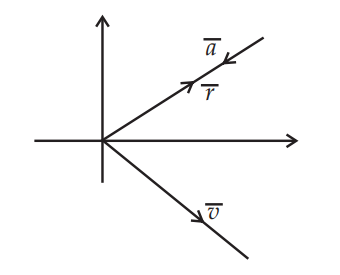
Hence the velocity is perpendicular to r and the acceleration is directed towards the origin.
Circular motion with tangential acceleration
-
A particle of mass 10 g moves along a circle of radius 6.4 cm with a constant tangential acceleration. What is the magnitude of this acceleration, if the kinetic energy of the particle becomes equal to $8 \times 10^{-4}$ J by the end of the second revolution after the beginning of the motion?
Use v from KE, then v² = 2as along the circular path.
$\frac{1}{2}mv^2 = 8\times10^{-4}$ J $\Rightarrow v^2 = \frac{2\times8\times10^{-4}}{10\times10^{-3}} = \frac{16}{100} \Rightarrow v = 0.4$ m/s
Distance in two revolutions $s = 2\times2\pi R = 4\pi R$
$v^2 = u^2 + 2as \Rightarrow \left(\frac{4}{10}\right)^2 = 0 + 2a\times4\pi\times6.4\times10^{-2}$
$a = \frac{16}{100\times8\pi\times6.4\times10^{-2}} = \frac{160}{8\times3.14\times64} \approx 0.1\ m/s^2$ -
A particle moves along a circle of radius $\left(\dfrac{20}{\pi}\right)$ m with constant tangential acceleration. If the velocity of the particle is 80 m/s at the end of the second revolution after motion has begun, the tangential acceleration is : -The tangential acceleration is constant, $\dfrac{dv}{dt} = a$ (say), so the equations of uniformly accelerated motion apply along the circular path.
Use $v^2 = u^2 + 2as$, where s is the distance travelled along the circle.
Distance in two revolutions: $s = 2 \times 2\pi r = 2 \times 2\pi \times \dfrac{20}{\pi} = 80$ m
$u = 0$ (motion begins from rest), $v = 80$ m/s
$80^2 = 0 + 2 \times a \times 80$
$a = \dfrac{6400}{160} = 40$ m s$^{-2}$
So the tangential acceleration is 40 m s$^{-2}$.
Non-uniform circular motion – centripetal component
-
In the given figure, a = 15 m/$s^2$ represents the total acceleration of a particle moving in the clockwise direction in a circle of radius R = 2.5 m at a given instant of time. The speed of the particle is:
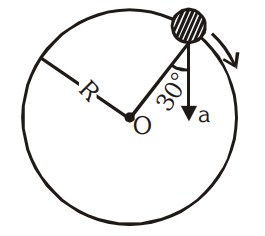
The radial component of the total acceleration equals v²/R.
Centripetal component: $a\cos30^\circ = a_c = \frac{v^2}{R}$
$\Rightarrow v^2 = aR\times\frac{\sqrt{3}}{2} = 15\times2.5\times\frac{\sqrt{3}}{2} = 32.47$
$\Rightarrow v \approx 5.7$ m/s
Relative velocity
-
A ship A is moving westwards with a speed of 10 km $h^{-1}$ and a ship B 100 km south of A is moving northwards with a speed of 10 km $h^{-1}$. The time after which the distance between them becomes shortest is$\vec v_A = 10(-\hat i)$ km/h and $\vec v_B = 10\hat j$ km/h.
Velocity of B relative to A: $\vec v_{BA} = 10\hat j + 10\hat i$, so $|\vec v_{BA}| = \sqrt{10^2 + 10^2} = 10\sqrt{2}$ km/h, directed at $45^\circ$.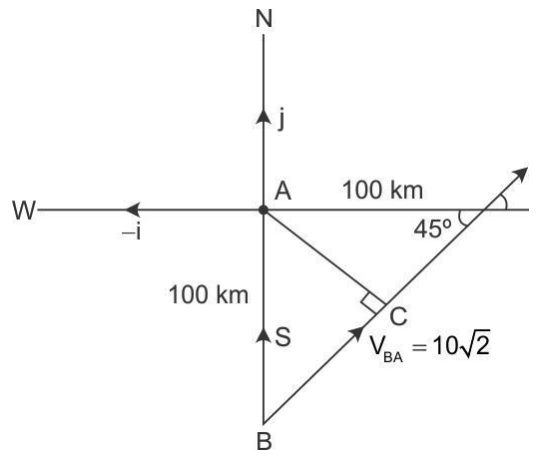
Relative to A, B moves along BC; the distance is least when B reaches the foot C of the perpendicular from A.
$BC = 100\cos 45^\circ = 50\sqrt{2}$ km
$t = \frac{50\sqrt{2}}{10\sqrt{2}} = 5$ h -
Two particles A and B, move with constant velocities $\vec u_1$ and $\vec u_2$. At the initial moment their position vectors are $\vec r_1$ and $\vec r_2$ respectively. The condition for particles A and B for their collision is:For collision, the velocity of B relative to A must point along the position of A relative to B.
Direction of relative position of A w.r.t. B: $\frac{\vec r_1 - \vec r_2}{|\vec r_1 - \vec r_2|}$
Direction of velocity of B w.r.t. A: $\frac{\vec u_2 - \vec u_1}{|\vec u_2 - \vec u_1|}$
Condition: $\frac{\vec r_1 - \vec r_2}{|\vec r_1 - \vec r_2|} = \frac{\vec u_2 - \vec u_1}{|\vec u_2 - \vec u_1|}$
Scalar product
-
If vectors $\vec A = \cos\omega t\,\hat i + \sin\omega t\,\hat j$ and $\vec B = \cos\frac{\omega t}{2}\,\hat i + \sin\frac{\omega t}{2}\,\hat j$ are functions of time, then the value of t at which they are orthogonal to each other is:Orthogonal: $\vec A\cdot\vec B = 0$
$\cos\omega t\cos\frac{\omega t}{2} + \sin\omega t\sin\frac{\omega t}{2} = 0 \Rightarrow \cos\left(\omega t - \frac{\omega t}{2}\right) = \cos\frac{\omega t}{2} = 0$
$\frac{\omega t}{2} = \frac{\pi}{2} \Rightarrow t = \frac{\pi}{\omega}$
Resolution of Vectors
-
Three forces acting on a body are shown in the figure. To have the resultant force only along the y-direction, the magnitude of the minimum additional force needed is -
(4 N acts at $30^\circ$ to the +y axis towards the -x side, 1 N acts at $60^\circ$ above the +x axis, and 2 N acts exactly opposite to the 4 N force.)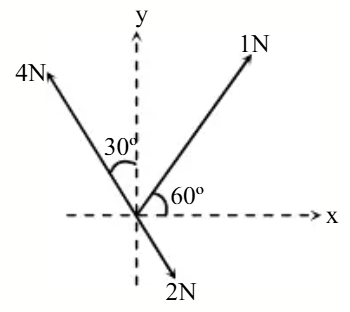 The 4 N and 2 N forces are opposite to each other, so their net is $4 - 2 = 2$ N along the direction of the 4 N force.
Now the figure reduces to: 2 N at $30^\circ$ to the +y axis (towards -x) and 1 N at $60^\circ$ to the +x axis.
Horizontal component of the 2 N force along the -ve x-direction: $x_1 = 2\sin 30^\circ = 1$ N
Horizontal component of the 1 N force along the +ve x-direction: $x_2 = 1\cos 60^\circ = \dfrac{1}{2}$ N
Net horizontal force $= 1 - \dfrac{1}{2} = \dfrac{1}{2}$ N along the -ve x-direction.
For the resultant to be only along the y-direction, the net x-component must be zero.
The smallest force that does this is one that just cancels the x-component: $\dfrac{1}{2}$ N along the +ve x-direction.
So the minimum additional force needed is 0.5 N.
Scalar and Vector Products
-
If $|\vec{A} \times \vec{B}| = \sqrt{3}\,\vec{A}\cdot\vec{B}$ then the value of $|\vec{A} + \vec{B}|$ is:-Given $|\vec{A} \times \vec{B}| = \sqrt{3}\,\vec{A}\cdot\vec{B}$
$\Rightarrow AB\sin\theta = \sqrt{3}AB\cos\theta$
$\Rightarrow \tan\theta = \sqrt{3}$
$\theta = 60^\circ$
Therefore $|\vec{A} + \vec{B}| = \sqrt{A^2 + B^2 + 2AB\cos\theta}$
$= \sqrt{A^2 + B^2 + 2AB\cos 60^\circ} = \sqrt{A^2 + B^2 + 2AB \times \dfrac{1}{2}}$
$= (A^2 + B^2 + AB)^{1/2}$
Relative Motion in Two Dimensions
-
Two boys are standing at the ends A and B of a ground where AB = $a$. The boy at B starts running in a direction perpendicular to AB with velocity $v_1$. The boy at A starts running simultaneously with velocity $v$ and catches the other boy in a time $t$, where $t$ is -Let the two boys meet at point C after time $t$. The boy from B runs along BC, perpendicular to AB, and the boy from A runs straight along AC.
BC $= v_1 t$ and AC $= vt$.
Triangle ABC is right-angled at B, so $AB^2 = AC^2 - BC^2$
$a^2 = v^2t^2 - v_1^2t^2 = t^2(v^2 - v_1^2)$
$t^2 = \dfrac{a^2}{v^2 - v_1^2}$
$t = \sqrt{\dfrac{a^2}{v^2 - v_1^2}}$
Displacement in Rolling Motion
-
A point P considered at contact point of a wheel on ground which rolls on ground without slipping then value of displacement of point P when wheel completes half of rotation (If radius of wheel is 1m) : -In half a rotation, the wheel rolls forward a distance equal to half its circumference: $\pi R$.
The point P, initially touching the ground, reaches the top of the wheel, i.e. a height 2R above the ground.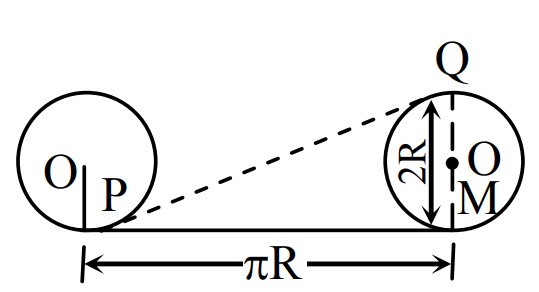
So P has a horizontal displacement $PM = \pi R$ and a vertical displacement $QM = 2R$.
Displacement $PQ = \sqrt{(PM)^2 + (QM)^2} = \sqrt{(\pi R)^2 + (2R)^2}$
With R = 1 m: $PQ = \sqrt{\pi^2 + 4}$ m
Relative Velocity: River-Boat Problems
-
The width of river is 1 km. The velocity of boat is 5 km/hr. The boat covered the width of river with shortest possible path in 15 min. Then the velocity of river stream is :For the shortest path, the boat is steered upstream at an angle so that its resultant velocity is straight across the river.
Then the speed across the river is $\sqrt{u^2 - v^2}$, where u = 5 km/h is the boat speed in still water and v the river speed.
Time: $t = \dfrac{d}{\sqrt{u^2 - v^2}}$
$\dfrac{1}{4}$ h $= \dfrac{1}{\sqrt{25 - v^2}} \Rightarrow \sqrt{25 - v^2} = 4$
$25 - v^2 = 16 \Rightarrow v = 3$ km/hr
That is every question in Motion in a Plane for this filter.
Want a score?
Answers here are not saved. Practise as a test to be marked and see your progress.
Practise as a test