Looking for classes? Ksquare Career Institute, Bengaluru →

Physics
Ray Optics and Optical Instruments
89 questions from 36 papers, each with its answer.
- 89 questions
- 36 papers
- 5.05% of Physics
Refraction through a Prism
-
A light ray enters through a right angled prism at point $P$ with the angle of incidence $30^\circ$ as shown in figure. It travels through the prism parallel to its base $BC$ and emerges along the face $AC$. The refractive index of the prism is:
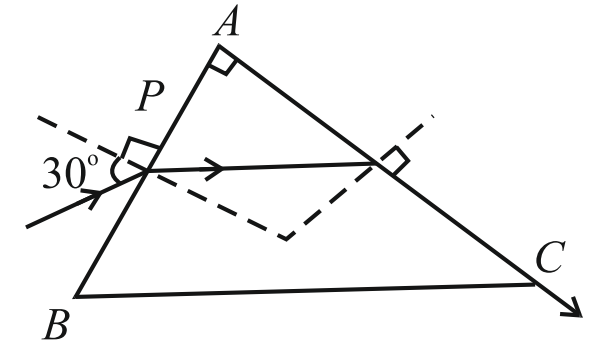 [add image: right-angled prism with the ray entering at P and travelling parallel to BC] Let $\theta$ be the angle of incidence at face AC. The ray just emerges along AC (critical condition): $\mu \sin\theta = 1 \Rightarrow \sin\theta = \frac{1}{\mu}$, so $\cos\theta = \frac{\sqrt{\mu^2 - 1}}{\mu}$ From the geometry, the angle of refraction at face AB is $(90^\circ - \theta)$. Snell's law at AB: $\sin 30^\circ = \mu \sin(90^\circ - \theta) = \mu\cos\theta$ $\frac{1}{2} = \mu \times \frac{\sqrt{\mu^2 - 1}}{\mu} = \sqrt{\mu^2 - 1}$ $\mu^2 = \frac{5}{4} \Rightarrow \mu = \frac{\sqrt{5}}{2}$
-
A ray is incident at an angle of incidence $i$ on one surface of a small angle prism (with angle of prism $A$) and emerges normally from the opposite surface. If the refractive index of the material of the prism is $\mu$, then the angle of incidence is nearly equal to:The ray emerges normally from the second surface, so the angle of emergence e = 0 and $r_2 = 0$. $r_1 + r_2 = A \Rightarrow r_1 = A$ Snell's law at the first surface: $1 \cdot \sin i = \mu\sin r_1 = \mu\sin A$ For small angles ($\sin\theta \approx \theta$): $i = \mu A$
-
The refracting angle of a prism is A, and refractive index of the material of the prism is $\cot(A/2)$. The angle of minimum deviation is$\mu = \frac{\sin\left(\frac{A + \delta_m}{2}\right)}{\sin\left(\frac{A}{2}\right)} = \cot\frac{A}{2} = \frac{\cos\frac{A}{2}}{\sin\frac{A}{2}}$
$\sin\left(\frac{A + \delta_m}{2}\right) = \cos\frac{A}{2} = \sin\left(90^\circ - \frac{A}{2}\right)$
$\frac{A + \delta_m}{2} = 90^\circ - \frac{A}{2}$
$\delta_m = 180^\circ - 2A$ -
The angle of a prism is 'A'. One of its refracting surfaces is silvered. Light rays falling at an angle of incidence 2A on the first surface returns back through the same path after suffering reflection at the silvered surface. The refractive index $\mu$, of the prism is:
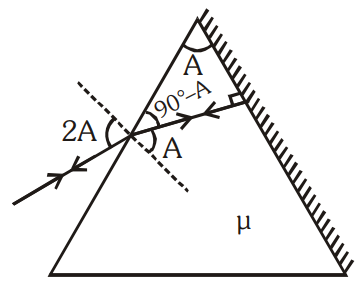
For the ray to retrace its path it must hit the silvered face normally, so the angle of refraction at the first face is A.
Snell's law: $(1)\sin 2A = \mu\sin A \Rightarrow \mu = 2\cos A$ -
A ray of light is incident at an angle of incidence, i on one face of a prism of angle A (assumed to be small) and emerges normally from the opposite face. If the refractive index of the prism is $\mu$, the angle of incidence i, is nearly equal toThe ray emerges normally, so the angle of incidence at the second face $r_2 = 0$.
$r_1 + r_2 = A \Rightarrow r_1 = A$
Snell's law at the first face: $\sin i = \mu\sin r_1 = \mu\sin A$
For small angles $\sin i \approx i$ and $\sin A \approx A$, so $i \approx \mu A$ -
The refractive index of the material of a prism is $\sqrt{2}$ and its refracting angle is $30^\circ$. One of the refracting surfaces of the prism is made a mirror inwards. A beam of monochromatic light entering the prism from the other face will retrace its path after reflection from the mirrored surface if its angle of incidence on the prism is :-For the ray to retrace its path after reflection, it must fall normally on the mirrored face, i.e. the angle of incidence at the mirrored face is $0^\circ$.
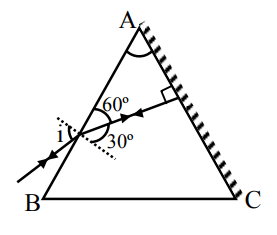
In a prism $r_1 + r_2 = A$. Here $r_2 = 0^\circ$, so the angle of refraction at the first face is $r_1 = A = 30^\circ$.
Applying Snell's law at the first face: $1 \cdot \sin i = \mu \sin 30^\circ$
$\sin i = \sqrt{2} \times \dfrac{1}{2} = \dfrac{1}{\sqrt{2}}$
$\Rightarrow i = 45^\circ$
So the angle of incidence on the prism must be $45^\circ$.
Astronomical Telescope
-
An astronomical refracting telescope is being used by an observer to observe planets in normal adjustment. The focal lengths of the objective and eye piece used in the construction of the telescope are 20 m and 2 cm respectively. Consider the following statements about the telescope: (a) The distance between the objective and eyepiece is 20.02 m (b) The magnification of the telescope is (-) 1000 (c) The image of the planet is erect and diminished (d) The aperture of eye piece is smaller than that of objective The correct statements are:In normal adjustment the final image is at infinity and is inverted. $m=-\frac{f_o}{f_e}=-\frac{20}{2\times10^{-2}}=-1000$. Tube length $L=f_o+f_e=20+0.02=20.02$ m. The aperture of the eyepiece is smaller than that of the objective. So (a), (b) and (d) are correct; (c) is wrong since the image is inverted.
Total Internal Reflection
-
Light travels a distance $x$ in time $t_1$ in air and $10x$ in time $t_2$ in another denser medium. What is the critical angle for this medium?
$\mu=\frac{t_2}{10t_1}$ and $\sin C=\frac{1}{\mu}=\frac{10t_1}{t_2}$.
Speed of light in air: $C=\frac{x}{t_1}$ Speed of light in the denser medium: $C_2=\frac{10x}{t_2}$ $\Rightarrow\mu=\frac{C}{C_2}=\frac{x}{t_1}\times\frac{t_2}{10x}=\frac{t_2}{10t_1}$ For total internal reflection $\sin C=\frac{1}{\mu}\Rightarrow\sin C=\frac{10t_1}{t_2}$ $C=\sin^{-1}\left(\frac{10t_1}{t_2}\right)$ -
Two transparent media A and B are separated by a plane boundary. The speed of light in those media are $1.5\times10^8\ m/s$ and $2.0\times10^8\ m/s$, respectively. The critical angle for a ray of light for these two media is :$\mu = \frac{c}{v} \Rightarrow \mu \propto \frac{1}{v}$ A is the denser medium (lower speed). For critical angle (ray going from A to B): $\sin i_c = \frac{\mu_B}{\mu_A} = \frac{v_A}{v_B} = \frac{1.5}{2.0} = \frac{3}{4}$ $i_c = \sin^{-1}(0.750)$
-
A beam of light consisting of red, green and blue colours is incident on a right angled prism. The refractive index of the material of the prism for the above red, green and blue wavelengths are 1.39, 1.44 and 1.47, respectively.
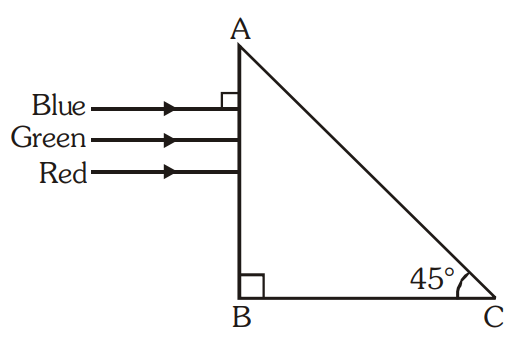 The prism will:Light falls on the hypotenuse face at $45^\circ$. Total internal reflection needs $\mu \ge \frac{1}{\sin45^\circ} = \sqrt2 \approx 1.414$.
$\mu_{green} = 1.44$ and $\mu_{blue} = 1.47$ exceed 1.414, so green and blue are totally internally reflected.
$\mu_{red} = 1.39 < 1.414$, so red is refracted out — the prism separates red from green and blue. -
The speed of light in media $M_1$ and $M_2$ is $1.5\times10^8$ m/s and $2.0\times10^8$ m/s respectively. A ray of light enters from medium $M_1$ to $M_2$ at an incidence angle i. If the ray suffers total internal reflection, the value of i isRefractive index $\mu = \frac{c}{v}$: $\mu_1 = \frac{3\times10^8}{1.5\times10^8} = 2$ and $\mu_2 = \frac{3\times10^8}{2.0\times10^8} = \frac{3}{2}$
Light goes from the denser medium $M_1$ to the rarer medium $M_2$, so total internal reflection is possible.
At the critical angle C: $\mu_1\sin C = \mu_2\sin90^\circ$
$\sin C = \frac{\mu_2}{\mu_1} = \frac{3/2}{2} = \frac{3}{4}$
For total internal reflection the angle of incidence must not be less than the critical angle: $\sin i \geq \frac{3}{4}$
$i \geq \sin^{-1}\left(\frac{3}{4}\right)$ -
A disc is placed on a surface of pond which has refractive index $\dfrac{5}{3}$. A source of light is placed 4 m below the surface of liquid. The minimum radius of disc will be so light is not coming outLight from the source escapes only through a circle on the surface, within which the angle of incidence is less than the critical angle $\theta_c$. Beyond this circle, total internal reflection occurs.
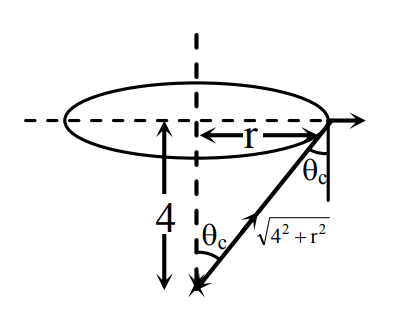
$\sin\theta_c = \dfrac{1}{\mu} = \dfrac{1}{5/3} = \dfrac{3}{5}$
From the geometry: $\sin\theta_c = \dfrac{r}{\sqrt{4^2 + r^2}}$
$\dfrac{r}{\sqrt{16 + r^2}} = \dfrac{3}{5} \Rightarrow 25r^2 = 9(16 + r^2) \Rightarrow 16r^2 = 144$
$r = 3$ m
So the disc must have a minimum radius of 3 m to block all the light.
Refraction and Reflection at a Plane Surface – Brewster's Angle
-
A light ray falls on a glass surface of refractive index $\sqrt{3}$, at an angle $60^\circ$. The angle between the refracted and reflected rays would be :By Snell's law: $1 \times \sin 60^\circ = \sqrt{3}\sin r \Rightarrow \frac{\sqrt{3}}{2} = \sqrt{3}\sin r \Rightarrow \sin r = \frac{1}{2}$, so $r = 30^\circ$ Angle of reflection = $60^\circ$, so the angle between the reflected and refracted rays $= 180^\circ - 60^\circ - 30^\circ = 90^\circ$ (Alternatively, $\tan i_p = \mu = \sqrt{3} \Rightarrow i_p = 60^\circ$; the ray is incident at Brewster's angle, so the reflected and refracted rays are perpendicular.)
Combination of Lenses – Telescopic Arrangement
-
A convex lens 'A' of focal length 20 cm and a concave lens 'B' of focal length 5 cm are kept along the same axis with a distance 'd' between them. If a parallel beam of light falling on 'A' leaves 'B' as a parallel beam, then the distance 'd' in cm will be:
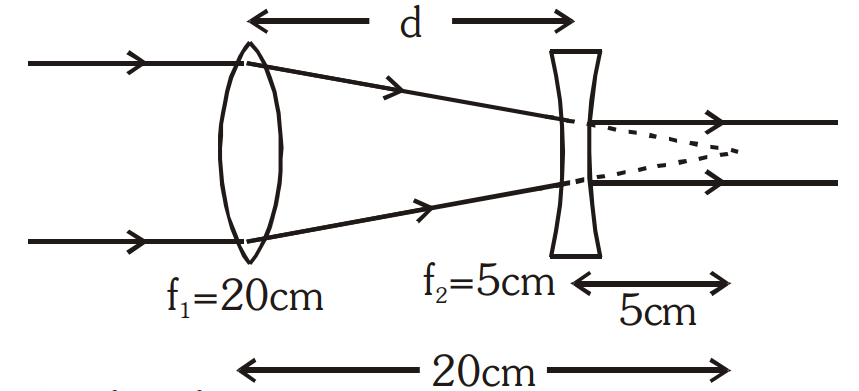
For a parallel beam to emerge parallel, the second focal point of A must coincide with the focal point of B (on the far side of B).
$d = f_1 - f_2 = 20 - 5 = 15$ cm
Optical Instruments – Resolving Power of a Telescope
-
Assume that light of wavelength 600 nm is coming from a star. The limit of resolution of telescope whose objective has a diameter of 2 m is:Limit of resolution $\theta_R = \frac{1.22\lambda}{d}$, with $\lambda = 600 \times 10^{-9}$ m and d = 2 m $\theta_R = \frac{1.22 \times 600 \times 10^{-9}}{2} = 3.66 \times 10^{-7}$ rad
Refraction through a prism, angle of minimum deviation
-
A ray of monochromatic light is passing through an equilateral prism (ABC) as shown in the figure. The refracted ray (QR) is parallel to its base (BC) and the angle of incidence (i) is $50^\circ$. Then the angle of deviation ($\delta$) is:
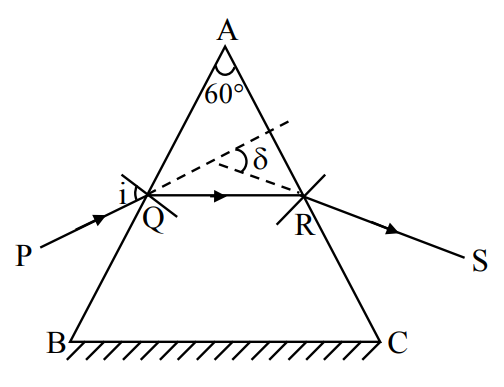 For an equilateral prism, $A = 60^\circ$. Since the refracted ray is parallel to the base, this is the condition of minimum deviation: $r = \frac{A}{2} = \frac{60^\circ}{2} = 30^\circ$ and $i = e = 50^\circ$ $\delta = i + e - A = 50^\circ + 50^\circ - 60^\circ$ $= 40^\circ$
Reflection, refraction and colour of objects
-
Given below are two statements: Statement I: Image formation needs regular reflection and/or refraction. Statement II: The variety in colour of objects we see around us is due to the constituent colours of the light incident on them. In the light of the above statements, choose the most appropriate answer from the options given below:Regular reflection and/or refraction is needed to form an image, which is why we see our image in a mirror but not on a rough wall. The variety of colours we see in objects is due to the constituent colours of the incident light that get selectively reflected. Hence both statements are correct.
Mirror formula
-
An object is placed on the principal axis of a concave mirror at a distance of 1.5 f (f is the focal length). The image will be at,Using sign convention, $u=-1.5f$, mirror focal length $f=-f$ (concave). $\dfrac{1}{v}+\dfrac{1}{u}=\dfrac{1}{f}\Rightarrow\dfrac{1}{v}=\dfrac{1}{-f}-\dfrac{1}{-1.5f}=-\dfrac{1}{f}+\dfrac{1}{1.5f}=\dfrac{-1.5+1}{1.5f}=\dfrac{-0.5}{1.5f}=\dfrac{-1}{3f}\Rightarrow v=-3f$.
Total internal reflection - critical angle and refractive index
-
If the critical angle for total internal reflection from a medium to vacuum is $45^\circ$, then velocity of light in the medium is,Refractive index $\mu=\dfrac{1}{\sin\theta_c}=\dfrac{1}{\sin45^\circ}=\sqrt2$. $v=\dfrac{c}{\mu}=\dfrac{3\times10^8}{\sqrt2}$ m/s.
Spherometer - measurement of radius of curvature
-
A plano-convex lens of unknown material and unknown focal length is given. With the help of a spherometer we can measure the,A spherometer is used to measure the radius of curvature of a curved (spherical) surface, such as the curved face of a plano-convex lens.
Lens maker's formula
-
The power of a biconvex lens is 10 dioptre and the radius of curvature of each surface is 10 cm. Then the refractive index of the material of the lens is,$f=\dfrac{1}{P}=\dfrac{1}{10}$ m $=10$ cm. Using $\dfrac{1}{f}=(\mu-1)\left(\dfrac{1}{R_1}-\dfrac{1}{R_2}\right)$ with $R_1=+10$ cm, $R_2=-10$ cm: $\dfrac{1}{10}=(\mu-1)\left(\dfrac{1}{10}+\dfrac{1}{10}\right)=(\mu-1)\dfrac{1}{5}\Rightarrow\mu-1=\dfrac{1}{2}\Rightarrow\mu=\dfrac{3}{2}$.
-
A double convex lens has focal length 25 cm. The radius of curvature of one of the surfaces is double of the other. Find the radii if the refractive index of the material of the lens is 1.5:$\frac{1}{f}=(\mu-1)\left(\frac{1}{R_1}-\frac{1}{R_2}\right) \Rightarrow \frac{1}{25}=0.5\left[\frac{1}{R}+\frac{1}{2R}\right]=\frac{0.75}{R} \Rightarrow R=18.75$ cm, $R_2=37.5$ cm.
-
An equiconvex lens is cut into two halves along (i) XOX' and (ii) YOY' as shown in the figure. Let f, f', f'' be the focal lengths of the complete lens, of each half in case (i), and of each half in case (ii), respectively.
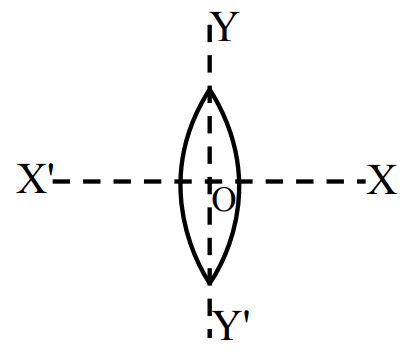
Choose the correct statement from the following-For an equiconvex lens with radius R on both sides: $\dfrac{1}{f} = (\mu - 1)\left(\dfrac{1}{R} + \dfrac{1}{R}\right) = \dfrac{2(\mu - 1)}{R}$
Case (i), cut along XOX' (the principal axis): each half is still bounded by both curved surfaces of radius R; only the aperture is halved. So each half has the same focal length: $f' = f$.
Case (ii), cut along YOY': each half is a plano-convex lens with one curved surface of radius R and one plane surface ($R_2 = \infty$).
$\dfrac{1}{f''} = (\mu - 1)\left(\dfrac{1}{R} - \dfrac{1}{\infty}\right) = \dfrac{\mu - 1}{R} = \dfrac{1}{2f}$
$\Rightarrow f'' = 2f$
So $f' = f$ and $f'' = 2f$.
Lens made of multiple media - multiple images
-
A lens is made up of 3 different transparent media as shown in figure. A point object O is placed on its axis beyond 2f. How many real images will be obtained on the other side?
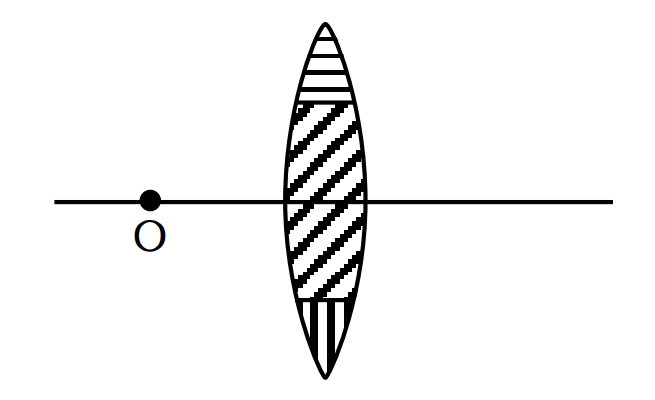 Since the lens is made of three different transparent materials, each material has its own distinct refractive index, resulting in three different effective focal lengths and hence three separate real images.
Refraction through a thin-angle prism
-
A horizontal ray of light is incident on the right angled prism with prism angle $6^\circ$. If the refractive index of the material of the prism is 1.5, then the angle of emergence will be:
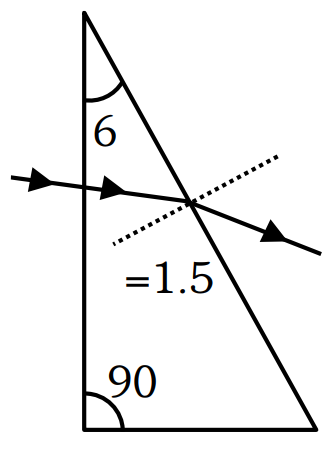 For the given geometry, $A=r_1+r_2=6^\circ$. Since the incident ray is horizontal (normal incidence at the first face for this configuration), $r_1\approx0$, so $r_2\approx6^\circ$. Using $\mu=\dfrac{\sin e}{\sin r_2}$: $1.5=\dfrac{\sin e}{\sin6^\circ}\Rightarrow\sin e=1.5\sin6^\circ\Rightarrow e\approx9^\circ$ (using the small-angle approximation).
Total internal reflection - dependence of critical angle on wavelength
-
Which set of colours will come out in air for a situation shown in figure?
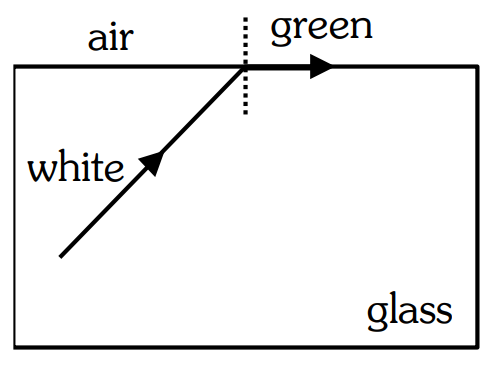 The critical angle $\sin i_c=\dfrac{1}{\mu}\propto\lambda$ (critical angle increases with wavelength, since $\mu$ decreases with increasing wavelength). At the given angle of incidence inside the glass, only colours with a sufficiently large critical angle (i.e., longer wavelengths — yellow, orange and red) can emerge into air without undergoing total internal reflection.
Convex lens producing an equal-size image
-
An object is mounted on a wall. Its image of equal size is to be obtained on a parallel wall with the help of a convex lens placed between these walls. The lens is kept at distance x in front of the second wall. The required focal length of the lens will be:For an equal-size real image, the object and image distances from the lens are equal ($u=v=x$), corresponding to magnification $-1$ (i.e., object at the centre of curvature, $u=2f$). So $x=2f\Rightarrow f=\dfrac{x}{2}$.
Apparent depth
-
Consider three media P, Q and R with refractive indices 1, 1.25 and 1.5 respectively. The medium Q having a thickness of 5 cm is placed between extended media P and R as shown in the figure. An object O is placed at the centre of medium Q. If viewed from medium P near the normal direction, the apparent depth of O is $h_1$. For similar observation from medium R, the apparent depth is $h_2$. The value of $|h_1-h_2|$, in cm, is:
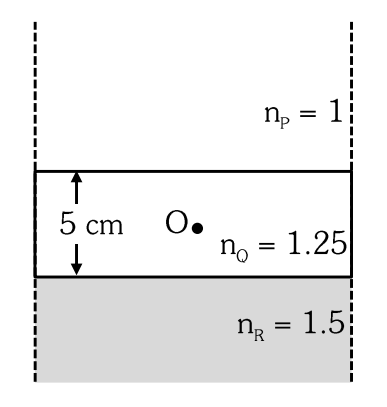 The object is 2.5 cm from each face of Q. Observer I (in P): $\frac{d'}{d}=\frac{\mu_P}{\mu_Q} \Rightarrow d'=2.5\times\frac{1}{1.25}=2$ cm $=h_1$. Observer II (in R): $d'=2.5\times\frac{1.5}{1.25}=3$ cm $=h_2$. $|h_1-h_2|=1$ cm.
Combination of lenses
-
The lens combination as shown in the figure, consists of two lenses, $L_1$ and $L_2$, of the focal lengths +10 cm and -10 cm, respectively. The position of the image formed is:
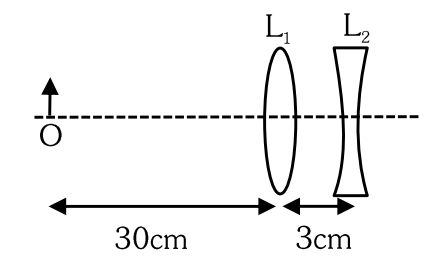 First lens: u = -30 cm, f = +10 cm, so $v=\frac{uf}{u+f}=\frac{-30\times10}{-30+10}=15$ cm. This image lies 12 cm beyond the concave lens (placed 3 cm away) and acts as a virtual object for it. Second lens: u = +12 cm, f = -10 cm, so $v=\frac{12\times(-10)}{12-10}=-60$ cm (virtual image). The negative sign means the image is 60 cm to the left of the concave lens.
-
A plano convex lens fits exactly into a plano concave lens. Their plane surfaces are parallel to each other. If lenses are made of different materials of refractive indices $\mu_1$ and $\mu_2$ and R is the radius of curvature of the curved surface of the lenses, then the focal length of combination is
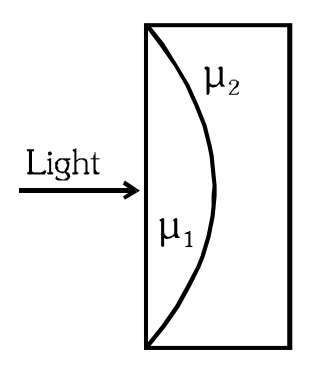
$\frac{1}{f_{eq}} = \frac{1}{f_1} + \frac{1}{f_2}$
$\frac{1}{f_{eq}} = (\mu_1 - 1)\left(\frac{1}{R}\right) + (\mu_2 - 1)\left(-\frac{1}{R}\right) = \frac{\mu_1 - \mu_2}{R}$
$f_{eq} = \frac{R}{\mu_1 - \mu_2}$
Refraction of Light – Natural Phenomena (Rainbow)
-
Pick the wrong answer in the context with rainbow.A rainbow is seen only when the sun is behind the observer, i.e. the observer faces away from the sun. So the statement "An observer can see a rainbow when his front is towards the sun" is wrong. The other statements (secondary rainbow from two internal reflections
Refraction through a prism – silvered prism
-
The refractive index of the material of a prism is $\sqrt{2}$ and the angle of the prism is $30^\circ$. One of the two refracting surfaces of the prism is made a mirror inwards, by silver coating. A beam of monochromatic light entering the prism from the other face will retrace its path (after reflection from the silvered surface) if its angle of incidence on the prism is
Normal incidence on the silvered face makes $r = A = 30^\circ$; then Snell's law gives $i = 45^\circ$.
For retracing its path, the light ray should be normally incident on the silvered face.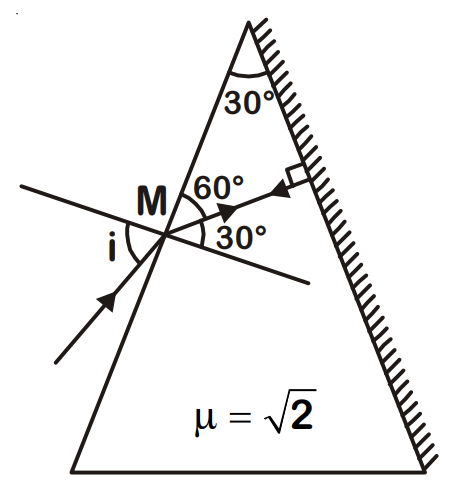
So the angle of refraction at the first face is $r = 30^\circ$.
Applying Snell's law at M: $\frac{\sin i}{\sin 30^\circ} = \frac{\sqrt{2}}{1}$
$\sin i = \sqrt{2}\times\frac{1}{2} = \frac{1}{\sqrt{2}}$, i.e. $i = 45^\circ$
Mirror formula – concave mirror
-
An object is placed at a distance of 40 cm from a concave mirror of focal length 15 cm. If the object is displaced through a distance of 20 cm towards the mirror, the displacement of the image will be
Image moves from 24 cm to 60 cm in front of the mirror.
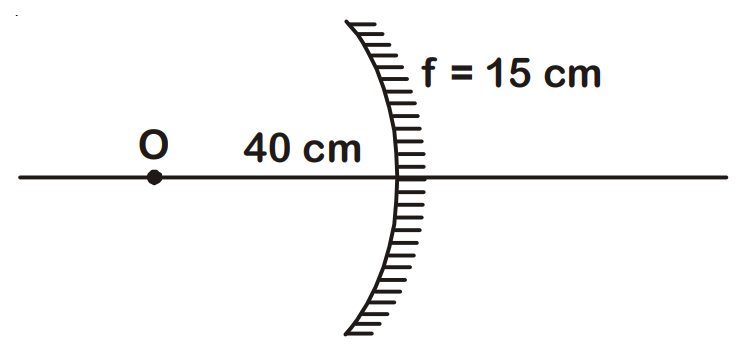
$\frac{1}{f} = \frac{1}{v_1} + \frac{1}{u}$
$-\frac{1}{15} = \frac{1}{v_1} - \frac{1}{40}$
$\frac{1}{v_1} = \frac{1}{-15} + \frac{1}{40} \Rightarrow v_1 = -24$ cm
When the object is displaced by 20 cm towards the mirror, $u_2 = -20$ cm
$\frac{1}{f} = \frac{1}{v_2} + \frac{1}{u_2} \Rightarrow \frac{1}{-15} = \frac{1}{v_2} - \frac{1}{20}$
$\frac{1}{v_2} = \frac{1}{20} - \frac{1}{15} \Rightarrow v_2 = -60$ cm
So, the image shifts away from the mirror by $60 - 24 = 36$ cm.
Astronomical telescope – object at finite distance
-
A astronomical telescope has objective and eyepiece of focal lengths 40 cm and 4 cm respectively. To view an object 200 cm away from the objective, the lenses must be separated by a distance
Tube length = $v_o + f_e$ in normal adjustment.
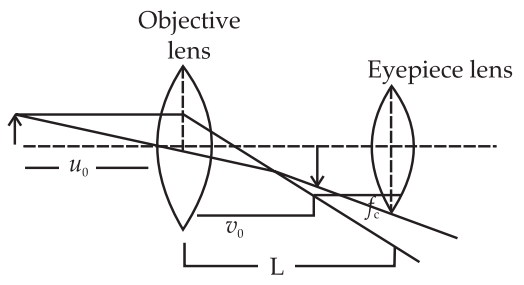
For the objective: $\frac{1}{v_o} - \frac{1}{u_o} = \frac{1}{f_o} \Rightarrow \frac{1}{v_o} - \frac{1}{(-200)} = \frac{1}{40}$
$\frac{1}{v_o} = \frac{1}{40} - \frac{1}{200} = \frac{4}{200} \Rightarrow v_o = 50$ cm
For normal adjustment, distance between lenses $l = v_o + f_e = 50 + 4 = 54$ cm
Spherical mirrors – magnification and nature of image
-
Match the corresponding entries of Column 1 with Column 2. [Where m is the magnification produced by the mirror]
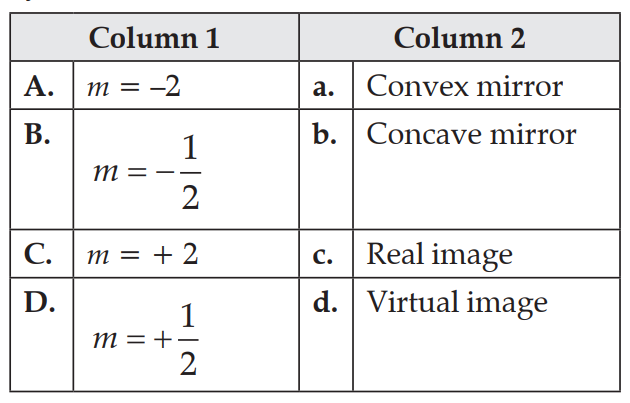
Negative m = real image; positive m = virtual image; |m| > 1 with virtual image needs a concave mirror.
Magnification for a mirror $m = -\frac{v}{u}$
For A (m = –2): v = 2u; u and v have the same sign, so the mirror is concave and the image is real: A → b, c
For B (m = –1/2): 2v = u; same sign, image real, concave mirror: B → b, c
For C (m = +2): v = –2u; u and v have opposite signs, the image is virtual; the source takes the mirror as convex: C → a, d
For D (m = +1/2): v = –u/2; opposite signs and magnification less than 1, so the mirror is convex and the image is virtual: D → a, d
Note: the source key gives this combination. A virtual image with m = +2 (magnified) is actually formed only by a concave mirror, so C should strictly be 'b and d'; please check this key before use.
Combination of thin lenses
-
Two identical glass ($\mu_g = 3/2$) equiconvex lenses of focal length f each are kept in contact. The space between the two lenses is filled with water ($\mu_w = 4/3$). The focal length of the combination is:
The water forms a concave lens between two convex lenses.
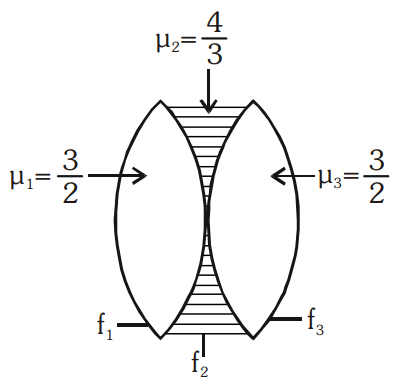
$f_1 = f_3 = \frac{R}{2\left(\frac{3}{2} - 1\right)} = R = f$ (given)
Water lens: $f_2 = \frac{-R}{2\left(\frac{4}{3} - 1\right)} = -\frac{3}{2}R = -\frac{3}{2}f$
$\frac{1}{f_{eq}} = \frac{1}{f_1} + \frac{1}{f_2} + \frac{1}{f_3} = \frac{1}{f} - \frac{2}{3f} + \frac{1}{f} = \frac{4}{3f}$
$f_{eq} = \frac{3f}{4}$
Human eye
-
For a normal eye, the cornea of eye provides a converging power of 40 D and the least converging power of the eye lens behind the cornea is 20 D. Using this information, the distance between the retina and the cornea-eye lens can be estimated to beFor a normal eye, rays from infinity focus on the retina with the lens at its minimum power.
Combined power = 40 D + 20 D = 60 D
The distance between the retina and the cornea-eye lens equals the focal length: $f = \frac{1}{60}$ m = 1.67 cm
Combination of lens and mirror
-
A concave mirror of focal length $f_1$ is placed at a distance of d from a convex lens of focal length $f_2$. A beam of light coming from infinity and falling on this convex lens-concave mirror combination returns to infinity. The distance 'd' must equalThe parallel beam is focused by the lens at its focus, a distance $f_2$ from the lens.
For the beam to return to infinity the rays must retrace their path, so they must hit the mirror normally.
That happens when the focus of the lens is at the centre of curvature of the mirror, a distance $2f_1$ from the mirror.
$d = f_2 + 2f_1$
Reflection by spherical mirrors
-
A rod of length 10 cm lies along the principal axis of a concave mirror of focal length 10 cm in such a way that its end closer to the pole is 20 cm away from the mirror. The length of the image is
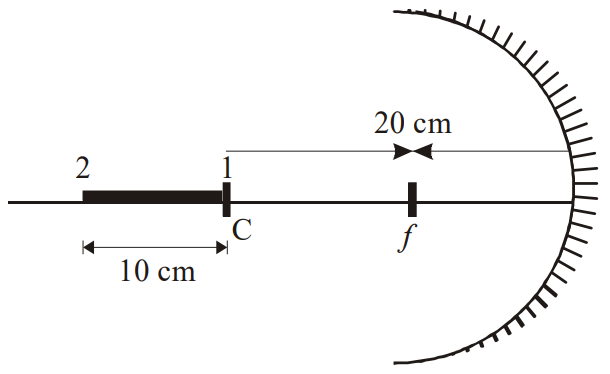
Near end: $u_1 = -20$ cm, which is the centre of curvature (2f), so its image forms at the same place: $v_1 = -20$ cm
Far end: $u_2 = -30$ cm. Mirror formula $\frac{1}{f} = \frac{1}{v} + \frac{1}{u}$: $\frac{1}{-10} = \frac{1}{v_2} + \frac{1}{-30}$
$\frac{1}{v_2} = -\frac{1}{10} + \frac{1}{30} = -\frac{1}{15} \Rightarrow v_2 = -15$ cm
Length of image $= |v_1| - |v_2| = 20 - 15 = 5$ cm
Refraction through a lens
-
A converging beam of rays is incident on a diverging lens. Having passed through the lens the rays intersect at a point 15 cm from the lens on the opposite side. If the lens is removed the point where the rays meet will move 5 cm closer to the lens. The focal length of the lens isWithout the lens the converging rays would meet at a point 15 − 5 = 10 cm behind the lens position. This point acts as a virtual object for the lens.
For a virtual object on the far side of the lens, u = +10 cm.
With the lens the rays actually meet 15 cm from the lens on the opposite side, so v = +15 cm.
Lens formula: $\frac{1}{v} - \frac{1}{u} = \frac{1}{f}$
$\frac{1}{f} = \frac{1}{15} - \frac{1}{10} = \frac{2 - 3}{30} = -\frac{1}{30}$
f = −30 cm (negative, as expected for a diverging lens) -
A biconvex lens has a radius of curvature of magnitude 20 cm. Which one of the following options describes best the image formed of an object of height 2 cm placed 30 cm from the lens?The refractive index is not given; taking glass with $\mu = 1.5$.
Lens maker's formula: $\frac{1}{f} = (\mu - 1)\left(\frac{1}{R_1} - \frac{1}{R_2}\right) = (1.5 - 1)\left(\frac{1}{20} + \frac{1}{20}\right) = 0.5\times\frac{1}{10} = \frac{1}{20}$
f = 20 cm
Lens formula with u = −30 cm: $\frac{1}{v} - \frac{1}{u} = \frac{1}{f}$, so $\frac{1}{v} = \frac{1}{20} - \frac{1}{30} = \frac{1}{60}$
v = +60 cm; v is positive, so the image is real and on the other side of the lens.
Magnification $m = \frac{v}{u} = \frac{60}{-30} = -2$; the negative sign means the image is inverted.
Image height = $|m|\times h_o = 2\times2 = 4$ cm
So the image is real, inverted and 4 cm high. -
A lens having focal length f and aperture of diameter d forms an image of intensity I. Aperture of diameter $\frac{d}{2}$ in central region of lens is covered by a black paper. Focal length of lens and intensity of image now will be respectivelyThe focal length depends only on the refractive index and the radii of curvature of the lens, not on its aperture; so it remains f.
The intensity of the image is proportional to the area of the lens that transmits light, i.e., $I \propto d^2$.
Original transmitting area $\propto d^2$; area covered $\propto \left(\frac{d}{2}\right)^2 = \frac{d^2}{4}$
Remaining area $\propto d^2 - \frac{d^2}{4} = \frac{3d^2}{4}$
New intensity $= I - \frac{I}{4} = \frac{3I}{4}$
So the focal length is f and the intensity is $\frac{3I}{4}$.
Image Formation by a Convex Lens
-
A boy is trying to start a fire by focusing sunlight on a piece of paper using an equiconvex lens of focal length 10 cm. The diameter of the Sun is $1.39 \times 10^{9}$ m and its mean distance from the earth is $1.5 \times 10^{11}$ m. What is the diameter of the Sun's image on the paper ?The Sun is very far away, so its rays are practically parallel and the image is formed in the focal plane of the lens.
Object distance $u = 1.5 \times 10^{11}$ m; image distance $v = f = 10$ cm $= 0.1$ m
Magnification: $\dfrac{h_i}{h_o} = \dfrac{v}{u}$
$\Rightarrow \dfrac{h_i}{1.39 \times 10^{9}} = \dfrac{0.1}{1.5 \times 10^{11}}$
$h_i = \dfrac{0.1 \times 1.39 \times 10^{9}}{1.5 \times 10^{11}}$
$h_i = \dfrac{1.39 \times 10^{8}}{1.5 \times 10^{11}}$ m
$h_i = 9.2 \times 10^{-4}$ m
So the diameter of the Sun's image on the paper is about $9.2 \times 10^{-4}$ m.
Total Internal Reflection and Critical Angle
-
A small coin is resting on the bottom of a beaker filled with liquid. A ray of light from the coin travels upto the surface of the liquid and moves along its surface. How fast is the light travelling in the liquid?
(The ray meets the surface at a horizontal distance of 3 cm from the point directly above the coin; the depth of the liquid is 4 cm.)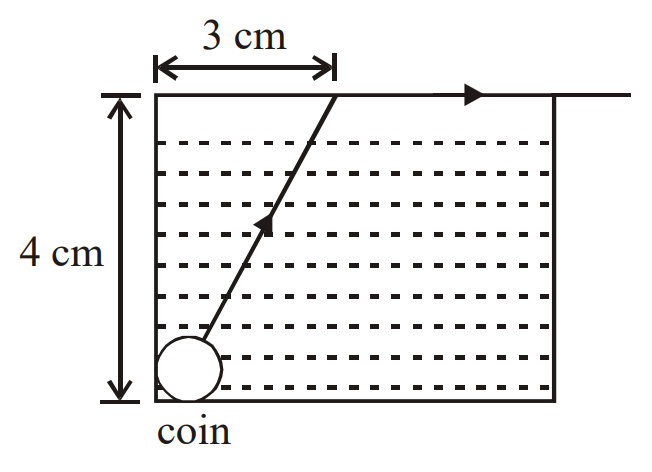
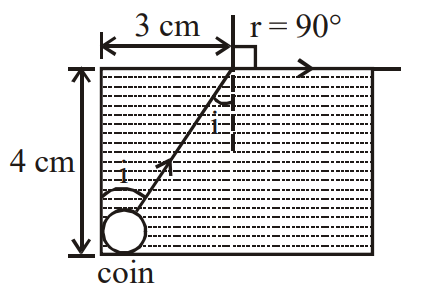
The refracted ray moves along the surface, so the angle of refraction is $r = 90^\circ$ and the angle of incidence $i$ is the critical angle.
In the right triangle formed, the vertical side is 4 cm and the horizontal side is 3 cm, so the hypotenuse comes out to be $\sqrt{3^2 + 4^2} = 5$ cm.
$\sin i = \dfrac{3}{5}$
By Snell's law for light going from the liquid to air: $\dfrac{1}{\mu} = \dfrac{\sin i}{\sin 90^\circ}$
$\mu = \dfrac{1}{\sin i} = \dfrac{5}{3}$
Speed of light in the liquid: $v = \dfrac{c}{\mu} = \dfrac{3 \times 10^{8}}{5/3}$
$v = 1.8 \times 10^{8}$ m/s
Refraction through a Glass Slab and Dispersion
-
A beam of light composed of red and green rays is incident obliquely at a point on the face of a rectangular glass slab. When coming out on the opposite parallel face, the red and green rays emerge from :-The refractive index of glass is different for different colours: $\mu_{green} \gt \mu_{red}$ (by Cauchy's relation, $\mu$ is larger for shorter wavelengths).
At the first face, both rays have the same angle of incidence $i$, but by Snell's law $\sin i = \mu \sin r$, the green ray is bent more (smaller $r$) than the red ray. So the two rays travel in different directions inside the slab.
Because they travel along different paths, they strike the second face at two different points.
At the second face (parallel to the first), each ray emerges at an angle equal to the original angle of incidence $i$, since a parallel slab produces only a lateral shift and no deviation.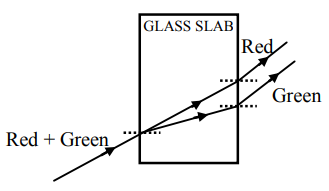
So the red and green rays emerge from two points, propagating in two different parallel directions (both parallel to the incident beam).
Lens Formula: Real Image between Fixed Object and Screen
-
A bulb is located on a wall. Its image is to be obtained on a parallel wall with the help of convex lens. If the distance between parallel walls is 'd' then required focal length of lens placed in between the walls is : -For a real image of the bulb on the other wall, the object distance u and image distance v (magnitudes) must add up to d: $u + v = d$.
Lens formula: $\dfrac{1}{v} + \dfrac{1}{u} = \dfrac{1}{f} \Rightarrow f = \dfrac{uv}{u + v} = \dfrac{uv}{d}$
For fixed $u + v = d$, the product uv is greatest when $u = v = \dfrac{d}{2}$, giving $uv_{max} = \dfrac{d^2}{4}$.
So $f = \dfrac{uv}{d} \leq \dfrac{d^2/4}{d} = \dfrac{d}{4}$
Equivalently, the minimum distance between an object and its real image is 4f, so $d \geq 4f$.
So the focal length must be less than or equal to $\dfrac{d}{4}$.
Silvered Lens
-
A plano-convex lens ($\mu$ = 1.5) has radius of curvature 10 cm. It is silvered on its plane surface. Find focal length after silvering :When one surface of a lens is silvered, it behaves as a mirror. Light passes through the lens, reflects from the silvered surface, and passes through the lens again.
Equivalent power: $P_{eq} = 2P_L + P_M$
Power of the plano-convex lens: $P_L = (\mu - 1)\dfrac{1}{R}$; the silvered plane surface is a plane mirror with $P_M = 0$.
$P_{eq} = 2(\mu - 1)\dfrac{1}{R} + 0$
$f = -\dfrac{1}{P_{eq}} = -\dfrac{R}{2(\mu - 1)} = -\dfrac{10}{2(1.5 - 1)} = -10$ cm
So it acts as a concave mirror of focal length 10 cm.
Real and Apparent Depth
-
A bubble in glass slab ($\mu$ = 1.5) when viewed from one side appears at 5 cm and 2 cm from other side, then thickness of slab is :Real depth = $\mu \times$ apparent depth.
From the first side: real depth of the bubble $= 1.5 \times 5 = 7.5$ cm
From the other side: real depth $= 1.5 \times 2 = 3$ cm
Thickness of the slab = sum of the two real depths $= 7.5 + 3 = 10.5$ cm
That is every question in Ray Optics and Optical Instruments for this filter.
Want a score?
Answers here are not saved. Practise as a test to be marked and see your progress.
Practise as a test