2004 AIPMT Ray Optics and Optical InstrumentsRefraction through a Glass Slab and Dispersion Medium Question 77 of 89 in Ray Optics and Optical Instruments

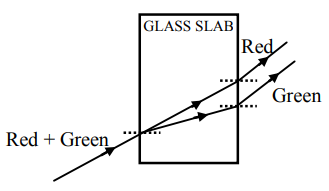
A beam of light composed of red and green rays is incident obliquely at a point on the face of a rectangular glass slab. When coming out on the opposite parallel face, the red and green rays emerge from :-

A Two points propagating in two different parallel directions
B One point propagating in two different directions through slab
C One point propagating in the same direction through slab
D Two points propagating in two different non parallel directions

The answer is A.
Solution

The refractive index of glass is different for different colours: $\mu_{green} \gt \mu_{red}$ (by Cauchy's relation, $\mu$ is larger for shorter wavelengths).
At the first face, both rays have the same angle of incidence $i$, but by Snell's law $\sin i = \mu \sin r$, the green ray is bent more (smaller $r$) than the red ray. So the two rays travel in different directions inside the slab.
Because they travel along different paths, they strike the second face at two different points.
At the second face (parallel to the first), each ray emerges at an angle equal to the original angle of incidence $i$, since a parallel slab produces only a lateral shift and no deviation.

So the red and green rays emerge from two points, propagating in two different parallel directions (both parallel to the incident beam).

Concept Dispersion in a parallel-sided slab

Ray Optics and Optical Instruments in past papers

89 questions from this chapter have appeared across 25 exam years.
