Looking for classes? Ksquare Career Institute, Bengaluru →

A disc is placed on a surface of pond which has refractive index $\dfrac{5}{3}$. A source of light is placed 4 m below the surface of liquid. The minimum radius of disc will be so light is not coming out
A
$\infty$
B
3 m
C
6 m
D
4 m
Detailed Solution
Light from the source escapes only through a circle on the surface, within which the angle of incidence is less than the critical angle $\theta_c$. Beyond this circle, total internal reflection occurs.
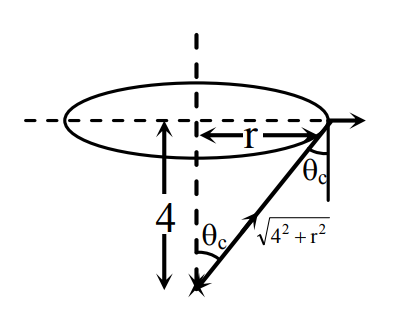
$\sin\theta_c = \dfrac{1}{\mu} = \dfrac{1}{5/3} = \dfrac{3}{5}$
From the geometry: $\sin\theta_c = \dfrac{r}{\sqrt{4^2 + r^2}}$
$\dfrac{r}{\sqrt{16 + r^2}} = \dfrac{3}{5} \Rightarrow 25r^2 = 9(16 + r^2) \Rightarrow 16r^2 = 144$
$r = 3$ m
So the disc must have a minimum radius of 3 m to block all the light.
$\sin\theta_c = \dfrac{1}{\mu} = \dfrac{1}{5/3} = \dfrac{3}{5}$
From the geometry: $\sin\theta_c = \dfrac{r}{\sqrt{4^2 + r^2}}$
$\dfrac{r}{\sqrt{16 + r^2}} = \dfrac{3}{5} \Rightarrow 25r^2 = 9(16 + r^2) \Rightarrow 16r^2 = 144$
$r = 3$ m
So the disc must have a minimum radius of 3 m to block all the light.