Looking for classes? Ksquare Career Institute, Bengaluru →

Ray Optics and Optical Instruments
Total Internal Reflection
8 questions from 8 papers, each with its answer.
- questions
- 8
- papers
- 8
- years asked, 2017–2026
- 2 of 10
- of Ray Optics and Optical Instruments
- 8.99%
Appears in
Concepts tested
- Critical angle 2
- Applications of TIR
- Critical angle and dispersion
- critical angle from light travel times
- critical angle from speeds of light
- Radius of circle of light
- Refraction then TIR at adjacent face
All Questions
2023 1 question
-
Light travels a distance $x$ in time $t_1$ in air and $10x$ in time $t_2$ in another denser medium. What is the critical angle for this medium?
$\mu=\frac{t_2}{10t_1}$ and $\sin C=\frac{1}{\mu}=\frac{10t_1}{t_2}$.
Speed of light in air: $C=\frac{x}{t_1}$ Speed of light in the denser medium: $C_2=\frac{10x}{t_2}$ $\Rightarrow\mu=\frac{C}{C_2}=\frac{x}{t_1}\times\frac{t_2}{10x}=\frac{t_2}{10t_1}$ For total internal reflection $\sin C=\frac{1}{\mu}\Rightarrow\sin C=\frac{10t_1}{t_2}$ $C=\sin^{-1}\left(\frac{10t_1}{t_2}\right)$
2022 1 question
-
Two transparent media A and B are separated by a plane boundary. The speed of light in those media are $1.5\times10^8\ m/s$ and $2.0\times10^8\ m/s$, respectively. The critical angle for a ray of light for these two media is :$\mu = \frac{c}{v} \Rightarrow \mu \propto \frac{1}{v}$ A is the denser medium (lower speed). For critical angle (ray going from A to B): $\sin i_c = \frac{\mu_B}{\mu_A} = \frac{v_A}{v_B} = \frac{1.5}{2.0} = \frac{3}{4}$ $i_c = \sin^{-1}(0.750)$
2015 AIPMT-II 1 question
-
A beam of light consisting of red, green and blue colours is incident on a right angled prism. The refractive index of the material of the prism for the above red, green and blue wavelengths are 1.39, 1.44 and 1.47, respectively.
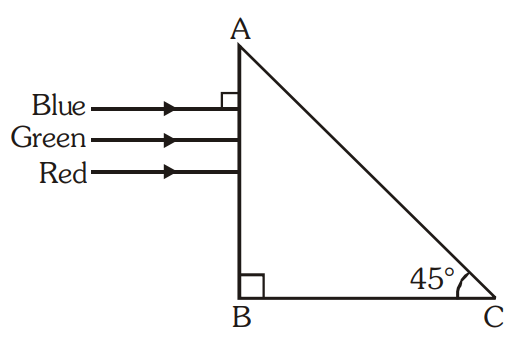 The prism will:Light falls on the hypotenuse face at $45^\circ$. Total internal reflection needs $\mu \ge \frac{1}{\sin45^\circ} = \sqrt2 \approx 1.414$.
$\mu_{green} = 1.44$ and $\mu_{blue} = 1.47$ exceed 1.414, so green and blue are totally internally reflected.
$\mu_{red} = 1.39 < 1.414$, so red is refracted out — the prism separates red from green and blue.
2011 AIPMT-PRE 1 question
-
Which of the following is not due to total internal reflection?Brilliance of diamond: its critical angle is very small (about $24.4^\circ$), so light entering it suffers repeated total internal reflections.
Optical fibre: light is guided along the fibre by repeated total internal reflection at the core–cladding boundary.
Mirage: light from an object is totally internally reflected at the hot, rarer air layers near the ground.
Apparent depth of a pond: light from the bottom simply bends away from the normal on passing from water to air, making the pond look shallower. This is ordinary refraction; no total internal reflection is involved.
Hence the difference between apparent and real depth of a pond is not due to total internal reflection.
2010 AIPMT-MAINS 1 question
-
The speed of light in media $M_1$ and $M_2$ is $1.5\times10^8$ m/s and $2.0\times10^8$ m/s respectively. A ray of light enters from medium $M_1$ to $M_2$ at an incidence angle i. If the ray suffers total internal reflection, the value of i isRefractive index $\mu = \frac{c}{v}$: $\mu_1 = \frac{3\times10^8}{1.5\times10^8} = 2$ and $\mu_2 = \frac{3\times10^8}{2.0\times10^8} = \frac{3}{2}$
Light goes from the denser medium $M_1$ to the rarer medium $M_2$, so total internal reflection is possible.
At the critical angle C: $\mu_1\sin C = \mu_2\sin90^\circ$
$\sin C = \frac{\mu_2}{\mu_1} = \frac{3/2}{2} = \frac{3}{4}$
For total internal reflection the angle of incidence must not be less than the critical angle: $\sin i \geq \frac{3}{4}$
$i \geq \sin^{-1}\left(\frac{3}{4}\right)$
2010 AIPMT-PRE 1 question
-
A ray of light travelling in a transparent medium of refractive index $\mu$ falls on a surface separating the medium from air at an angle of incidence of $45^\circ$. For which of the following values of $\mu$ can the ray undergo total internal reflection?Total internal reflection occurs when the angle of incidence exceeds the critical angle C, where $\sin C = \frac{1}{\mu}$.
Condition: $i > C$, i.e., $\sin i > \sin C = \frac{1}{\mu}$
$\mu > \frac{1}{\sin45^\circ} = \sqrt{2}$
$\mu > 1.414$
Among the given values only 1.50 is greater than 1.414.
Hence $\mu = 1.50$.
2002 AIPMT 1 question
-
For the given incident ray as shown in figure, the condition of total internal reflection of this ray the minimum refractive index of prism will be : -
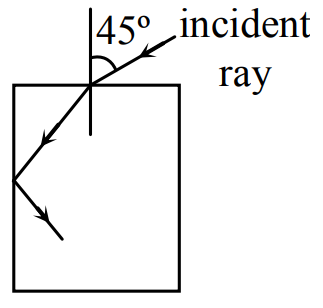 Let the ray refract at the top face with angle of refraction r. It then meets the vertical face at an angle of incidence $90^\circ - r$, because the two faces are perpendicular.
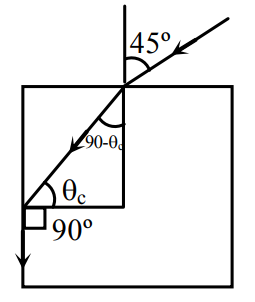
For the minimum refractive index, the ray just suffers total internal reflection at the side face: $90^\circ - r = \theta_c$, so $r = 90^\circ - \theta_c$.
Snell's law at the top face: $1 \cdot \sin 45^\circ = \mu\sin(90^\circ - \theta_c) = \mu\cos\theta_c$
Since $\sin\theta_c = \dfrac{1}{\mu}$: $\cos\theta_c = \dfrac{\sqrt{\mu^2 - 1}}{\mu}$, so $\mu\cos\theta_c = \sqrt{\mu^2 - 1}$
$\dfrac{1}{\sqrt{2}} = \sqrt{\mu^2 - 1} \Rightarrow \mu^2 = 1 + \dfrac{1}{2} = \dfrac{3}{2}$
$\Rightarrow \mu = \sqrt{\dfrac{3}{2}}$
Alternate (objective) method: for this arrangement $\mu = \sqrt{1 + \sin^2\theta}$, so $\mu = \sqrt{1 + \sin^2 45^\circ} = \sqrt{1 + \dfrac{1}{2}} = \sqrt{\dfrac{3}{2}}$.
2001 AIPMT 1 question
-
A disc is placed on a surface of pond which has refractive index $\dfrac{5}{3}$. A source of light is placed 4 m below the surface of liquid. The minimum radius of disc will be so light is not coming outLight from the source escapes only through a circle on the surface, within which the angle of incidence is less than the critical angle $\theta_c$. Beyond this circle, total internal reflection occurs.
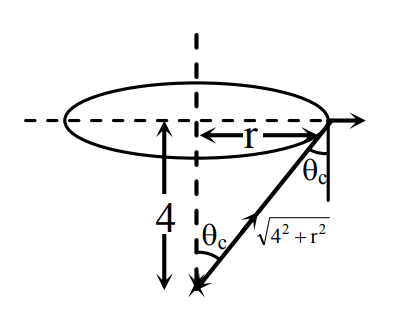
$\sin\theta_c = \dfrac{1}{\mu} = \dfrac{1}{5/3} = \dfrac{3}{5}$
From the geometry: $\sin\theta_c = \dfrac{r}{\sqrt{4^2 + r^2}}$
$\dfrac{r}{\sqrt{16 + r^2}} = \dfrac{3}{5} \Rightarrow 25r^2 = 9(16 + r^2) \Rightarrow 16r^2 = 144$
$r = 3$ m
So the disc must have a minimum radius of 3 m to block all the light.