Looking for classes? Ksquare Career Institute, Bengaluru →

Ray Optics and Optical Instruments
Refraction through a Prism
10 questions from 10 papers, each with its answer.
- questions
- 10
- papers
- 10
- years asked, 2017–2026
- 3 of 10
- of Ray Optics and Optical Instruments
- 11.24%
Appears in
Concepts tested
- Minimum deviation 2
- angle of emergence from a right-angled prism
- angle of incidence for normal emergence from a thin prism
- Dispersion without deviation
- Minimum deviation equal to prism angle
- Normal incidence on silvered face
- Refractive index from prism geometry
- Retracing of path from silvered prism face
- Small-angle prism
All Questions
2024 1 question
-
A light ray enters through a right angled prism at point $P$ with the angle of incidence $30^\circ$ as shown in figure. It travels through the prism parallel to its base $BC$ and emerges along the face $AC$. The refractive index of the prism is:
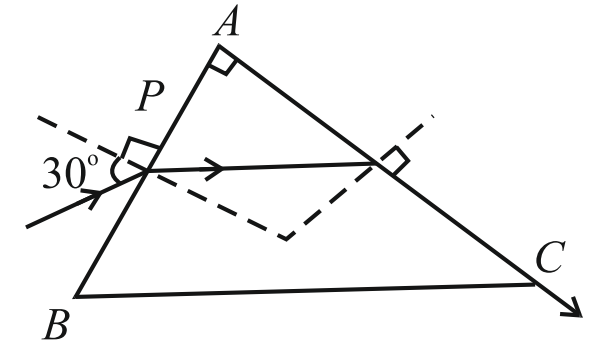 [add image: right-angled prism with the ray entering at P and travelling parallel to BC] Let $\theta$ be the angle of incidence at face AC. The ray just emerges along AC (critical condition): $\mu \sin\theta = 1 \Rightarrow \sin\theta = \frac{1}{\mu}$, so $\cos\theta = \frac{\sqrt{\mu^2 - 1}}{\mu}$ From the geometry, the angle of refraction at face AB is $(90^\circ - \theta)$. Snell's law at AB: $\sin 30^\circ = \mu \sin(90^\circ - \theta) = \mu\cos\theta$ $\frac{1}{2} = \mu \times \frac{\sqrt{\mu^2 - 1}}{\mu} = \sqrt{\mu^2 - 1}$ $\mu^2 = \frac{5}{4} \Rightarrow \mu = \frac{\sqrt{5}}{2}$
2021 1 question
-
Find the value of the angle of emergence from the prism. Refractive index of the glass is $\sqrt{3}$.
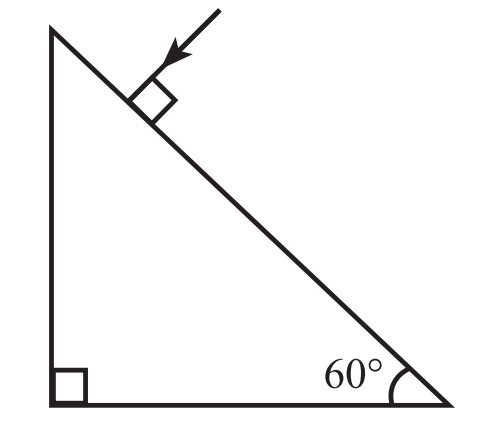 The ray enters normally, so $r_1 = 0^\circ$. Prism angle A = $30^\circ$, so $r_2 = A - r_1 = 30^\circ$.
Snell's law at the second face: $\sqrt{3}\sin 30^\circ = 1 \times \sin e$
$\sin e = \frac{\sqrt{3}}{2} \Rightarrow e = 60^\circ$
2020 1 question
-
A ray is incident at an angle of incidence $i$ on one surface of a small angle prism (with angle of prism $A$) and emerges normally from the opposite surface. If the refractive index of the material of the prism is $\mu$, then the angle of incidence is nearly equal to:The ray emerges normally from the second surface, so the angle of emergence e = 0 and $r_2 = 0$. $r_1 + r_2 = A \Rightarrow r_1 = A$ Snell's law at the first surface: $1 \cdot \sin i = \mu\sin r_1 = \mu\sin A$ For small angles ($\sin\theta \approx \theta$): $i = \mu A$
2015 AIPMT-I 1 question
-
The refracting angle of a prism is A, and refractive index of the material of the prism is $\cot(A/2)$. The angle of minimum deviation is$\mu = \frac{\sin\left(\frac{A + \delta_m}{2}\right)}{\sin\left(\frac{A}{2}\right)} = \cot\frac{A}{2} = \frac{\cos\frac{A}{2}}{\sin\frac{A}{2}}$
$\sin\left(\frac{A + \delta_m}{2}\right) = \cos\frac{A}{2} = \sin\left(90^\circ - \frac{A}{2}\right)$
$\frac{A + \delta_m}{2} = 90^\circ - \frac{A}{2}$
$\delta_m = 180^\circ - 2A$
2014 AIPMT 1 question
-
The angle of a prism is 'A'. One of its refracting surfaces is silvered. Light rays falling at an angle of incidence 2A on the first surface returns back through the same path after suffering reflection at the silvered surface. The refractive index $\mu$, of the prism is:
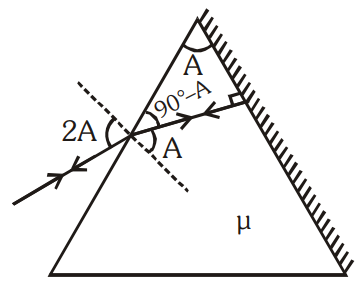
For the ray to retrace its path it must hit the silvered face normally, so the angle of refraction at the first face is A.
Snell's law: $(1)\sin 2A = \mu\sin A \Rightarrow \mu = 2\cos A$
2012 AIPMT-MAINS 1 question
-
For the angle of minimum deviation of a prism to be equal to its refracting angle, the prism must be made of a material whose refractive index$\mu = \frac{\sin\left(\frac{A + \delta_m}{2}\right)}{\sin\left(\frac{A}{2}\right)}$
With $\delta_m = A$: $\mu = \frac{\sin A}{\sin\frac{A}{2}} = \frac{2\sin\frac{A}{2}\cos\frac{A}{2}}{\sin\frac{A}{2}} = 2\cos\frac{A}{2}$
At minimum deviation $i = \frac{A + \delta_m}{2} = A$, and i must be less than $90^\circ$, so A lies between $0^\circ$ and $90^\circ$.
For A → $0^\circ$, $\mu$ → 2; for A = $90^\circ$, $\mu = 2\cos45^\circ = \sqrt2$.
So $\mu$ lies between 2 and $\sqrt2$.
2012 AIPMT-PRE 1 question
-
A ray of light is incident at an angle of incidence, i on one face of a prism of angle A (assumed to be small) and emerges normally from the opposite face. If the refractive index of the prism is $\mu$, the angle of incidence i, is nearly equal toThe ray emerges normally, so the angle of incidence at the second face $r_2 = 0$.
$r_1 + r_2 = A \Rightarrow r_1 = A$
Snell's law at the first face: $\sin i = \mu\sin r_1 = \mu\sin A$
For small angles $\sin i \approx i$ and $\sin A \approx A$, so $i \approx \mu A$
2011 AIPMT-MAINS 1 question
-
A thin prism of angle $15^\circ$ made of glass of refractive index $\mu_1 = 1.5$ is combined with another prism of glass of refractive index $\mu_2 = 1.75$. The combination of the prisms produces dispersion without deviation. The angle of the second prism should beDeviation produced by a thin prism: $\delta = (\mu - 1)A$
For dispersion without deviation, the two prisms are placed oppositely so that their deviations cancel: $\delta_1 = \delta_2$
$(\mu_1 - 1)A_1 = (\mu_2 - 1)A_2$
$(1.5 - 1)\times15^\circ = (1.75 - 1)\times A_2$
$7.5^\circ = 0.75A_2$
$A_2 = 10^\circ$
2010 AIPMT-MAINS 1 question
-
A ray of light is incident on a $60^\circ$ prism at the minimum deviation position. The angle of refraction at the first face (i.e., incident face) of the prism isFor a prism, $r_1 + r_2 = A$, where $r_1$ and $r_2$ are the angles of refraction at the two faces.
At minimum deviation the ray passes symmetrically through the prism: $r_1 = r_2 = r$
$2r = A$
$r = \frac{A}{2} = \frac{60^\circ}{2}$
$r = 30^\circ$
2004 AIPMT 1 question
-
The refractive index of the material of a prism is $\sqrt{2}$ and its refracting angle is $30^\circ$. One of the refracting surfaces of the prism is made a mirror inwards. A beam of monochromatic light entering the prism from the other face will retrace its path after reflection from the mirrored surface if its angle of incidence on the prism is :-For the ray to retrace its path after reflection, it must fall normally on the mirrored face, i.e. the angle of incidence at the mirrored face is $0^\circ$.
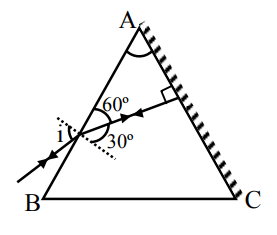
In a prism $r_1 + r_2 = A$. Here $r_2 = 0^\circ$, so the angle of refraction at the first face is $r_1 = A = 30^\circ$.
Applying Snell's law at the first face: $1 \cdot \sin i = \mu \sin 30^\circ$
$\sin i = \sqrt{2} \times \dfrac{1}{2} = \dfrac{1}{\sqrt{2}}$
$\Rightarrow i = 45^\circ$
So the angle of incidence on the prism must be $45^\circ$.