Looking for classes? Ksquare Career Institute, Bengaluru →

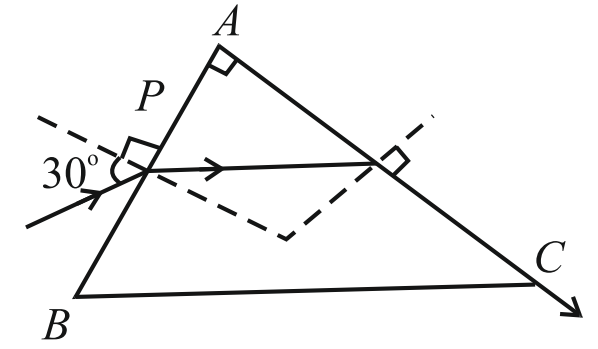
A light ray enters through a right angled prism at point $P$ with the angle of incidence $30^\circ$ as shown in figure. It travels through the prism parallel to its base $BC$ and emerges along the face $AC$. The refractive index of the prism is:
A
$\frac{\sqrt{3}}{4}$
B
$\frac{\sqrt{3}}{2}$
C
$\frac{\sqrt{5}}{4}$
D
$\frac{\sqrt{5}}{2}$
Detailed Solution
[add image: right-angled prism with the ray entering at P and travelling parallel to BC]
Let $\theta$ be the angle of incidence at face AC. The ray just emerges along AC (critical condition):
$\mu \sin\theta = 1 \Rightarrow \sin\theta = \frac{1}{\mu}$, so $\cos\theta = \frac{\sqrt{\mu^2 - 1}}{\mu}$
From the geometry, the angle of refraction at face AB is $(90^\circ - \theta)$. Snell's law at AB:
$\sin 30^\circ = \mu \sin(90^\circ - \theta) = \mu\cos\theta$
$\frac{1}{2} = \mu \times \frac{\sqrt{\mu^2 - 1}}{\mu} = \sqrt{\mu^2 - 1}$
$\mu^2 = \frac{5}{4} \Rightarrow \mu = \frac{\sqrt{5}}{2}$