Looking for classes? Ksquare Career Institute, Bengaluru →

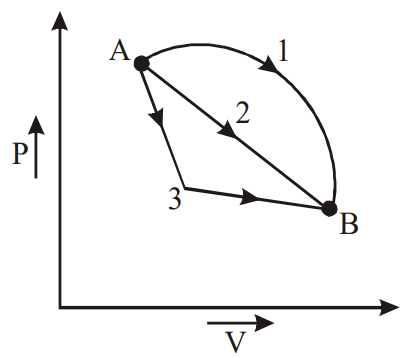
An ideal gas goes from state A to state B via three different processes as indicated in the P-V diagram. If $Q_1$, $Q_2$, $Q_3$ indicate the heat absorbed by the gas along the three processes and $\Delta U_1$, $\Delta U_2$, $\Delta U_3$ indicate the change in internal energy along the three processes respectively, then
A
$Q_3 > Q_2 > Q_1$ and $\Delta U_1 > \Delta U_2 > \Delta U_3$
B
$Q_1 > Q_2 > Q_3$ and $\Delta U_1 = \Delta U_2 = \Delta U_3$
C
$Q_3 > Q_2 > Q_1$ and $\Delta U_1 = \Delta U_2 = \Delta U_3$
D
$Q_1 = Q_2 = Q_3$ and $\Delta U_1 > \Delta U_2 > \Delta U_3$
Detailed Solution
Internal energy is a state function. All three processes have the same initial state A and final state B, so $\Delta U_1 = \Delta U_2 = \Delta U_3$.
Work done = area under the P–V curve. Path 1 lies highest and path 3 lowest, so $W_1 > W_2 > W_3$.
First law: $Q = \Delta U + W$; with equal $\Delta U$, $Q_1 > Q_2 > Q_3$.
Work done = area under the P–V curve. Path 1 lies highest and path 3 lowest, so $W_1 > W_2 > W_3$.
First law: $Q = \Delta U + W$; with equal $\Delta U$, $Q_1 > Q_2 > Q_3$.