Looking for classes? Ksquare Career Institute, Bengaluru →

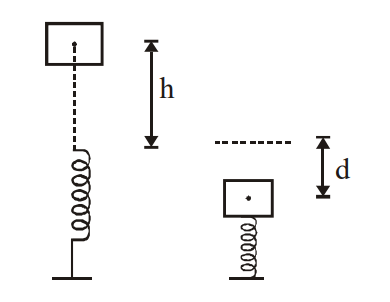
A vertical spring with force constant $k$ is fixed on a table. A ball of mass $m$ at a height $h$ above the free upper end of the spring falls vertically on the spring so that the spring is compressed by a distance $d$. The net work done in the process is
A
$mg(h + d) - \dfrac{1}{2}kd^2$
B
$mg(h - d) - \dfrac{1}{2}kd^2$
C
$mg(h - d) + \dfrac{1}{2}kd^2$
D
$mg(h + d) + \dfrac{1}{2}kd^2$
Detailed Solution
The ball falls through a total height $(h + d)$: $h$ before touching the spring and $d$ while compressing it.
Work done by gravity $= +mg(h + d)$
The spring force opposes the compression, so the work done by the spring force $= -\dfrac{1}{2}kd^2$
Net work done $= mg(h + d) - \dfrac{1}{2}kd^2$
The ball starts from rest and is momentarily at rest at maximum compression, so by the work-energy theorem this net work is zero: the gravitational potential energy lost by the ball gets converted into the elastic potential energy of the spring, $mg(h + d) = \dfrac{1}{2}kd^2$.
So the expression for the net work done is $mg(h + d) - \dfrac{1}{2}kd^2$.
Work done by gravity $= +mg(h + d)$
The spring force opposes the compression, so the work done by the spring force $= -\dfrac{1}{2}kd^2$
Net work done $= mg(h + d) - \dfrac{1}{2}kd^2$
The ball starts from rest and is momentarily at rest at maximum compression, so by the work-energy theorem this net work is zero: the gravitational potential energy lost by the ball gets converted into the elastic potential energy of the spring, $mg(h + d) = \dfrac{1}{2}kd^2$.
So the expression for the net work done is $mg(h + d) - \dfrac{1}{2}kd^2$.