Looking for classes? Ksquare Career Institute, Bengaluru →

Work, Energy and Power
Work-Energy Theorem
9 questions from 9 papers, each with its answer.
- questions
- 9
- papers
- 9
- years asked, 2017–2026
- 4 of 10
- of Work, Energy and Power
- 12.68%
Appears in
Concepts tested
- bullet penetrating a block
- Energy lost to friction
- Friction on half of an incline
- Stopping Distance and Braking Force
- Work by a variable force
- Work done by gravity and spring force
- Work from change in kinetic energy
- Work-energy theorem
- work-energy-theorem-air-resistance
All Questions
2025 1 question
-
The kinetic energies of two similar cars A and B are $100\text{ J}$ and $225\text{ J}$ respectively. On applying brakes, car A stops after $1000\text{ m}$ and car B stops after $1500\text{ m}$. If $F_A$ and $F_B$ are the forces applied by the brakes on cars A and B, respectively, then the ratio $F_A / F_B$ is:
From work-energy theorem, $F = \frac{KE}{s}$. Therefore, $F_A / F_B = \frac{100/1000}{225/1500} = \frac{0.10}{0.15} = \frac{2}{3}$.
According to the Work-Energy Theorem, work done by the braking force equals the change in kinetic energy: $W = F \cdot s = \Delta KE \implies F = \frac{KE}{s}$. For car A: $F_A = \frac{100\text{ J}}{1000\text{ m}} = 0.10\text{ N}$. For car B: $F_B = \frac{225\text{ J}}{1500\text{ m}} = 0.15\text{ N}$. The ratio is $\frac{F_A}{F_B} = \frac{0.10}{0.15} = \frac{2}{3}$.
2024 Re-NEET 1 question
-
An object moving along horizontal x-direction with kinetic energy 10 J is displaced through $x=(3\hat{i})$ m by the force $\vec{F}=(-2\hat{i}+3\hat{j})$ N. The kinetic energy of the object at the end of the displacement x isBy the work-energy theorem, $W=\Delta KE$. $W=\vec{F}\cdot\vec{x}=(-2\hat{i}+3\hat{j})\cdot(3\hat{i})=-6$ J. So $K_f-10=-6\Rightarrow K_f=4$ J.
2023 1 question
-
A bullet from a gun is fired on a rectangular wooden block with velocity $u$. When bullet travels $24\ cm$ through the block along its length horizontally, velocity of bullet becomes $\frac{u}{3}$. Then it further penetrates into the block in the same direction before coming to rest exactly at the other end of the block. The total length of the block is:
Work-energy theorem for both stages gives total length $d=24\times\frac{9}{8}=27\ cm$.
$\frac{1}{2}m\left(\frac{u}{3}\right)^2-\frac{1}{2}mu^2=-F_R\times24$ $0-\frac{1}{2}mu^2=-F_R\times d$ $\frac{\frac{1}{2}mu^2}{\frac{1}{2}mu^2\times\frac{8}{9}}=\frac{d}{24}$ $d=24\times\frac{9}{8}=27\ cm$
2017 1 question
-
Consider a drop of rain water having mass 1 g falling from a height of 1 km. It hits the ground with a speed of 50 m/s. Take g constant with a value 10 m/$s^2$. The work done by the (i) gravitational force and the (ii) resistive force of air is
$W_g = mgh = 10$ J; $W_a = \Delta K - W_g$.
$W_g + W_a = K_f - K_i$ $mgh + W_a = \frac{1}{2}mv^2 - 0$ $10^{-3}\times10\times10^{3} + W_a = \frac{1}{2}\times10^{-3}\times(50)^2$ $W_a = -8.75$ J, i.e. work done by air resistance is –8.75 J and work done by gravity is 10 J.
2015 AIPMT-I 1 question
-
A block of mass 10 kg, moving in x direction with a constant speed of 10 m$s^{-1}$, is subjected to a retarding force F = 0.1x J/m during its travel from x = 20 m to 30 m. Its final KE will beWork done by the retarding force: $W = -\int_{20}^{30} 0.1x\,dx = -0.1\left[\frac{x^2}{2}\right]_{20}^{30} = -0.05(900 - 400) = -25$ J
Initial KE $= \frac{1}{2}\times 10\times 10^2 = 500$ J
By the work-energy theorem, $KE_{final} = KE_{initial} + W = 500 - 25 = 475$ J
2013 NEET 1 question
-
The upper half of an inclined plane of inclination $\theta$ is perfectly smooth while lower half is rough. A block starting from rest at the top of the plane will again come to rest at the bottom, if the coefficient of friction between the block and lower half of the plane is given by:Let each half have length s. Work-energy theorem ($W = \Delta KE$):
$(mg\sin\theta)(2s) - (\mu mg\cos\theta)(s) = 0 - 0$
$\mu = 2\tan\theta$
2009 AIPMT 1 question
-
A body of mass 1 kg is thrown upwards with a velocity 20 m/s. It momentarily comes to rest after attaining a height of 18 m. How much energy is lost due to air friction? (g = 10 m/$s^2$)Initial kinetic energy: $K_i = \frac{1}{2}mu^2 = \frac{1}{2}\times1\times(20)^2 = 200$ J
At the highest point the body is at rest, so all its remaining energy is potential: $U = mgh = 1\times10\times18 = 180$ J
Energy lost due to air friction = initial energy − final energy
= 200 − 180
= 20 J
2007 AIPMT-PRE 1 question
-
A vertical spring with force constant $k$ is fixed on a table. A ball of mass $m$ at a height $h$ above the free upper end of the spring falls vertically on the spring so that the spring is compressed by a distance $d$. The net work done in the process isThe ball falls through a total height $(h + d)$: $h$ before touching the spring and $d$ while compressing it.
Work done by gravity $= +mg(h + d)$
The spring force opposes the compression, so the work done by the spring force $= -\dfrac{1}{2}kd^2$
Net work done $= mg(h + d) - \dfrac{1}{2}kd^2$
The ball starts from rest and is momentarily at rest at maximum compression, so by the work-energy theorem this net work is zero: the gravitational potential energy lost by the ball gets converted into the elastic potential energy of the spring, $mg(h + d) = \dfrac{1}{2}kd^2$.
So the expression for the net work done is $mg(h + d) - \dfrac{1}{2}kd^2$.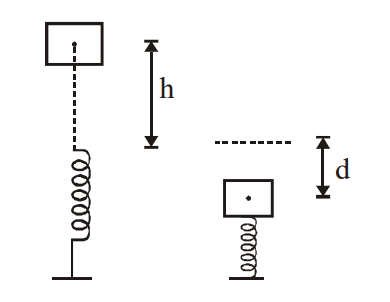
2006 AIPMT-PRE 1 question
-
A body of mass 3 kg is under a constant force which causes a displacement $s$ in metres in it, given by the relation $s = \dfrac{1}{3}t^2$, where $t$ is in seconds. Work done by the force in 2 seconds is :-By the work-energy theorem: $W = \Delta KE = \dfrac{1}{2}mv_2^2 - \dfrac{1}{2}mv_1^2$
Now $s = \dfrac{1}{3}t^2 \Rightarrow v = \dfrac{ds}{dt} = \dfrac{2}{3}t$
At $t = 0$: $v_1 = 0$
At $t = 2$ s: $v_2 = \dfrac{2}{3} \times 2 = \dfrac{4}{3}$ m s$^{-1}$
Therefore $W = \dfrac{1}{2} \times 3 \times \left(\dfrac{4}{3}\right)^2 - \dfrac{1}{2} \times 3 \times (0)^2$
$W = \dfrac{3}{2} \times \dfrac{16}{9} = \dfrac{8}{3}$ J
Check: $a = \dfrac{2}{3}$ m s$^{-2}$, $F = ma = 2$ N, $s = \dfrac{4}{3}$ m, so $W = Fs = \dfrac{8}{3}$ J.