Looking for classes? Ksquare Career Institute, Bengaluru →

Conservation of Mechanical Energy
Appears in
Concepts tested here
- Pendulum speed at lowest point
- Speed at lowest point of swing
- Speed depends only on height
All Questions
2001 AIPMT 1 question
-
A child is sitting on a swing. Its minimum and maximum heights from the ground are 0.75 m and 2 m respectively, its maximum speed will beAt the highest point the swing momentarily stops; at the lowest point the speed is maximum.
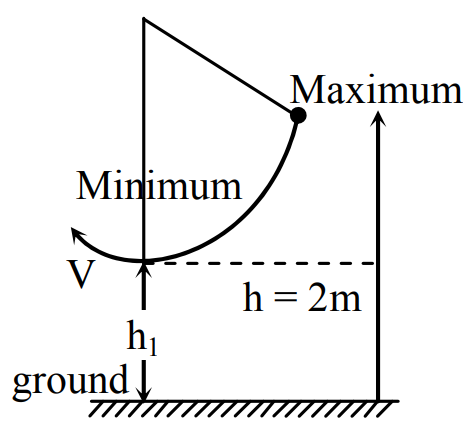
Apply conservation of mechanical energy between the maximum and minimum points:
$mgh = mgh_1 + \dfrac{1}{2}mV^2$
$V = \sqrt{2g(h - h_1)} = \sqrt{2 \times 10 \times (2 - 0.75)} = \sqrt{25}$
$V = 5$ m/s
2000 AIPMT 2 questions
-
A man is slipping on a frictionless inclined plane and a bag falls down from the same height. Then the speed of both is related as :On a frictionless incline only gravity does work (the normal force does no work).
By conservation of energy, for both the man and the bag: $mgh = \dfrac{1}{2}mv^2 \Rightarrow v = \sqrt{2gh}$
The speed depends only on the height fallen, not on the path or the mass. (The times taken are different.)
So $V_B = V_m$. -
The bob of simple pendulum having length l, is displaced from mean position to an angular position $\theta$ with respect to vertical. If it is released, then velocity of bob at lowest position :At angle $\theta$, the bob is at height $h = l - l\cos\theta = l(1 - \cos\theta)$ above the lowest point.
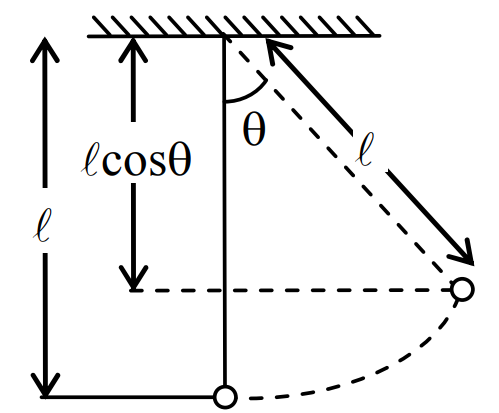
Potential energy at the extreme position = kinetic energy at the mean position:
$mgl(1 - \cos\theta) = \dfrac{1}{2}mv^2$
$v = \sqrt{2gl(1 - \cos\theta)}$