2025 Electromagnetic InductionInductors in DC Circuits Easy Question 5 of 40 in Electromagnetic Induction

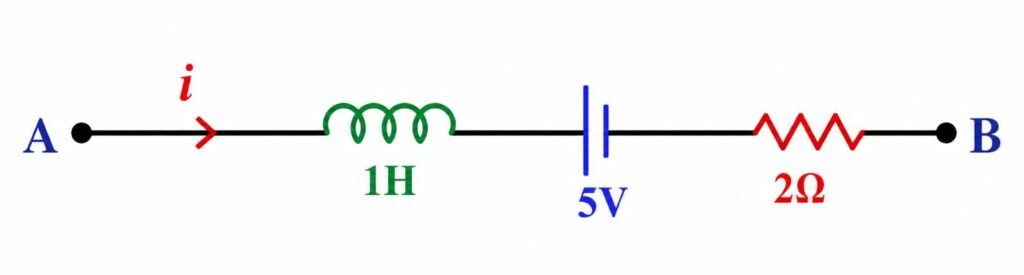
AB is a part of an electrical circuit with elements from A to B: inductor ($L = 1\text{ H}$), DC battery of $5\text{ V}$ with positive terminal towards A, and resistor ($R = 2\,\Omega$). The potential difference $V_A - V_B$ at the instant when current $i = 2\text{ A}$ is directed from A to B and is increasing at a rate of $1\text{ amp/second}$ is:
A 5 volt
B 6 volt
C 9 volt
D 10 volt

The answer is D.

Solution

Applying Kirchhoff's voltage rule from A to B: $V_A - L \frac{di}{dt} - 5 - iR = V_B$, wait, in the diagram the battery has + on A side, so $V_A - V_B = 1 + 5 + 4 = 10\text{ V}$.

Writing the potential equation from A to B along the direction of current: $V_A - L\frac{di}{dt} - V_{battery} - iR = V_B \implies V_A - V_B = L\frac{di}{dt} + V_{battery} + iR$. Given $L = 1\text{ H}$, $\frac{di}{dt} = 1\text{ A/s}$, $V_{battery} = 5\text{ V}$, $i = 2\text{ A}$, and $R = 2\,\Omega$: $V_A - V_B = (1)(1) + 5 + (2)(2) = 1 + 5 + 4 = 10\text{ V}$.

Concept Potential Difference in Inductive Branch

Electromagnetic Induction in past papers

40 questions from this chapter have appeared across 23 exam years.
