Solution

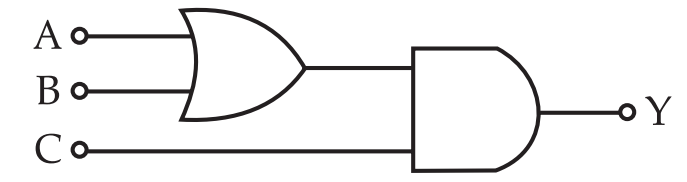
Y = (A + B)·C, so C must be 1 and at least one of A, B must be 1.


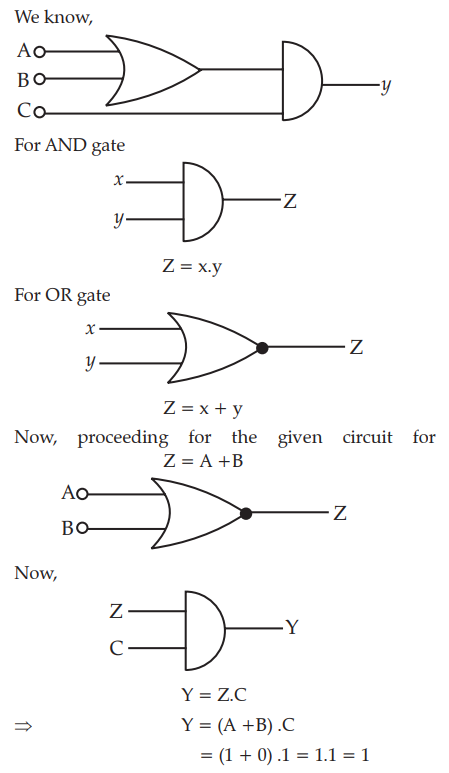
For an AND gate, Z = x·y; for an OR gate, Z = x + y.
For the given circuit, Z = A + B, and Y = Z·C = (A + B)·C.
Checking the options: A = 1, B = 0, C = 0 gives (1 + 0)·0 = 0; A = 1, B = 1, C = 0 gives 0; A = 1, B = 0, C = 1 gives (1 + 0)·1 = 1; A = 0, B = 1, C = 0 gives 0.
So the output is 1 for A = 1, B = 0, C = 1.

Concept logic-gate-or-and-truth-table

Semiconductor Electronics in past papers

12 questions from this chapter have appeared across 3 exam years.