Looking for classes? Ksquare Career Institute, Bengaluru →

Physics
Semiconductor Electronics: Materials, Devices and Simple Circuits
106 questions from 34 papers, each with its answer.
- 106 questions
- 34 papers
- 6.01% of Physics
Logic Gates
-
The figure shows a logic circuit with two inputs A and B and the output C. The voltage wave forms across A, B and C are as given. The logic circuit gate is
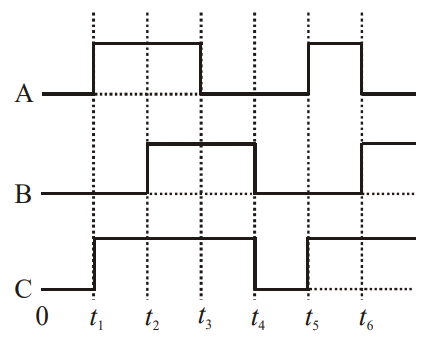 Reading the waveforms gives the truth table (A, B → C): 0, 0 → 0; 1, 0 → 1; 0, 1 → 1; 1, 1 → 1
The output is 1 whenever at least one input is 1, which is the truth table of an OR gate.
p-n junction diode
-
Two ideal diodes are connected to a battery as shown in the circuit. The current supplied by the battery is
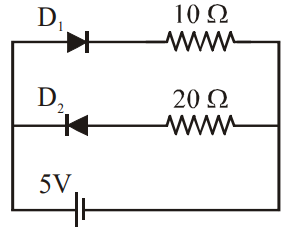 $D_1$ (in series with 10 $\Omega$) is forward biased and conducts; being ideal it has zero resistance.
$D_2$ (in series with 20 $\Omega$) is reverse biased and does not conduct.
So current flows only through the 10 $\Omega$ branch: $i = \frac{5}{10} = 0.5$ A
Transistor as an amplifier
-
In a CE transistor amplifier, the audio signal voltage across the collector resistance of 2 k$\Omega$ is 2 V. If the base resistance is 1 k$\Omega$ and the current amplification of the transistor is 100, the input signal voltage isVoltage gain $A_V = \frac{V_o}{V_i} = \beta\frac{R_C}{R_B}$
$\frac{2}{V_i} = 100\times\frac{2\times10^3}{1\times10^3} = 200$
$V_i = \frac{2}{200} = 0.01$ V = 10 mV
Transistor as a switch
-
Transfer characteristics [output voltage ($V_0$) vs input voltage ($V_i$)] for a base biased transistor in CE configuration is as shown in the figure. For using transistor as a switch, it is used
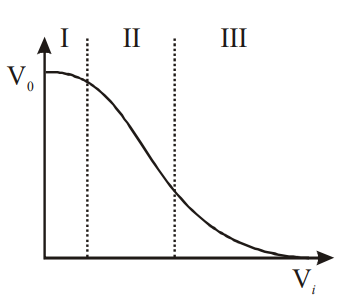 Region I is the cut-off region (transistor OFF, output high) and region III is the saturation region (transistor ON, output low).
Region II is the active region, used for amplification.
A switch is operated between the OFF and ON states, so the transistor is used in both region I and region III.
Energy bands in solids
-
C and Si both have same lattice structure, having 4 bonding electrons in each. However, C is insulator whereas Si is intrinsic semiconductor. This is becauseCarbon: $1s^22s^22p^2$ — the four bonding electrons are in the second orbit. Silicon: $1s^22s^22p^63s^23p^2$ — they are in the third orbit.
Electrons in the third orbit are farther from the nucleus and less tightly bound, so the energy needed to free them (the band gap) is much smaller for Si (about 1.1 eV) than for C (about 5.4 eV).
So C is an insulator while Si is an intrinsic semiconductor.
That is every question in Semiconductor Electronics: Materials, Devices and Simple Circuits for this filter.
Want a score?
Answers here are not saved. Practise as a test to be marked and see your progress.
Practise as a test