Looking for classes? Ksquare Career Institute, Bengaluru →

Wave Optics
Polarisation by Reflection - Brewster's Law
2 questions from 2 papers, each with its answer.
- questions
- 2
- papers
- 2
- years asked, 2017–2026
- 2 of 10
- of Wave Optics
- 5%
All Questions
2025 1 question
-
An unpolarized light beam travelling in air is incident on a medium of refractive index $1.73$ at Brewster's angle. Then-
At Brewster's angle, $\tan\theta_B = \mu = 1.73 \approx \sqrt{3} \implies \theta_B \approx 60^\circ$. Reflected light is completely plane-polarized with angle of reflection equal to $60^\circ$.
According to Brewster's law, when light is incident at Brewster's polarizing angle $\theta_B$: $\tan\theta_B = \mu = 1.73 \approx \sqrt{3} \implies \theta_B = 60^\circ$. By the law of reflection, the angle of reflection is equal to the angle of incidence, i.e., $60^\circ$. At this angle, the reflected light is completely linearly polarized with vibrations perpendicular to the plane of incidence, whereas the transmitted/refracted beam is only partially polarized.
2018 1 question
-
Unpolarised light is incident from air on a plane surface of a material of refractive index '$\mu$'. At a particular angle of incidence 'i', it is found that the reflected and refracted rays are perpendicular to each other. Which of the following options is correct for this situation?
At Brewster's angle ($\tan i = \mu$) the reflected light is plane-polarised perpendicular to the plane of incidence.
When reflected light rays and refracted rays are perpendicular, reflected light is polarised with its electric field vector perpendicular to the plane of incidence.
Also, $\tan i = \mu$ (Brewster angle).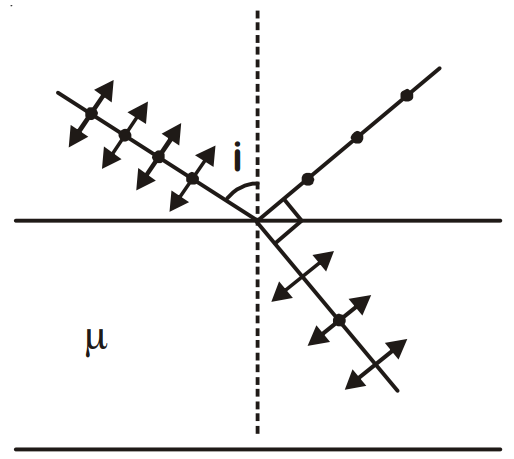
So the reflected light is polarised with its electric vector perpendicular to the plane of incidence.