Looking for classes? Ksquare Career Institute, Bengaluru →

Biology
Biological Classification
117 questions from 36 papers, each with its answer.
- 117 questions
- 36 papers
- 3.32% of Biology
Topics in this chapter
Most asked
Squares are the last ten exam years: filled means it was asked that year.
- 1Kingdom Fungi13 questionsPractise Kingdom Fungi
- 2Kingdom Monera11 questionsPractise Kingdom Monera
- 3Viruses9 questionsPractise Viruses
- 4Viruses, viroids and prions6 questionsPractise Viruses, viroids and prions
- 5Five Kingdom Classification5 questionsPractise Five Kingdom Classification
All topics
In syllabus order. Each goes to its questions below.
- 1. Cyanobacteria and Nitrogen Fixation 1 question
- 2. Five Kingdom Classification 5 questions
- 3. Criteria for Classification of Fungi 1 question
- 4. Common Names of Fungal Genera 1 question
- 5. Characteristic Features of Phaeophyceae (Brown Algae) 1 question
- 6. Kingdom Monera 11 questions
- 7. Kingdom Fungi – Reproduction 1 question
- 8. Viruses, Viroids and Lichens 1 question
- 9. Viruses, Viroids, Prions and Lichens 1 question
- 10. Kingdom Fungi 13 questions
- 11. Kingdom Fungi – Modes of Nutrition and Symbiotic Associations 1 question
- 12. Five Kingdom classification criteria (Whittaker) 1 question
- 13. Modes of nutrition in Protista/Monera 1 question
- 14. Cyanobacteria (blue-green algae) 1 question
- 15. Prokaryotic cell inclusions 1 question
- 16. Pigments in algae 1 question
- 17. Mycoplasma (PPLO) 1 question
- 18. Viruses, viroids and prions 6 questions
- 19. Lichens 4 questions
- 20. Kingdom Monera - archaebacteria 3 questions
- 21. Bacteria - shapes 1 question
- 22. Sexual reproduction in fungi 1 question
- 23. Prokaryotes vs eukaryotes – Monera and Fungi 1 question
- 24. Kingdom Protista – protozoans 1 question
- 25. Kingdom Fungi – basidiomycetes 1 question
- 26. Kingdom Protista – ciliated protozoans 1 question
- 27. Kingdom Protista – chrysophytes (diatoms) 1 question
- 28. Kingdom Monera – mycoplasma 2 questions
- 29. Viruses and viroids 2 questions
- 30. Kingdom Protista 5 questions
- 31. Kingdom Monera – archaebacteria (methanogens) 1 question
- 32. Kingdom Monera – eubacteria 1 question
- 33. Kingdom Fungi – cell wall 1 question
- 34. Viroids 1 question
- 35. Kingdom Fungi – characteristics 1 question
- 36. Archaebacteria – methanogens 1 question
- 37. Chrysophytes – diatoms 1 question
- 38. Archaebacteria 5 questions
- 39. Photosynthetic bacteria 1 question
- 40. Viruses 9 questions
- 41. Classification of organisms 1 question
- 42. Modes of nutrition 1 question
- 43. Mixed categorisation 1 question
- 44. Fungi 1 question
- 45. Plant diseases 1 question
- 46. Three Domain System 1 question
- 47. Kingdom Protista: Slime Moulds 1 question
- 48. Kingdom Monera: Bacteria 1 question
- 49. Diversity of Living Organisms 1 question
- 50. Diatoms and Cyanobacteria 1 question
- 51. Kingdom Protista: Ciliates 1 question
- 52. Kingdom Monera: Extremophiles 1 question
- 53. Viruses: Bacteriophages 1 question
- 54. Kingdom Protista: Amoeba 1 question
- 55. Viruses: Tobacco Mosaic Virus 1 question
- 56. Fungi: Mycorrhiza 1 question
- 57. Kingdom Monera: Modes of Nutrition 1 question
- 58. Kingdom Fungi: Plant Diseases 2 questions
- 59. Modes of Nutrition in Bacteria 1 question
- 60. Viruses: Genetic Material 1 question
- 61. Kingdom Monera: Cyanobacteria 1 question
- 62. Kingdom Fungi: Parasitic Fungi 1 question
Cyanobacteria and Nitrogen Fixation
-
Which of following organisms cannot fix nitrogen?
A. Azotobacter
B. Oscillatoria
C. Anabaena
D. Volvox
E. Nostoc
Choose the correct answer from the options given below:Volvox is a green alga (chlorophyte) and cannot fix nitrogen.
Azotobacter, Oscillatoria, Anabaena, and Nostoc are diazotrophs (bacteria/cyanobacteria capable of nitrogen fixation). Volvox is a colonial green alga (eukaryote) that cannot fix atmospheric nitrogen.
Five Kingdom Classification
-
Each of the following characteristics represent a Kingdom proposed by Whittaker. Arrange the following in increasing order of complexity of body organization.
A. Multicellular heterotrophs with cell wall made of chitin.
B. Heterotrophs with tissue/organ/organ system level of body organization.
C. Prokaryotes with cell wall made of polysaccharides and amino acids.
D. Eukaryotic autotrophs with tissue/organ level of body organization.
E. Eukaryotes with cellular body organization.
Choose the correct answer from the options given below:Order of complexity: Monera (C) -> Protista (E) -> Fungi (A) -> Plantae (D) -> Animalia (B).
In Whittaker's five-kingdom classification, organization complexity increases from: C (Monera, unicellular prokaryote) \rightarrow E (Protista, unicellular eukaryote) \rightarrow A (Fungi, multicellular loose mycelium) \rightarrow D (Plantae, tissue/organ autotrophs) \rightarrow B (Animalia, tissue/organ/organ-system heterotrophs). -
Pick up the wrong statement:
-
Five kingdom system of classification suggested by R.H. Whittaker is not based on:Whittaker's criteria were cell structure, body (thallus) organisation, mode of nutrition, reproduction and phylogenetic relationships.
Presence or absence of a well defined nucleus was not listed as a separate criterion. -
In the five-kingdom classification, $Chlamydomonas$ and $Chlorella$ have been included inIn Whittaker's five-kingdom classification, all unicellular eukaryotic organisms are placed in the kingdom Protista.
$Chlamydomonas$ and $Chlorella$ are unicellular, eukaryotic green algae, so in this system they were brought together with $Paramoecium$ and $Amoeba$ under Protista (NCERT states this directly).
Monera contains only prokaryotes (bacteria and cyanobacteria), so it cannot include these eukaryotic cells.
Plantae contains multicellular, eukaryotic, chlorophyll-bearing organisms; 'Algae' is not a kingdom in the five-kingdom system.
Hence $Chlamydomonas$ and $Chlorella$ are included in Protista. -
In five kingdom system, the main basis of classification : -R. H. Whittaker (1969) proposed the five kingdom classification: Monera, Protista, Fungi, Plantae and Animalia.
His criteria were cell structure (prokaryotic or eukaryotic), body organisation (unicellular or multicellular), mode of nutrition, reproduction and phylogenetic relationships.
Among these, the mode of nutrition is the main basis that separates the three multicellular kingdoms: Plantae (autotrophic, photosynthetic), Fungi (heterotrophic, absorptive) and Animalia (heterotrophic, ingestive).
So, as per the answer key, the main basis of the five kingdom system is nutrition.
Criteria for Classification of Fungi
-
Which one of the following is not a criterion for classification of fungi?The morphology of the mycelium, mode of spore formation and fruiting bodies form the basis for dividing the kingdom Fungi into various classes. Mode of nutrition is not a criterion for the classification of fungi.
Common Names of Fungal Genera
-
Match List I with List II regarding fungal genera and their common names.
Pick the matching item from Column II for each row.
Column I
- A. $Rhizopus$
- B. $Ustilago$
- C. $Puccinia$
- D. $Agaricus$
Column II
- I. Mushroom
- II. Smut fungus
- III. Bread mould
- IV. Rust fungus
Correct answer: A → III, B → II, C → IV, D → I
$Rhizopus$ – bread mould $Ustilago$ – smut fungus $Puccinia$ – rust fungus $Agaricus$ – mushroom Correct match: A-III, B-II, C-IV, D-I.
Characteristic Features of Phaeophyceae (Brown Algae)
-
Read the following statements and choose the set of correct statements. In the members of Phaeophyceae. A. Asexual reproduction occurs usually by biflagellate zoospores. B. Sexual reproduction is by oogamous method only. C. Stored food is in the form of carbohydrates which is either mannitol or laminarin D. The major pigments found are chlorophyll a, c and carotenoids and xanthophyll. E. Vegetative cells have a cellulosic wall, usually covered on the outside by gelatinous coating of algin. Choose the correct answer front the options given below:A. Asexual reproduction in Phaeophyceae is usually by biflagellate zoospores – correct. B. Sexual reproduction may be isogamous, anisogamous or oogamous, not oogamous only – incorrect. C. Stored food is complex carbohydrates – mannitol or laminarin – correct. D. Major pigments are chlorophyll a, c, carotenoids and xanthophylls (fucoxanthin) – correct. E. Vegetative cells have a cellulosic wall usually covered on the outside by a gelatinous coating of algin – correct. So A, C, D and E only are correct.
Kingdom Monera
-
Which of the following is not a prokaryote?Reference: NCERT Class XI, pages 13, 14, 16.
-
Which of the following is a correct statement?
-
Cell wall is absent in:
-
Maximum nutritional diversity is found in the groupBacteria (Monera) show the most extensive metabolic diversity.
They may be photosynthetic autotrophs, chemosynthetic autotrophs or heterotrophs (saprophytes, parasites, symbionts).
Plants are mostly autotrophic, and fungi and animals are heterotrophic. -
The most abundant prokaryotes helpful to humans in making curd from milk and in production of antibiotics are the ones categorised asHeterotrophic bacteria are the most abundant in nature; most are important decomposers.
They are helpful in making curd from milk, producing antibiotics and fixing nitrogen in legume roots. -
Nuclear membrane is absent inNostoc is a cyanobacterium, a prokaryote; its genetic material is not enclosed by a nuclear membrane.
Penicillium and Agaricus (fungi) and Volvox (alga) are eukaryotes with a nuclear membrane. -
The cyanobacteria are also referred to asCyanobacteria have chlorophyll a like green plants and are photosynthetic autotrophs; they are also called blue-green algae.
Golden algae are chrysophytes, which are protists. -
Select the correct combination of the statements (a–d) regarding the characteristics of certain organisms.
(a) Methanogens are Archaebacteria which produce methane in marshy areas
(b) $Nostoc$ is a filamentous blue-green alga which fixes atmospheric nitrogen
(c) Chemosynthetic autotrophic bacteria synthesize cellulose from glucose
(d) $Mycoplasma$ lack a cell wall and can survive without oxygen
The correct statements are(a) is correct: methanogens are archaebacteria; they live in marshy areas and in the gut of ruminants and produce methane.
(b) is correct: $Nostoc$ is a filamentous cyanobacterium (blue-green alga) that fixes atmospheric nitrogen in specialised cells called heterocysts.
(c) is wrong: chemosynthetic autotrophic bacteria oxidise inorganic substances such as nitrites, nitrates and ammonia and use the released energy for ATP production; they play a great role in recycling nutrients like nitrogen, phosphorus, iron and sulphur. They do not synthesise cellulose from glucose.
(d) is correct: mycoplasmas completely lack a cell wall, are the smallest living cells known and can survive without oxygen.
Hence the correct statements are (a), (b) and (d). -
Some hyperthermophilic organisms that grow in highly acidic (pH 2) habitats belong to the two groupsHyperthermophiles grow at very high temperatures, and those that also tolerate a pH of about 2 are thermoacidophiles; they live in hot sulphur springs.
Such extreme habitats can be colonised only by prokaryotes.
Most thermoacidophiles are archaebacteria (archaea), e.g., $Sulfolobus$ and $Thermoplasma$; their special cell wall and branched-chain membrane lipids let them survive.
A few eubacteria (some thermophilic bacteria of hot springs) can also grow under such conditions.
Liverworts, mosses, yeasts, diatoms and protists are eukaryotes that cannot survive in such habitats.
Hence the two groups are eubacteria and archaea. -
Oxygenic photosynthesis occurs inIn oxygenic photosynthesis water is the hydrogen donor and oxygen is released: $6CO_2 + 12H_2O \rightarrow C_6H_{12}O_6 + 6H_2O + 6O_2$
Among prokaryotes it occurs only in cyanobacteria, which have chlorophyll a and both photosystems, like green plants.
$Oscillatoria$ is a cyanobacterium (blue-green alga).
$Chlorobium$ (green sulphur bacterium), $Chromatium$ (purple sulphur bacterium) and $Rhodospirillum$ (purple non-sulphur bacterium) carry out anoxygenic photosynthesis: they use $H_2S$ or organic compounds as the hydrogen donor and do not release oxygen.
Hence oxygenic photosynthesis occurs in $Oscillatoria$. -
In which kingdom would you classify the archaea and nitrogen-fixing organism, if the five-kingdom system of classification is used :In Whittaker's five-kingdom system, kingdom Monera includes all prokaryotes (organisms without a true nucleus and membrane-bound organelles).
Archaebacteria (archaea), such as methanogens, halophiles and thermoacidophiles, are prokaryotes.
Nitrogen-fixing organisms such as Rhizobium, Azotobacter and cyanobacteria (Nostoc, Anabaena) are also prokaryotes.
So both are classified in kingdom Monera.
Kingdom Fungi – Reproduction
-
Which of the following statements is correct?
Viruses, Viroids and Lichens
-
Which of the following is correct about viroids?Viroids are infectious agents consisting of free RNA without a protein coat (found by T.O. Diener, causing potato spindle tuber disease).
Viruses, Viroids, Prions and Lichens
-
Which of the following statements is incorrect?
Kingdom Fungi
-
Which of the following statements is incorrect?
-
Which one of the following matches is correct?Alternaria is a deuteromycete (imperfect fungus) in which sexual reproduction is absent.
Phytophthora belongs to Phycomycetes; its mycelium is aseptate.
Mucor belongs to Zygomycetes; it reproduces by conjugation.
Agaricus belongs to Basidiomycetes; it is saprotrophic, not parasitic. -
Choose the wrong statement:
-
The imperfect fungi which are decomposers of litter and help in mineral cycling belong to:
-
Which one of the following fungi contains hallucinogens?Amanita muscaria (fly agaric) is a poisonous mushroom that contains hallucinogenic compounds.
Morchella is an edible morel, Neurospora is used in genetics and Ustilago causes smut. -
The pathogen $Microsporum$ responsible for ringworm disease in humans belongs to the same Kingdom of organisms as that ofRingworm is caused by fungi of the genera $Microsporum$, $Trichophyton$ and $Epidermophyton$.
So $Microsporum$ belongs to the Kingdom Fungi.
$Rhizopus$, the bread mould, is also a fungus (a phycomycete).
$Ascaris$, $Taenia$ and $Wuchereria$ are helminths belonging to Kingdom Animalia.
Hence $Microsporum$ belongs to the same kingdom as $Rhizopus$. -
Black (stem) rust of wheat is caused byRust diseases are caused by basidiomycete fungi of the genus $Puccinia$.
$Puccinia\ graminis\ tritici$ causes black (stem) rust of wheat.
$Alternaria\ solani$ causes early blight of potato.
$Ustilago\ nuda$ causes loose smut of wheat and barley.
$Xanthomonas\ oryzae$ is a bacterium that causes bacterial blight of rice.
Hence black rust of wheat is caused by $Puccinia\ graminis$. -
Cellulose is the major component of cell walls of :The cell wall of true fungi is made of chitin (fungal cellulose) and other polysaccharides.
Pythium belongs to the Oomycetes (water moulds), a group traditionally placed in Phycomycetes. Unlike other fungi, the cell wall of oomycetes is mainly made of cellulose and glucans, with little or no chitin.
Pythium causes the damping-off disease of seedlings.
Saccharomyces (yeast) is an ascomycete fungus; its cell wall has glucans, mannans and chitin, not cellulose.
Pseudomonas and Xanthomonas are bacteria; their cell walls are made of peptidoglycan (murein).
So cellulose is the major component of the cell wall of Pythium. -
Which pair of the following belongs to BasidiomycetesThe class Basidiomycetes includes those fungi that produce their basidia and basidiospores on or in a fruiting body called the basidiocarp.
Commonly known forms are mushrooms, bracket fungi, puffballs, stinkhorns and bird's nest fungi; rusts and smuts also belong here.
Bird's nest fungi and puffballs are both basidiomycetes, so this pair is correct.
Claviceps, Peziza and Morchella are members of Ascomycetes (sac fungi), which produce ascospores inside asci.
So every other pair contains one ascomycete: puffballs with Claviceps, Peziza with stinkhorns, and Morchella with mushrooms.
The pair belonging to Basidiomycetes is bird's nest fungi and puffballs. -
Ergot of rye is caused by a species of
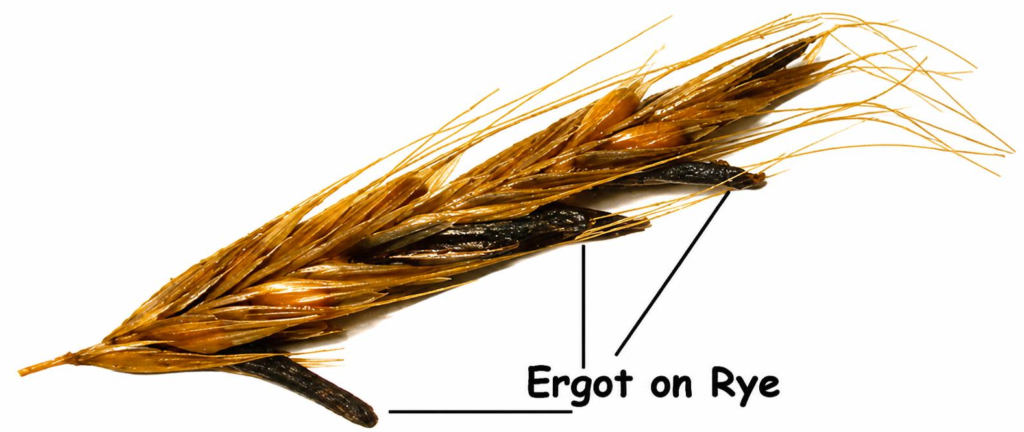
Ergot of rye is a plant disease caused by the fungus Claviceps purpurea, a member of Ascomycetes.
The fungus infects the ovaries of the rye flowers. The so-called ergot that replaces the grain of the rye is a dark, purplish sclerotium, from which the sexual stage of the life cycle forms after overwintering.
The sclerotia contain poisonous alkaloids; eating bread made from infected grain causes the disease ergotism. The hallucinogenic drug LSD is also derived from ergot alkaloids.
Uncinula causes powdery mildew of grapes.
Ustilago causes smut diseases of cereals.
Phytophthora infestans causes late blight of potato.
So ergot of rye is caused by a species of Claviceps. -
Which of the following environmental conditions are essential for optimum growth of Mucor on a piece of bread ?
A. Temperature of about $25^\circ C$
B. Temperature of about $5^\circ C$
C. Relative humidity of about 5%
D. Relative humidity of about 95%
E. A shady place
F. A brightly illuminated place
Choose the answer from the following optionsMucor is a saprophytic fungus (a mould of the class Phycomycetes) that grows on moist, stale bread and other decaying organic matter.
Temperature: fungi grow best at moderately warm temperatures of about 25 to $30^\circ C$. At about $5^\circ C$ (refrigerator temperature) growth is very slow, which is why food is preserved in a refrigerator. So A is required, not B.
Humidity: fungi need plenty of moisture for the germination of spores and the growth of hyphae, so a high relative humidity of about 95 percent is required. At 5 percent humidity the bread would dry up and the fungus would not grow. So D is required, not C.
Light: fungi have no chlorophyll and do not need light; bright light and the accompanying dryness are unfavourable, so they grow best in a shady or dark place. So E is required, not F.
So the essential conditions are A, D and E only. -
Which of the following secretes toxins during storage conditions of crop plants : -During storage of grains and seeds in warm, humid conditions, the mould Aspergillus flavus grows on groundnut, maize and other crops.
It secretes aflatoxins, which are highly toxic and carcinogenic (they damage the liver and cause liver cancer) to humans and animals.
Penicillium spoils stored fruits and is known for antibiotics, while Fusarium and Colletotrichum are mainly field pathogens.
So Aspergillus secretes toxins during storage of crop plants. -
Stored food in fungi :Fungi store their reserve food as glycogen (and oil droplets), like animals.
Chitin is a structural component of their cell walls, not a food reserve. Starch is the reserve food of green plants.
So the stored food in fungi is glycogen.
Kingdom Fungi – Modes of Nutrition and Symbiotic Associations
-
Match Column-I with Column-II.
Pick the matching item from Column II for each row.
Column I
- A. Saprophyte
- B. Parasite
- C. Lichens
- D. Mycorrhiza
Column II
- I. Symbiotic association of fungi with plant roots
- II. Decomposition of dead organic materials
- III. Living on living plants or animals
- IV. Symbiotic association of algae and fungi
Correct answer: A → II, B → III, C → IV, D → I
Five Kingdom classification criteria (Whittaker)
-
The main criteria used for Five Kingdom Classification proposed by R.H. Whittaker (1969) included: I. Cell structure II. Body organization III. Presence of flagellum IV. Reproduction V. Phylogenetic relationships Choose the CORRECT answer from the options given below:
Modes of nutrition in Protista/Monera
-
Match List-I (Organisms) with List-II (Mode of Nutrition) and choose the correct answer from the options given below:
Pick the matching item from Column II for each row.
Column I
- A. Euglenoid
- B. Dinoflagellate
- C. Slime mould
- D. Plasmodium
Column II
- I. Parasitic
- II. Saprophytic
- III. Photosynthetic
- IV. Switching between photosynthetic and heterotrophic mode
Correct answer: A → IV, B → III, C → II, D → I
Euglenoid switches between photosynthetic and heterotrophic modes of nutrition (A-IV); Dinoflagellates are largely photosynthetic (B-III); Slime moulds are saprophytic (C-II); Plasmodium (sporozoan) is parasitic (D-I).
Cyanobacteria (blue-green algae)
-
Which of the following is incorrect about Cyanobacteria?Cyanobacteria (e.g. Nostoc, Anabaena) possess specialised cells called heterocysts, which are the sites of nitrogen fixation — so the statement that they lack heterocysts is incorrect.
Prokaryotic cell inclusions
-
Inclusion bodies of blue-green, purple and green photosynthetic bacteria areGas vacuoles are inclusion bodies found in blue-green, purple and green photosynthetic bacteria, helping them float/regulate buoyancy in water.
Pigments in algae
-
Phycoerythrin is the major pigment inPhycoerythrin is the major accessory pigment found in red algae (Rhodophyceae), giving them their characteristic red colour.
Mycoplasma (PPLO)
-
The size of Pleuropneumonia - like organism (PPLO) isMycoplasma (Pleuropneumonia-like organisms, PPLO) are the smallest living cells known, with a size of about 0.1 micrometer ($\mu m$).
Viruses, viroids and prions
-
Mad cow disease is caused by _______.Reference: NCERT Class XI, page 21.
-
Mad cow disease in cattle and Cr Jacob disease in humans are due to infection by ________.Bovine spongiform encephalopathy (mad cow disease) in cattle and Creutzfeldt-Jakob disease in humans are caused by prions, which are abnormally folded proteins.
-
Mad cow disease in cattle is caused by an organism which has:
-
Infectious proteins are present inPrions are infectious agents made only of abnormally folded protein; they contain no nucleic acid.
They cause neurological diseases such as bovine spongiform encephalopathy (mad cow disease) in cattle, scrapie in sheep, and kuru and Creutzfeldt–Jakob disease (CJD) in humans.
Viroids are the opposite: free, infectious RNA of low molecular weight without any protein coat (e.g., potato spindle tuber disease).
Satellite viruses and gemini viruses contain nucleic acid along with protein.
Hence infectious proteins are present in prions. -
T.O. Diener discovered aIn 1971 T.O. Diener discovered a new infectious agent, smaller than viruses, that caused potato spindle tuber disease.
It was found to be a free RNA; it lacked the protein coat that is found in viruses, hence the name viroid.
The RNA of the viroid is of low molecular weight.
Bacteriophages are viruses that infect bacteria (discovered by Twort and d'Herelle), and infectious proteins are prions (Prusiner).
Hence Diener discovered a free infectious RNA. -
The causative agent of mad-cow disease is a -Mad-cow disease is bovine spongiform encephalopathy (BSE), a fatal disease of the nervous system of cattle.
It is caused by a prion, an infectious agent that consists only of an abnormally folded protein and contains no nucleic acid.
The abnormal prion protein makes the normal proteins of the brain cells change into the abnormal form, and their accumulation destroys the nerve cells, giving the brain a spongy appearance.
Its analogous variant in humans is Creutzfeldt-Jakob disease (CJD); scrapie of sheep is another prion disease.
It is not caused by a bacterium, a worm or a virus.
So the causative agent of mad-cow disease is a prion.
Lichens
-
Symbiotic association between fungi and algae are called ________.Reference: NCERT Class XI, page 21.
-
Which of the following statements is correct
-
There exists a close association between the alga and the fungus within a lichen. The fungus -A lichen is a symbiotic (mutualistic) association between an alga (phycobiont) and a fungus (mycobiont).
The algal component contains chlorophyll and prepares food by photosynthesis for both partners; some cyanobacterial partners also fix nitrogen.
The fungal component forms the bulk of the thallus. It provides shelter and protection to the alga, anchors the lichen to the substratum, and absorbs water and mineral nutrients for it.
So the fungus does not provide food, fix nitrogen or release oxygen; these are done by the algal partner.
Lichens are very good indicators of air pollution, because they do not grow in polluted areas.
So the fungus provides protection, anchorage and absorption for the alga. -
Lichens are well known combination of an alga and a fungus where fungus has :-A lichen is a symbiotic association (mutualism) between an alga (phycobiont) and a fungus (mycobiont).
The algal partner is autotrophic and prepares food by photosynthesis for both.
The fungal partner provides shelter, absorbs water and minerals and protects the alga from drying.
Both partners benefit, and they are so closely associated that the lichen looks like a single organism.
So in a lichen the fungus has a symbiotic relationship with the alga. (Lichens are good indicators of air pollution, as they do not grow in polluted areas.)
Kingdom Monera - archaebacteria
-
Match the organisms in Column-I with habitats in Column-II. Select the correct answer.
Pick the matching item from Column II for each row.
Column I
- A. Halophiles
- B. Thermoacidophiles
- C. Methanogens
- D. Cyanobacteria
Column II
- I. Hot springs
- II. Aquatic environment
- III. Guts of ruminants
- IV. Salty area
Correct answer: A → IV, B → I, C → III, D → II
-
Which of the following are found in extreme saline conditions?
Halophilic archaebacteria live in extreme salt.
Archaebacteria are able to survive in harsh conditions because of branched lipid chains in the cell membrane, which reduce fluidity of the cell membrane. Halophiles (a group of archaebacteria) are exclusively found in saline habitats. -
What is true for Archaebacteria : -Archaebacteria live in extreme habitats: halophiles in salty water, thermoacidophiles in hot springs and methanogens in marshes and the guts of ruminants.
Their cell walls and membrane lipids are different from other bacteria, which helps them survive such conditions.
They are considered the oldest living organisms, believed to be survivors of the earliest forms of life on earth.
Not all are halophiles or photosynthetic, and they are living organisms, not just fossils.
So archaebacteria are the oldest living beings.
Bacteria - shapes
-
Match List-I with List-II.
Pick the matching item from Column II for each row.
Column I
- A. Spherical
- B. Rod
- C. Comma
- D. Spirillum
Column II
- I. Vibrio
- II. Cocci
- III. Spirilla
- IV. Bacilli
Correct answer: A → II, B → IV, C → I, D → III
Reference: NCERT Class XI, page 89.
Sexual reproduction in fungi
-
Match List-I with List-II.
Pick the matching item from Column II for each row.
Column I
- A. Fusion of protoplasms between gametes
- B. Fusion of two nuclei
- C. Generation of haploid spores
Column II
- I. Meiosis
- II. Plasmogamy
- III. Karyogamy
Correct answer: A → II, B → III, C → I
Reference: NCERT Class XI, page 17.
Prokaryotes vs eukaryotes – Monera and Fungi
-
Which among the following is not a prokaryote?
Yeast is a eukaryotic fungus.
$Saccharomyces$, i.e. yeast, is a eukaryote (unicellular fungus). $Mycobacterium$ – a bacterium; $Oscillatoria$ and $Nostoc$ are cyanobacteria.
Kingdom Protista – protozoans
-
Select the wrong statement:
Pseudopodia characterise amoeboid protozoans, not sporozoans.
Pseudopodia are locomotory structures in sarcodines (amoeboid protozoans), not in sporozoans. So the statement about pseudopodia in Sporozoans is wrong.
Kingdom Fungi – basidiomycetes
-
After karyogamy followed by meiosis, spores are produced exogenously in
Basidiospores are borne exogenously on the basidium.
In $Agaricus$ (a genus of basidiomycetes), basidiospores (meiospores) are produced exogenously. $Neurospora$ (a genus of ascomycetes) produces ascospores as meiospores, but endogenously inside the ascus. $Alternaria$ (a genus of deuteromycetes) does not produce sexual spores. $Saccharomyces$ (unicellular ascomycete) produces ascospores endogenously.
Kingdom Protista – ciliated protozoans
-
Ciliates differ from all other protozoans in
Ciliates have a macronucleus and a micronucleus.
Ciliates differ from other protozoans in having two types of nuclei, e.g. $Paramoecium$ has a macronucleus and a micronucleus.
Kingdom Protista – chrysophytes (diatoms)
-
Which of the following organisms are known as chief producers in the oceans?
Diatoms are the chief producers in the oceans.
Diatoms are the chief producers of the ocean.
Kingdom Monera – mycoplasma
-
Which among the following are the smallest living cells, known without a definite cell wall, pathogenic to plants as well as animals and can survive without oxygen?
Mycoplasma lacks a cell wall and is the smallest living cell.
Mycoplasmas are the smallest, wall-less prokaryotes, pleomorphic in nature. They are pathogenic on both plants and animals. -
Which one of the following statements about mycoplasma is wrong?Mycoplasmas are the smallest living cells known, and they completely lack a cell wall.
Penicillin acts by inhibiting the synthesis of the peptidoglycan cell wall of bacteria. Since mycoplasmas have no cell wall, penicillin has no effect on them; they are resistant, not sensitive, to penicillin.
So the statement that they are sensitive to penicillin is wrong. (They are sensitive to antibiotics that act on protein synthesis, such as tetracycline.)
Because they lack a rigid wall they have no fixed shape and are pleomorphic.
They are pathogenic in animals and plants, for example causing little leaf of brinjal and witches' broom.
They are also called PPLO (pleuropneumonia-like organisms).
The other three statements are therefore correct.
Viruses and viroids
-
Viroids differ from viruses in having:
Viroids are naked RNA.
Viroids are sub-viral agents: infectious RNA particles without a protein coat. -
Select the wrong statement:
Kingdom Protista
-
Chrysophytes, euglenoids, dinoflagellates and slime moulds are included in the kingdom
All these groups are unicellular eukaryotic protists.
Protists are single-celled eukaryotes. Chrysophytes, dinoflagellates, euglenoids, protozoans and slime moulds are included in kingdom Protista. -
In which group of organisms the cell walls form two thin overlapping shells which fit together?
-
Single-celled eukaryotes are included inIn Whittaker's five-kingdom classification, all single-celled eukaryotes are placed under the kingdom Protista.
Protista includes chrysophytes (diatoms), dinoflagellates, euglenoids, slime moulds and protozoans.
Monera and Archaea contain prokaryotes, which lack a true nucleus.
Fungi are mostly multicellular, heterotrophic eukaryotes with chitinous cell walls.
Hence single-celled eukaryotes are included in Protista. -
Which one of the following is a slime mould?Slime moulds are saprophytic protists. Their body moves along decaying twigs and leaves, engulfing organic material.
Under suitable conditions they form an aggregation called a plasmodium, which may grow and spread over several feet.
Physarum (for example Physarum polycephalum, the 'many-headed slime') is an acellular slime mould that lives in shady, cool, moist places such as decaying leaves and logs.
During unfavourable conditions the plasmodium differentiates and forms fruiting bodies bearing spores at their tips.
Thiobacillus is a chemoautotrophic sulphur bacterium.
Anabaena is a filamentous cyanobacterium (blue-green alga).
Rhizopus is the bread mould, a fungus of the class Phycomycetes.
So the slime mould is Physarum. -
What is common about Trypanosoma, Noctiluca, Monocystis and Giardia -Trypanosoma is a flagellated protozoan that causes sleeping sickness.
Noctiluca is a marine dinoflagellate known for bioluminescence; it is free-living.
Monocystis is a sporozoan that lives as a parasite in the seminal vesicles of the earthworm; it has no flagella in the adult stage.
Giardia is a flagellated protozoan that is parasitic in the human intestine.
Noctiluca is not a parasite, so they are not all parasites; Monocystis has no flagella, so they do not all have flagella; and only Monocystis is a typical spore producer.
All four are single-celled eukaryotes and belong to the kingdom Protista.
So what is common is that these are all unicellular protists.
Kingdom Monera – archaebacteria (methanogens)
-
The primitive prokaryotes responsible for the production of biogas from the dung of ruminant animals, include the
Methanogens in ruminant guts produce methane.
Archaebacteria live in extreme conditions like salty areas, hot springs and marshy areas; they have a distinctive cell wall structure.
Methanogens are archaebacteria that live in the gut of ruminants like cows and buffaloes and produce methane gas during fermentation.
Kingdom Monera – eubacteria
-
Which one of the following statements is wrong?
Eubacteria are true bacteria.
Eubacteria are the 'true bacteria'. They have a rigid cell wall and flagellum and are motile. Cyanobacteria, photosynthetic and chemosynthetic autotrophs belong to eubacteria.
So calling eubacteria 'false bacteria' is wrong.
Kingdom Fungi – cell wall
-
One of the major components of cell wall of most fungi is
Fungal walls contain chitin.
Chitin is a polysaccharide made up of N-acetyl glucosamine. It is found mainly in the cell wall of fungi and the exoskeleton of arthropods.
Viroids
-
Which of the following statements is wrong for viroids?
Viroid RNA is of low molecular weight.
Viroids are virus-like agents smaller than viruses, composed of naked strands of RNA without a capsid. Their RNA has low molecular weight.
Kingdom Fungi – characteristics
-
Which one of the following is wrong for fungi?
Archaebacteria – methanogens
-
Methanogens belong to:
Chrysophytes – diatoms
-
Select the wrong statement:
Archaebacteria
-
The guts of cow and buffalo possessMethanogens (archaebacteria) present in the gut of cows and buffaloes are responsible for the partial digestion of cellulose and produce methane.
-
Archaebacteria differ from eubacteria in:Archaebacteria have a different cell wall structure and unusual branched-chain lipids in their cell membrane, which lets them survive in extreme conditions.
-
Which of the following are likely to be present in deep sea water?Archaebacteria live in the harshest habitats, such as deep-sea hydrothermal vents, hot springs and salty areas.
-
Organisms called methanogens are most abundant in aMethanogens are archaebacteria that are strict anaerobes and produce methane.
They live in the gut (rumen) of ruminant animals such as cows and buffaloes, where they help in the digestion of cellulose.
The dung of cattle (gobar) is therefore rich in these bacteria, and they produce methane (biogas) from it.
So they are most abundant in a cattle yard; they are also common in marshy areas and flooded paddy fields.
Hot springs are the habitat of thermoacidophiles, another group of archaebacteria.
Hence methanogens are most abundant in a cattle yard. -
Thermococcus, Methanococcus and Methanobacterium exemplify:Thermococcus, Methanococcus and Methanobacterium are archaebacteria (archaea).
Methanococcus and Methanobacterium are methanogens, which produce methane, and Thermococcus is a thermophile living at very high temperatures.
These archaea belong to the group Euryarchaeota, whose DNA is wrapped around proteins that are homologous to the core histones (H2A, H2B, H3 and H4) of eukaryotes.
Their DNA is relaxed or positively supercoiled, which helps to stabilise it at high temperature.
Being prokaryotes, they do not have mitochondria or other membrane-bound organelles, so the statements describing them simply as bacteria with a cytoskeleton and mitochondria are wrong.
So they exemplify archaebacteria that contain protein homologous to eukaryotic core histones.
Photosynthetic bacteria
-
Chromatophores take part in:
Viruses
-
Which of the following shows coiled RNA strand and capsomeres?Tobacco mosaic virus is rod-shaped, with a single coiled RNA strand surrounded by protein subunits called capsomeres arranged helically.
-
Viruses have:A virus is a nucleoprotein: its genetic material is enclosed in a protein coat (capsid). It has either DNA or RNA, never both, and no nucleus.
-
Which statement is wrong for viruses?Viruses are obligate parasites, are not affected by antibiotics, and direct the host machinery to make their nucleic acids and proteins.
Their capsids may be helical (e.g. TMV), polyhedral (e.g. adenovirus) or complex (e.g. bacteriophage).
So the statement that all of them have helical symmetry is wrong. -
Given below is the diagram of a bacteriophage. In which one of the options are all the four parts A, B, C and D correct?
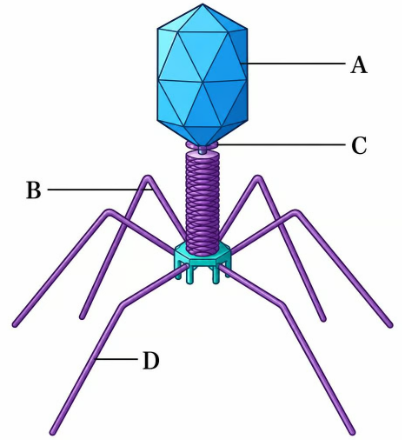 A bacteriophage (e.g., T-even phage) has a polyhedral head, a short collar, a tail with a contractile sheath, a basal plate and tail fibres.
A is the polyhedral structure at the top that encloses the nucleic acid (DNA): the head.
C is the narrow ring-like region just below the head, joining it to the tail: the collar.
B is the long cylindrical, contractile covering of the tail: the sheath.
D is the set of long thread-like leg structures arising from the base plate, with which the phage attaches to the bacterium: the tail fibres.
Hence A – head, B – sheath, C – collar, D – tail fibres. -
Virus envelope is known asA virus is a nucleoprotein particle: it has genetic material (DNA or RNA) surrounded by a protein coat.
The protein coat that envelops and protects the nucleic acid is called the capsid; it is made of small subunits called capsomeres arranged in helical or polyhedral forms.
The core is the central nucleic acid, the virion is the complete infectious virus particle outside the host, and nucleoprotein refers to the nucleic acid together with its protein.
Hence the covering (envelope) of the virus is known as the capsid. -
Viruses are no more "alive" than isolated chromosomes because : -A virus consists of nucleic acid (DNA or RNA, never both) enclosed in a protein coat. It has no metabolic machinery of its own.
Outside a host cell a virus is inert, like a chemical (it can even be crystallised). It can replicate only inside a living host cell, using the host's enzymes, ribosomes and energy.
Similarly, an isolated chromosome cannot replicate on its own; it needs the environment of a living cell.
Viruses do not need food molecules or oxygen for respiration, since they have no metabolism.
So viruses are no more alive than isolated chromosomes because both require the environment of a cell to replicate. -
Which one of the following statements about viruses is correct : -Viruses have no cellular organisation and no metabolic machinery of their own (no ribosomes or enzymes for energy production).
They can multiply only inside living host cells by using the host's machinery. So they are obligate (intracellular) parasites.
A virus contains either DNA or RNA, never both.
The protein coat of a virus is the capsid (made of capsomeres); the nucleic acid is the core.
So the correct statement is that viruses are obligate parasites. -
Enzymes are not found in :Viruses have no cellular structure and no metabolic machinery. They consist of nucleic acid enclosed in a protein coat, and use the enzymes of the host cell to multiply.
(Some viruses carry a few enzymes inside the particle, such as reverse transcriptase or lysozyme, but they do not have metabolic enzymes.)
Fungi, algae and cyanobacteria are living cells with many enzymes.
So enzymes are not found in viruses. -
Viruses are living, because :Viruses show one important characteristic of living things: inside a living host cell, they reproduce (replicate) and make copies of themselves, and they have genetic material that can mutate.
They do not respire or carry out metabolism on their own, and outside the host they are inert.
So viruses are considered living because they multiply in host cells.
Classification of organisms
-
Which one single organism or the pair of organisms is correctly assigned to its or their named taxonomic group?Yeast (Saccharomyces) is a unicellular fungus of the class Ascomycetes.
Nostoc and Anabaena are cyanobacteria (Monera); Paramecium and Plasmodium are protists while Penicillium is a fungus; a lichen is an association of an alga and a fungus.
Modes of nutrition
-
How many organisms in the list given below are autotrophs?
$Lactobacillus$, $Nostoc$, $Chara$, $Nitrosomonas$, $Nitrobacter$, $Streptomyces$, $Saccharomyces$, $Trypanosoma$, $Porphyra$, $Wolffia$Autotrophs prepare their own food either by photosynthesis or by chemosynthesis.
Photoautotrophs in the list: $Nostoc$ (a cyanobacterium), $Chara$ (a green alga), $Porphyra$ (a red alga) and $Wolffia$ (a tiny angiosperm).
Chemoautotrophs in the list: $Nitrosomonas$ and $Nitrobacter$ (nitrifying bacteria that obtain energy by oxidising ammonia and nitrite).
Heterotrophs in the list: $Lactobacillus$ (a lactic acid bacterium), $Streptomyces$ (a saprophytic actinomycete), $Saccharomyces$ (yeast, a fungus) and $Trypanosoma$ (a parasitic protozoan).
Number of autotrophs = 4 + 2 = 6.
So six organisms are autotrophs.
Mixed categorisation
-
Which one of the following sets of items in the options is correctly categorised with one exception in it?$Plasmodium$ (malaria) and $Trypanosoma$ (sleeping sickness) are protozoan parasites, but $Cuscuta$ is a parasitic flowering plant. So this set has exactly one exception and it is correctly named as $Cuscuta$.
Typhoid, pneumonia and diphtheria are all bacterial diseases, so diphtheria is not an exception.
UAA, UAG and UGA are all stop codons, so UAG is not an exception.
Kangaroo, koala and wombat are all Australian marsupials, so wombat is not an exception.
Hence the set with a genuine exception is $Plasmodium$, $Cuscuta$, $Trypanosoma$ – protozoan parasites – with $Cuscuta$ as the exception.
Fungi
-
Which one of the following is wrongly matched?$Puccinia$ is the rust fungus (it causes rust of wheat); the smut fungus is $Ustilago$. Both are basidiomycetes, but the pair $Puccinia$ – smut is wrong.
$Cassia$ and gulmohur show imbricate aestivation of the corolla, so that pair is correct.
Guttation, the loss of water as droplets from the tips of leaves through hydathodes, is caused by root pressure, so that pair is correct.
In roots the protoxylem lies towards the periphery and the metaxylem towards the centre, i.e., the xylem is exarch, so that pair is correct.
Hence the wrongly matched pair is $Puccinia$ – smut.
Plant diseases
-
Which one is the wrong pairing for the disease and its causal organism?Late blight of potato is caused by $Phytophthora\ infestans$.
$Alternaria\ solani$ causes early blight of potato, so this pairing is wrong.
Root-knot disease of vegetables is caused by the nematode $Meloidogyne$ (correct).
Black rust of wheat is caused by $Puccinia\ graminis\ tritici$ (correct).
Loose smut of wheat is caused by $Ustilago\ nuda$ (correct).
Hence the wrong pairing is late blight of potato : $Alternaria\ solani$.
Three Domain System
-
In the light of recent classification of living organisms into three domains of life (bacteria, archaea and eukarya), which one of the following statements is true about archaea?Carl Woese proposed the three domain system (Bacteria, Archaea and Eukarya) on the basis of differences in 16S ribosomal RNA sequences.
Archaea are prokaryotic in organisation: they have no nucleus and no membrane-bound organelles, so they do not completely differ from prokaryotes.
They resemble eukaryotes in some features of their genetic machinery, such as histone-like proteins, RNA polymerase and the initiation of translation, but they do not resemble eukarya in all respects.
They also have some novel features of their own: membrane lipids with branched chains joined to glycerol by ether linkages, cell walls without peptidoglycan (murein), and unique pathways such as methanogenesis.
These novel features, which are absent in bacteria as well as in eukaryotes, allow them to live in extreme habitats such as hot springs, salty areas and marshy areas.
So the true statement is that archaea have some novel features that are absent in other prokaryotes and eukaryotes.
Kingdom Protista: Slime Moulds
-
The thalloid body of a slime mould (Myxomycetes) is known as -Slime moulds are saprophytic protists that move along decaying twigs and leaves, engulfing organic material.
The vegetative body of an acellular slime mould (Myxomycetes) is a naked, multinucleate mass of protoplasm without cell walls.
This body is called a plasmodium; under suitable conditions it may grow and spread over several feet.
During unfavourable conditions the plasmodium differentiates and forms fruiting bodies, which bear spores at their tips.
Protonema is the juvenile filamentous stage of mosses.
Mycelium is the body of a fungus, made up of hyphae.
So the thalloid body of a slime mould is known as the plasmodium.
Kingdom Monera: Bacteria
-
The bacterium (Clostridium botulinum) that causes botulism is -Clostridium botulinum is a rod-shaped, spore-forming bacterium.
It is an obligate anaerobe: it can grow only in the complete absence of oxygen, and oxygen is harmful to it.
That is why it multiplies in improperly sterilised canned and sealed foods, where conditions are anaerobic.
There it produces botulinum toxin, a powerful neurotoxin that causes the severe food poisoning called botulism.
A facultative anaerobe can live with or without oxygen, and an obligate aerobe can live only in the presence of oxygen.
So Clostridium botulinum is an obligate anaerobe.
Diversity of Living Organisms
-
Match items in Column I with those in Column II -
Pick the matching item from Column II for each row.
Column I
- A. Peritrichous flagellation
- B. Living fossil
- C. Rhizophore
- D. Smallest flowering plant
- E. Largest perennial alga
Column II
- J. Ginkgo
- K. Macrocystis
- L. Escherichia coli
- M. Selaginella
- N. Wolffia
Correct answer: A → L, B → J, C → M, D → N, E → K
Peritrichous flagellation means that the flagella are distributed all over the surface of the bacterial cell; Escherichia coli has peritrichous flagella. So A - L.
Ginkgo biloba is called a living fossil because it has survived almost unchanged since the Mesozoic era. So B - J.
Rhizophores are leafless, colourless downward-growing branches that bear roots at their tips; they are found in Selaginella. So C - M.
Wolffia, a tiny floating duckweed of family Lemnaceae, is the smallest flowering plant. So D - N.
Macrocystis, a brown alga (kelp), is the largest perennial alga, reaching lengths of about 60 m. So E - K.
Correct match: A-L, B-J, C-M, D-N, E-K.
Diatoms and Cyanobacteria
-
Auxospores and hormocysts are formed respectively, by -Diatoms have a cell wall of two overlapping silica halves (frustules). At each vegetative division the daughter cells become progressively smaller.
The original size is restored by the formation of auxospores, usually after sexual reproduction; auxospores are formed by several (most) diatoms.
Hormocysts are multicellular, thick-walled resting structures formed at the ends of filaments in a few cyanobacteria, such as Westiella and some members of the Stigonematales.
On germination they give rise to new filaments.
So auxospores are formed by several diatoms and hormocysts by a few cyanobacteria.
Kingdom Protista: Ciliates
-
Which of the following unicellular organisms has a macronucleus for trophic function and one or more micronuclei for reproduction -Paramecium is a ciliated protozoan that shows nuclear dimorphism: it has two kinds of nuclei.
The large, polyploid macronucleus controls the vegetative (trophic) functions such as metabolism, growth and the synthesis of proteins.
One or more small, diploid micronuclei take part in reproduction, especially in conjugation (sexual process), and give rise to the new macronucleus.
Trypanosoma, Euglena and Amoeba have only one kind of nucleus.
So the organism is Paramecium.
Kingdom Monera: Extremophiles
-
Barophilic prokaryotes -The prefix 'baro' refers to pressure, not to barium.
Barophilic (piezophilic) prokaryotes are micro-organisms that grow best at high hydrostatic pressure.
Such pressures are found in the deep oceans, so barophiles grow and multiply in very deep marine sediments and deep sea waters, where the pressure may be hundreds of atmospheres.
Their membranes and enzymes are adapted to work under these pressures.
They have nothing to do with barium salts, and organisms of alkaline frozen lakes would be alkaliphiles and psychrophiles.
So barophilic prokaryotes grow and multiply in very deep marine sediments.
Viruses: Bacteriophages
-
Viruses that infect bacteria, multiply and cause their lysis are called -Viruses that infect bacteria are called bacteriophages.
In the lytic cycle, the phage injects its DNA, takes over the host cell's machinery, makes many new phage particles, and finally breaks open (lyses) the bacterial cell to release them. Such phages are called lytic (virulent) phages, e.g. T4.
Lysogenic (temperate) phages integrate their DNA into the bacterial chromosome as a prophage and do not lyse the cell immediately.
Lysozyme is an enzyme that digests bacterial cell walls; lipolytic refers to fat-digesting activity.
So viruses that infect bacteria, multiply and cause their lysis are called lytic.
Kingdom Protista: Amoeba
-
The chief advantage of encystment to an Amoeba is : -During unfavourable conditions such as drought, extreme temperature or lack of food, Amoeba withdraws its pseudopodia, becomes rounded and secretes a thick, protective three-layered cyst wall around itself. This is encystment.
Inside the cyst it can survive for a long time; it may also divide by multiple fission (sporulation) to form many pseudopodiospores.
When favourable conditions return, the cyst wall breaks and the young amoebae are released.
So the chief advantage of encystment is the ability to survive during adverse physical conditions.
Viruses: Tobacco Mosaic Virus
-
Tobacco mosaic virus is a tubular filament of size : -Tobacco mosaic virus (TMV), the first virus to be discovered and crystallised (Stanley, 1935), is a rod-shaped (helical) virus.
It is about 300 nm long and about 18 nm in diameter (often rounded to 20 nm).
It consists of a single strand of RNA (about 6400 nucleotides) wound in a helix, surrounded by about 2130 identical protein subunits (capsomeres).
So TMV is a tubular filament of size about 300 × 20 nm.
Fungi: Mycorrhiza
-
Mycorrhiza is an example of :-Mycorrhiza is an association between a fungus and the roots of a higher plant (e.g. Glomus with many plants, and fungi with Pinus roots).
The fungal hyphae absorb water and minerals, especially phosphorus, from the soil and pass them to the plant; they also protect the roots from pathogens.
The plant supplies sugars and other organic compounds to the fungus.
Since both partners benefit, it is a mutualistic symbiotic relationship.
So mycorrhiza is an example of a symbiotic relationship.
Kingdom Monera: Modes of Nutrition
-
Organisms which obtain energy by the oxidation of reduced inorganic compounds are called : -Chemoautotrophs make their own food from $CO_2$ using energy obtained by oxidising reduced inorganic substances such as ammonia, nitrite, hydrogen sulphide, ferrous iron or hydrogen.
Examples: nitrifying bacteria Nitrosomonas ($NH_3 \rightarrow NO_2^-$) and Nitrobacter ($NO_2^- \rightarrow NO_3^-$), sulphur bacteria and iron bacteria.
Photoautotrophs get their energy from light; saprozoic organisms absorb dissolved organic matter.
So such organisms are called chemoautotrophs.
Kingdom Fungi: Plant Diseases
-
Which fungal disease spreads by seed and flowers : -Loose smut of wheat is caused by the fungus Ustilago tritici (U. nuda tritici).
Its spores are carried by wind to healthy wheat flowers at flowering time. The fungus infects the flower and the developing grain, and remains dormant inside the embryo of the seed (internally seed-borne).
When the infected seed is sown, the fungus grows with the plant and replaces the ears with masses of black spores.
Covered smut of barley is externally seed-borne (spores on the seed surface), corn stunt is caused by a spiroplasma, and soft rot of potato by bacteria.
So loose smut of wheat spreads by seed and flowers. -
Black rust of wheat is caused by :Black (stem) rust of wheat is caused by the basidiomycete fungus Puccinia graminis tritici, which needs two hosts (wheat and barberry) to complete its life cycle.
Ustilago causes smut, Albugo causes white rust of crucifers, and Phytophthora causes late blight of potato.
So black rust of wheat is caused by Puccinia.
Modes of Nutrition in Bacteria
-
What is true for photolithotrophs : -'Photo' means that the energy source is light (radiation). 'Litho' means that the hydrogen (electron) donor is an inorganic compound.
Photolithotrophs obtain energy from light and hydrogen from inorganic substances such as $H_2O$ (green plants, cyanobacteria) or $H_2S$ (green and purple sulphur bacteria).
Photo-organotrophs use organic compounds as the hydrogen donor (e.g. purple non-sulphur bacteria).
So photolithotrophs obtain energy from radiation and hydrogen from inorganic compounds.
Viruses: Genetic Material
-
Cauliflower mosaic virus contains : -Most plant viruses (e.g. TMV) have single-stranded RNA.
Cauliflower mosaic virus (CaMV) is an exception: its genome is double-stranded DNA, which it replicates through an RNA intermediate (reverse transcription).
Its 35S promoter is widely used in plant genetic engineering.
So cauliflower mosaic virus contains ds DNA.
Kingdom Monera: Cyanobacteria
-
What is true for cyanobacteria : -Cyanobacteria (blue-green algae) carry out oxygenic photosynthesis like plants: they use water as the electron donor and release oxygen.
Many of them (e.g. Nostoc, Anabaena) also fix atmospheric nitrogen using the enzyme nitrogenase, usually in special cells called heterocysts, which protect nitrogenase from oxygen.
So cyanobacteria are oxygenic with nitrogenase.
Kingdom Fungi: Parasitic Fungi
-
Adhesive pad of fungi penetrates the host with the help of : -Many parasitic fungi form an adhesive pad (appressorium) on the host surface.
From it, a fine infection peg pierces the host cuticle and cell wall. This uses both mechanical pressure (high turgor pressure in the appressorium) and enzymes (cutinases and cellulases that soften the wall).
So the adhesive pad penetrates the host with the help of mechanical pressure and enzymes.
That is every question in Biological Classification.
Want a score?
Answers here are not saved. Practise as a test to be marked and see your progress.
Practise as a testQuestions per paper
Asked in 14 of the last 16 papers (2017–2026).
- 2026: 1 question
- 2026 Re-NEET: 5 questions
- 2025: 2 questions
- 2024: 3 questions
- 2024 Re-NEET: 1 question
- 2023: not asked
- 2023 Manipur: not asked
- 2022: 1 question
- 2022 Phase 2: 1 question
- 2021: 1 question
- 2020: 1 question
- 2020 Phase-2: 4 questions
- 2019: 3 questions
- 2019 Odisha: 3 questions
- 2018: 5 questions
- 2017: 3 questions
Concepts tested
- Viruses, viroids and prions 4
- Cyanobacteria 2
- Lichens 2
- Mutualism in lichens 2
- Aflatoxins from Aspergillus
- Appressorium penetration
- Archaebacteria as primitive organisms
- Autotrophs
- Bacteria - shapes
- basidiospores-exogenous
- Basis for classifying fungi into different classes
- Cell membrane of archaebacteria
- Cell wall composition
- Characters of bacteria
- Chemoautotrophic bacteria
- Chromatophores
- ciliates-dimorphic-nuclei
- Classes of fungi