Looking for classes? Ksquare Career Institute, Bengaluru →

Human Reproduction
Male reproductive system
7 questions from 6 papers, each with its answer.
- questions
- 7
- papers
- 6
- years asked, 2017–2026
- 1 of 10
- of Human Reproduction
- 6.03%
Appears in
Concepts tested
- Male accessory ducts 2
- Leydig cells
- Male accessory ducts and glands
- Male reproductive system
- Scrotum
- Urethra
All Questions
2026 Re-NEET 1 question
-
Which of the following structure is not a part of the male reproductive system?Reference: NCERT Class XII, page 29.
2014 AIPMT 1 question
-
The shared terminal duct of the reproductive and urinary system in the human male is:In the human male the urethra carries both urine and semen, and opens outside through the urethral meatus.
2012 AIPMT-PRE 1 question
-
The Leydig cells as found in the human body are the secretory source ofLeydig cells (interstitial cells) lie in the spaces outside the seminiferous tubules of the testis.
They synthesise and secrete testicular hormones called androgens, mainly testosterone.
2011 AIPMT-PRE 2 questions
-
The testes in humans are situated outside the abdominal cavity inside a pouch called scrotum. The purpose served is forSpermatogenesis requires a temperature slightly lower than the normal internal body temperature.
The scrotum keeps the testes outside the abdominal cavity and helps in maintaining their temperature about 2–2.5 $^\circ C$ lower than the internal body temperature.
At the normal body temperature of the abdomen, sperm formation would be impaired.
The other suggested purposes (display of sex, avoiding compression, space for the epididymis) are not the reason for this position.
Hence the purpose is maintaining the scrotal temperature lower than the internal body temperature. -
If for some reason the vasa efferentia in the human reproductive system get blocked, the gametes will not be transported fromThe male accessory ducts are the rete testis, vasa efferentia, epididymis and vas deferens.
Path of sperms: seminiferous tubules → rete testis → vasa efferentia → epididymis → vas deferens → ejaculatory duct → urethra.
The vasa efferentia leave the testis and open into the epididymis, which lies along the posterior surface of each testis.
If the vasa efferentia are blocked, sperms cannot pass from the testis to the epididymis.
Hence the gametes will not be transported from testes to epididymis.
2010 AIPMT-PRE 1 question
-
Vasa efferentia are the ductules leading fromThe male accessory ducts are the rete testis, vasa efferentia, epididymis and vas deferens.
The seminiferous tubules of the testicular lobules open into the rete testis through the tubuli recti.
The vasa efferentia are the fine ductules that leave the rete testis, carry the sperms out of the testis and open into the epididymis, which leads on to the vas deferens.
Path of sperms: seminiferous tubules → rete testis → vasa efferentia → epididymis → vas deferens.
Among the given choices, the one that starts correctly at the rete testis and leads on along this duct system is 'rete testis to vas deferens' (the epididymis lying in between); this is the answer accepted in the key.
2009 AIPMT 1 question
-
Given below is a diagrammatic sketch of a portion of human male reproductive system. Select the correct set of the names of the parts labelled A, B, C, D.
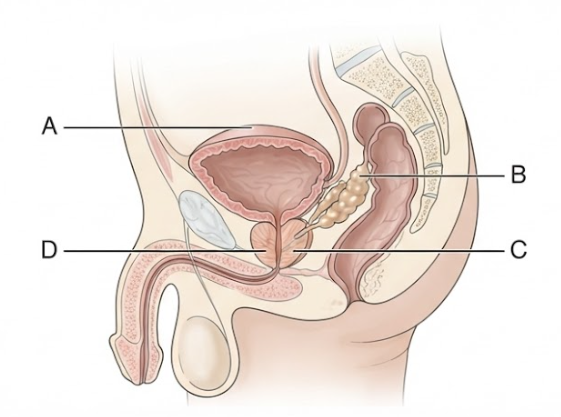 A is the duct that comes up from the epididymis, loops over the urinary bladder and joins the duct of the seminal vesicle: the vas deferens. (The ureter comes from the kidney and opens into the bladder; it is not part of this duct system.)
B is the elongated, sac-like gland lying behind the bladder, whose duct joins the vas deferens to form the ejaculatory duct: the seminal vesicle.
C is the single gland surrounding the urethra just below the urinary bladder: the prostate.
D is the small, paired gland lying below the prostate and opening into the urethra: the bulbourethral (Cowper's) gland.
Hence A – vas deferens, B – seminal vesicle, C – prostate, D – bulbourethral gland.