Looking for classes? Ksquare Career Institute, Bengaluru →

Alcohols, Phenols and Ethers
Dehydration of Alcohols
3 questions from 3 papers, each with its answer.
- questions
- 3
- papers
- 3
- years asked, 2017–2026
- 1 of 10
- of Alcohols, Phenols and Ethers
- 4.62%
Appears in
Concepts tested
- Carbocation without rearrangement
- stability of the alkene formed on dehydration
- Temperature controls dehydration product
All Questions
2023 1 question
-
Which amongst the following will be most readily dehydrated under acidic conditions ?
The alcohol whose dehydration gives a conjugated diene is dehydrated most readily.
Formation of conjugated diene in option (c) makes the given reactant most reactive towards dehydration in acidic conditions. [add image]
2015 AIPMT-II 1 question
-
Which of the following is not the product of dehydration of
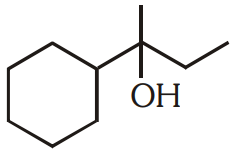 ?Dehydration proceeds through the tertiary carbocation on the side-chain carbon; it is already stable, so no rearrangement occurs.
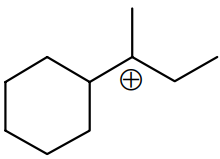
Alkenes can only form by loss of $H^+$ from carbons next to this cation, so the product with the double bond inside the ring away from that carbon is not possible.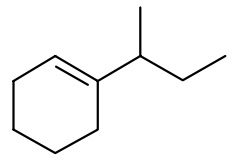
2001 AIPMT 1 question
-
In preparation of alkene from alcohol using $Al_2O_3$ which is effective factor : -When alcohol vapour is passed over heated alumina, it is dehydrated. The product depends mainly on the temperature:
At about 523 K (250 °C), intermolecular dehydration gives an ether: $2C_2H_5OH \xrightarrow{Al_2O_3,\ 523\ K} C_2H_5OC_2H_5 + H_2O$
At about 633 K (360 °C), intramolecular dehydration gives an alkene: $C_2H_5OH \xrightarrow{Al_2O_3,\ 633\ K} CH_2=CH_2 + H_2O$
So temperature is the effective factor that decides whether an alkene is formed.