Looking for classes? Ksquare Career Institute, Bengaluru →

Aldehydes, Ketones and Carboxylic Acids
Aldol Condensation
6 questions from 6 papers, each with its answer.
- questions
- 6
- papers
- 6
- years asked, 2017–2026
- 3 of 10
- of Aldehydes, Ketones and Carboxylic Acids
- 6.59%
Appears in
Concepts tested
- Aldol condensation of a ketone
- Aldol product
- aldol-condensation-cyclohexanone
- cross aldol condensation
- cross aldol condensation products
- Dehydration of β-hydroxy carbonyl compounds
All Questions
2022 1 question
-
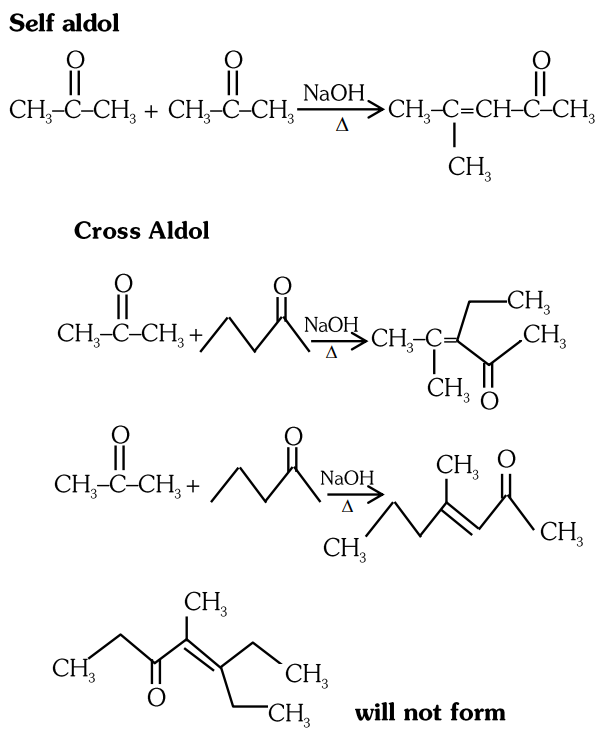
Which one of the following is not formed when acetone reacts with 2-pentanone in the presence of dilute NaOH followed by heating?-
2020 1 question
-
Reaction between benzaldehyde and acetophenone in presence of dilute NaOH is known as:$C_6H_5CHO + CH_3COC_6H_5 \xrightarrow{dil.\ OH^-} C_6H_5CH(OH)CH_2COC_6H_5 \xrightarrow{-H_2O} C_6H_5CH=CHCOC_6H_5$ Benzaldehyde (no $\alpha$-H) and acetophenone (with $\alpha$-H) react in the presence of dilute alkali to undergo cross aldol condensation (Claisen–Schmidt reaction).
2017 1 question
-
Of the following, which is the product formed when cyclohexanone undergoes aldol condensation followed by heating?
Aldol product dehydrates on heating to an $\alpha,\beta$-unsaturated ketone.
Two molecules of cyclohexanone undergo aldol addition in the presence of $OH^-$; on heating, dehydration gives the $\alpha,\beta$-unsaturated ketone.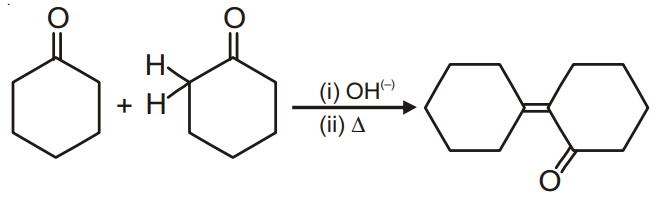
So the product is 2-cyclohexylidenecyclohexanone (two rings joined by a C=C double bond, with C=O on the ring carbon adjacent to it).
2010 AIPMT-MAINS 1 question
-
Which one of the following compounds will be most readily dehydrated?All four compounds are hydroxy ketones; they differ in the position of the –OH group relative to the C=O group.
A β-hydroxy ketone (–OH on the carbon two positions away from the carbonyl carbon) loses water very easily, as in the dehydration step of the aldol condensation.
Reasons: the hydrogen on the α-carbon, lying between the C=O and the C–OH, is acidic and is easily removed; and the product is an α,β-unsaturated ketone, in which the new C=C is conjugated with C=O and is therefore resonance stabilised.
In an α-hydroxy ketone or a γ-hydroxy ketone, loss of water cannot give such a conjugated system so readily.
The compound $CH_3-CO-CH_2-CH(OH)-CH_2-CH_3$, which has the –OH group at the β-position to the keto group, is therefore the most readily dehydrated, giving $CH_3-CO-CH=CH-CH_2-CH_3$.
2008 AIPMT 1 question
-
Acetophenone when reacted with a base, $C_2H_5ONa$, yields a stable compound which has the structure :Acetophenone, $C_6H_5COCH_3$, has $\alpha$-hydrogen atoms, so with a base like $C_2H_5ONa$ it undergoes the aldol condensation reaction.
Step 1: the base removes an $\alpha$-hydrogen to give the carbanion (enolate) $C_6H_5CO\overset{\ominus}{C}H_2$.
Step 2: this carbanion attacks the carbonyl carbon of a second molecule of acetophenone.
$C_6H_5COCH_3 + CH_3COC_6H_5 \xrightarrow{C_2H_5ONa} C_6H_5-C(OH)(CH_3)-CH_2-CO-C_6H_5$ (a $\beta$-hydroxy ketone)
Step 3: the $\beta$-hydroxy ketone readily loses a molecule of $H_2O$ because the product is stabilised by conjugation with the carbonyl group and the benzene ring.
$C_6H_5-C(OH)(CH_3)-CH_2-CO-C_6H_5 \xrightarrow{-H_2O} C_6H_5-C(CH_3)=CH-CO-C_6H_5$
The stable product is the $\alpha,\beta$-unsaturated ketone $C_6H_5-C(CH_3)=CH-CO-C_6H_5$ (1,3-diphenylbut-2-en-1-one, also called dypnone).
2007 AIPMT-PRE 1 question
-
The product formed in Aldol condensation isAldehydes and ketones having at least one $\alpha$-hydrogen atom, in the presence of dilute alkali, give a $\beta$-hydroxy aldehyde (aldol) or a $\beta$-hydroxy ketone (ketol).
The base removes an $\alpha$-hydrogen to form a carbanion (enolate), which attacks the carbonyl carbon of a second molecule.
$CH_3-CHO + H-CH_2-CHO \xrightarrow{dil.\ NaOH} CH_3-CH(OH)-CH_2-CHO$ (aldol, 3-hydroxybutanal)
The OH group is on the $\beta$-carbon with respect to the carbonyl group.
On heating, the aldol loses water to give an $\alpha,\beta$-unsaturated aldehyde: $CH_3-CH(OH)-CH_2-CHO \xrightarrow{\Delta,\ -H_2O} CH_3-CH=CH-CHO$ (crotonaldehyde)
So the product formed in aldol condensation is a beta-hydroxy aldehyde or a beta-hydroxy ketone.