Looking for classes? Ksquare Career Institute, Bengaluru →

Aldehydes, Ketones and Carboxylic Acids
Nucleophilic Addition – Cyanohydrin Formation
2 questions from 2 papers, each with its answer.
- questions
- 2
- papers
- 2
- years asked, 2017–2026
- 1 of 10
- of Aldehydes, Ketones and Carboxylic Acids
- 2.2%
Appears in
Concepts tested
- Cyanohydrin reduced to amino alcohol
- HCN addition and hydrolysis
All Questions
2023 1 question
-
Complete the following reaction:
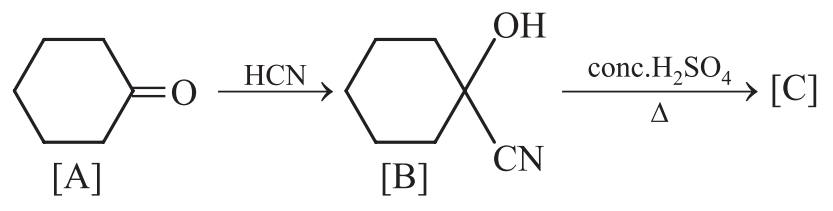 [C] is _______
The ketone forms a cyanohydrin [B] with HCN, which on treatment with conc. H2SO4 gives [C].
Reaction scheme: [A] $\xrightarrow{HCN}$ [B] $\xrightarrow[\Delta]{conc.\ H_2SO_4}$ [C]. [add image]
2003 AIPMT 1 question
-
A and B in the following reactions are :
$R-CO-R' \xrightarrow{HCN/KCN} A \xrightarrow{B} R-C(OH)(R')-CH_2NH_2$Step 1: HCN (with KCN as a source of $CN^-$) adds to the carbonyl group of the ketone to form a cyanohydrin (A):
$R-CO-R' + HCN \xrightarrow{KCN} RR'C(OH)CN$
Step 2: The product $R-C(OH)(R')-CH_2NH_2$ has a $-CH_2NH_2$ group in place of $-CN$. Reduction of a nitrile, $-C\equiv N \rightarrow -CH_2NH_2$, is done by $LiAlH_4$ (B):
$RR'C(OH)CN \xrightarrow{LiAlH_4} RR'C(OH)CH_2NH_2$
Hydrolysis with $H_3O^+$ would instead give the $\alpha$-hydroxy acid $RR'C(OH)COOH$.
So A = $RR'C(OH)CN$ and B = $LiAlH_4$.