Looking for classes? Ksquare Career Institute, Bengaluru →

Chemistry
Chemical Bonding and Molecular Structure
108 questions from 38 papers, each with its answer.
- 108 questions
- 38 papers
- 6.14% of Chemistry
Molecular Orbital Theory
-
The correct bond order in the following species is:Bond order $= \frac{N_b - N_a}{2}$, with 10 bonding electrons in each species.
$O_2^{2+}$ (14 e⁻): $\frac{10 - 4}{2} = 3$
$O_2^+$ (15 e⁻): $\frac{10 - 5}{2} = 2.5$
$O_2^-$ (17 e⁻): $\frac{10 - 7}{2} = 1.5$
So $O_2^- < O_2^+ < O_2^{2+}$.
VSEPR Theory
-
Maximum bond angle at nitrogen is present in which of the following$NO_2^+$ is linear ($sp$), bond angle $180^\circ$.
Order: $NO_2^+$ ($180^\circ$) > $NO_2$ ($\approx 132^\circ$) > $NO_3^-$ ($120^\circ$) > $NO_2^-$ ($\approx 115^\circ$)
Sigma and pi bonds
-
Which of the following species contains equal number of $\sigma$- and $\pi$-bonds?
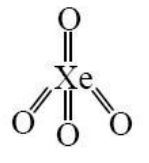
Each Xe=O bond has one $\sigma$ and one $\pi$ bond.
So $XeO_4$ has $4\sigma$ and $4\pi$ bonds — equal numbers.
VSEPR and isoelectronic species
-
Which of the following pairs of ions are isoelectronic and isostructural?$ClO_3^-$: 17 + 24 + 1 = 42 electrons; $SO_3^{2-}$: 16 + 24 + 2 = 42 electrons.
Both have $sp^3$ hybridisation with one lone pair (pyramidal).
So $ClO_3^-$ and $SO_3^{2-}$ are isoelectronic and isostructural.
That is every question in Chemical Bonding and Molecular Structure for this filter.
Want a score?
Answers here are not saved. Practise as a test to be marked and see your progress.
Practise as a test