Looking for classes? Ksquare Career Institute, Bengaluru →

Valence bond theory
Appears in
Concepts tested here
- Hybridisation and magnetic behaviour
- Outer orbital complexes
- Square planar nickel complex
All Questions
2015 AIPMT-II 1 question
-
The hybridization involved in complex $[Ni(CN)_4]^{2-}$ is (At. No. Ni = 28)

Oxidation state of Ni: $x - 4 = -2 \Rightarrow x = +2$; $Ni^{2+}$: $[Ar]3d^84s^0$
$CN^-$ is a strong field ligand, so the two unpaired 3d electrons pair up, leaving one 3d orbital empty.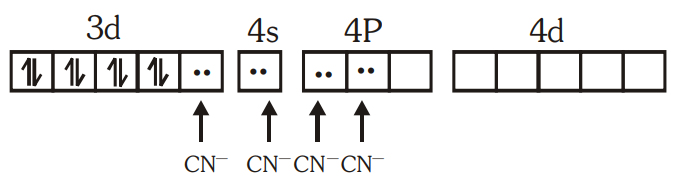
One 3d, one 4s and two 4p orbitals hybridise: $dsp^2$ (square planar).
2012 AIPMT-PRE 1 question
-
Which one of the following is an outer orbital complex and exhibits paramagnetic behaviour?$Ni^{2+}$: $3d^8$. Two vacant 3d orbitals are not available even after pairing, so the 4s, 4p and two 4d orbitals are used: $sp^3d^2$ (outer orbital). It has 2 unpaired electrons, so it is paramagnetic.

$[Co(NH_3)_6]^{3+}$ ($d^6$) is $d^2sp^3$, inner orbital and diamagnetic.
$[Cr(NH_3)_6]^{3+}$ ($d^3$) is $d^2sp^3$, inner orbital.
$[Zn(NH_3)_6]^{2+}$ ($d^{10}$) is outer orbital but diamagnetic.
So $[Ni(NH_3)_6]^{2+}$ is the outer orbital, paramagnetic complex.
2011 AIPMT-PRE 1 question
-
Of the following complex ions, which is diamagnetic in nature?$[Ni(CN)_4]^{2-}$: $Ni^{2+}$ is $3d^8$. $CN^-$ is a strong field ligand and pairs up the 3d electrons, leaving one 3d orbital empty; the hybridisation is $dsp^2$ (square planar) and there are no unpaired electrons, so it is diamagnetic.
$[NiCl_4]^{2-}$: $Ni^{2+}$ is $3d^8$. $Cl^-$ is a weak field ligand, no pairing occurs; hybridisation is $sp^3$ (tetrahedral) with 2 unpaired electrons, so it is paramagnetic.
$[CoF_6]^{3-}$: $Co^{3+}$ is $3d^6$. $F^-$ is a weak field ligand; hybridisation is $sp^3d^2$ with 4 unpaired electrons, so it is paramagnetic.
$[CuCl_4]^{2-}$: $Cu^{2+}$ is $3d^9$ with 1 unpaired electron, so it is paramagnetic.
Hence the diamagnetic ion is $[Ni(CN)_4]^{2-}$.