Looking for classes? Ksquare Career Institute, Bengaluru →

Coordination Compounds
Isomerism in Coordination Compounds
12 questions from 11 papers, each with its answer.
- questions
- 12
- papers
- 11
- years asked, 2017–2026
- 2 of 10
- of Coordination Compounds
- 11.54%
Appears in
Concepts tested
- Cis-trans isomerism
- Combining geometrical and linkage isomerism
- Coordination isomerism
- Counting isomers
- Geometrical and optical isomers
- Geometrical isomers of square planar complexes
- geometrical-isomerism-octahedral
- Geometry and isomerism
- Identifying solvate, linkage, ionization and coordination isomerism
- Optical isomerism
- Optical isomerism in chelate complexes
- Types of isomerism in an MA4B2 complex
All Questions
2024 1 question
-
Match List-I with List-II regarding the type of isomerism shown by the given coordination complexes.
Pick the matching item from Column II for each row.
Column I
- A. $[Co(NH_3)_5(NO_2)]Cl_2$
- B. $[Co(NH_3)_5(SO_4)]Br$
- C. $[Co(NH_3)_6][Cr(CN)_6]$
- D. $[Co(H_2O)_6]Cl_3$
Column II
- I. Solvate isomerism
- II. Linkage isomerism
- III. Ionization isomerism
- IV. Coordination isomerism
Correct answer: A → II, B → III, C → IV, D → I
$[Co(NH_3)_5(NO_2)]Cl_2$: $NO_2^-$ is ambidentate – linkage isomerism $[Co(NH_3)_5(SO_4)]Br$: exchange of ions inside and outside the coordination sphere – ionization isomerism $[Co(NH_3)_6][Cr(CN)_6]$: interchange of ligands between cationic and anionic complexes – coordination isomerism $[Co(H_2O)_6]Cl_3$: water as ligand vs water of crystallisation – solvate (hydrate) isomerism Correct match: A-II, B-III, C-IV, D-I.
2018 1 question
-
The type of isomerism shown by the complex $[CoCl_2(en)_2]$ is
$[MA_2(AA)_2]$ octahedral complexes show cis–trans isomerism.
In $[CoCl_2(en)_2]$, the coordination number of Co is 6 and the compound has octahedral geometry. [add image: cis and trans isomers of $[CoCl_2(en)_2]$] Among the given options, the type of isomerism shown is geometrical isomerism.
2015 AIPMT-II 1 question
-
Number of possible isomers for the complex $[Co(en)_2Cl_2]Cl$ will be: (en = ethylenediamine)$[Co(en)_2Cl_2]^+$ shows cis and trans geometrical isomers.
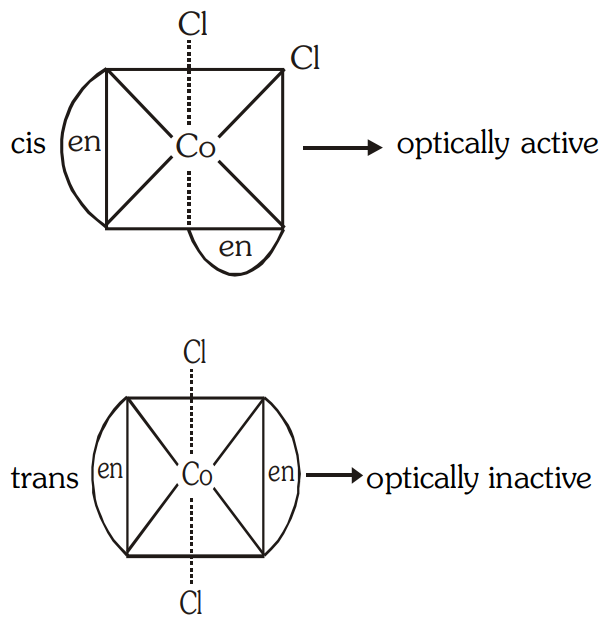
The trans form has a plane of symmetry (optically inactive); the cis form is optically active and exists as a pair of enantiomers.
Total stereoisomers = 2 + 1 = 3
2011 AIPMT-PRE 2 questions
-
The complex, $[Pt(Py)(NH_3)BrCl]$ will have how many geometrical isomers?
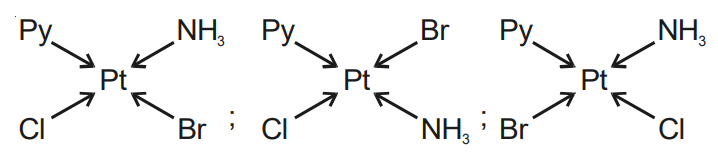
Pt(II) forms square planar complexes; this complex is of the type [Mabcd] with four different monodentate ligands (Py, $NH_3$, Br, Cl).
Fix one ligand, say Py, at one corner. The position trans to it can be occupied by any one of the other three ligands.
Isomer 1: Py trans to $NH_3$ (Br trans to Cl).
Isomer 2: Py trans to Br ($NH_3$ trans to Cl).
Isomer 3: Py trans to Cl ($NH_3$ trans to Br).
So a square planar complex [Mabcd] has 3 geometrical isomers. -
The complexes $[Co(NH_3)_6][Cr(CN)_6]$ and $[Cr(NH_3)_6][Co(CN)_6]$ are the examples of which type of isomerism?In both compounds the cation and the anion are complex ions.
In the first, $NH_3$ ligands are bound to Co and $CN^-$ ligands to Cr; in the second, $NH_3$ ligands are bound to Cr and $CN^-$ ligands to Co.
The ligands have been interchanged between the cationic and anionic coordination entities of the two different metal ions.
This type of isomerism is called coordination isomerism.
Linkage isomerism needs an ambidentate ligand bound through different atoms, and ionisation isomerism involves exchange of a ligand with the counter ion, which is not the case here.
2010 AIPMT-MAINS 1 question
-
Which one of the following complexes is not expected to exhibit isomerism?$[Ni(NH_3)_4(H_2O)_2]^{2+}$ is octahedral of the type $[MA_4B_2]$; it shows geometrical (cis–trans) isomerism.
$[Pt(NH_3)_2Cl_2]$ is square planar ($dsp^2$) of the type $[MA_2B_2]$; it shows cis–trans isomerism (cis-platin and trans-platin).
$[Ni(en)_3]^{2+}$ is octahedral with three bidentate ligands; it has no plane of symmetry and shows optical isomerism (d and l forms).
$[Ni(NH_3)_2Cl_2]$: $Ni^{2+}$ with these weak field ligands is $sp^3$ hybridised and tetrahedral. In a tetrahedron all four positions are adjacent to one another, so $[MA_2B_2]$ has only one arrangement; there is no geometrical isomerism, and no optical isomerism either, since it has a plane of symmetry.
Hence $[Ni(NH_3)_2Cl_2]$ is not expected to exhibit isomerism.
2010 AIPMT-PRE 1 question
-
The existence of two different coloured complexes with the composition of $[Co(NH_3)_4Cl_2]^+$ is due to$[Co(NH_3)_4Cl_2]^+$ is an octahedral complex of the type $[MA_4B_2]$.
The two $Cl^-$ ligands can occupy adjacent positions ($90^\circ$ apart, cis isomer) or opposite positions ($180^\circ$ apart, trans isomer).
These are geometrical isomers; the cis form is violet and the trans form is green.
Ionisation isomerism needs exchange of a ligand with a counter ion, linkage isomerism needs an ambidentate ligand, and coordination isomerism needs both cation and anion to be complexes; none applies to this single complex ion.
Hence the two coloured forms are due to geometrical isomerism.
2009 AIPMT 1 question
-
Which of the following does not show optical isomerism? (en = ethylenediamine)A complex is optically active if it is chiral, i.e., if it has no plane of symmetry and is not superimposable on its mirror image.
$[Co(en)_3]^{3+}$: three bidentate ligands give a propeller-like structure with no plane of symmetry; it shows optical isomerism.
$[Co(en)_2Cl_2]^+$: the cis isomer has no plane of symmetry and is optically active.
$[Co(en)Cl_2(NH_3)_2]^+$: its cis forms can be chiral and show optical isomerism.
$[Co(NH_3)_3Cl_3]$ is of the type $[MA_3B_3]$ with only monodentate ligands; it shows geometrical isomerism (fac and mer forms), but both forms have planes of symmetry, so neither is optically active.
Hence $[Co(NH_3)_3Cl_3]^0$ does not show optical isomerism.
2006 AIPMT-PRE 1 question
-
$[Co(NH_3)_4(NO_2)_2]Cl$ exhibits :-Linkage isomerism: $NO_2^-$ is an ambidentate ligand. It can bind through nitrogen (nitro, $-NO_2$) or through oxygen (nitrito, $-ONO$), so linkage isomers are possible.
Ionization isomerism: the ligand $NO_2^-$ inside the coordination sphere and the counter ion $Cl^-$ outside can exchange places, giving $[Co(NH_3)_4(NO_2)Cl]NO_2$. So ionization isomerism is possible.
Geometrical isomerism: the complex ion $[Co(NH_3)_4(NO_2)_2]^+$ is octahedral of the type $MA_4B_2$, which exists in cis and trans forms.
Optical isomerism: both the cis and the trans forms of an $MA_4B_2$ complex with monodentate ligands have a plane of symmetry, so the complex is not optically active.
So the compound exhibits linkage isomerism, ionization isomerism and geometrical isomerism.
2004 AIPMT 1 question
-
Which of the following coordination compounds would exhibit optical isomerismA complex shows optical isomerism if it is chiral, i.e. it has no plane or centre of symmetry, so it is not superimposable on its mirror image.
$[Pt(NH_3)_2Cl_2]$ is square planar. A square planar complex has its molecular plane as a plane of symmetry, so it is optically inactive (it shows only geometrical isomerism).
trans-$[Cr(CN)_2(en)_2]Cl$: in the trans form the two $CN^-$ groups are opposite each other and the two en rings lie in one plane, which is a plane of symmetry. So it is optically inactive (only the cis form is chiral).
$[Co(en)_3]Br_3$: three bidentate en ligands wrap around Co like the blades of a propeller. The arrangement has no plane of symmetry and exists as two non-superimposable mirror images (d and l forms). So it shows optical isomerism.
$[Co(NH_3)_5(NO_2)]I_2$ is of the $MA_5B$ type and has planes of symmetry, so it is optically inactive (it shows linkage isomerism).
So tris(ethylenediamine)cobalt(III) bromide exhibits optical isomerism.
2001 AIPMT 1 question
-
Which of the following will give maximum number of isomers : -$[Co(NH_3)_4Cl_2]$: $MA_4B_2$ type, shows only cis and trans geometrical isomers (2).
$[Ni(en)(NH_3)_4]^{2+}$: the en ligand must span cis positions, so there is only one form.
$[Ni(C_2O_4)(en)_2]^{2-}$: $M(AA)(BB)_2$ type; it exists as a pair of enantiomers (d and l), i.e. 2 isomers.
$[Cr(SCN)_2(NH_3)_4]^+$: $MA_4B_2$ type gives cis and trans forms. In addition, the ambidentate SCN ligand can bind through S (thiocyanato) or N (isothiocyanato), so each SCN can be S- or N-bonded (SCN, SCN; SCN, NCS; NCS, NCS). Combining geometrical and linkage isomerism gives the largest number of isomers.
So $[Cr(SCN)_2(NH_3)_4]^+$ gives the maximum number of isomers.
2000 AIPMT 1 question
-
Which complex compound will give four isomers :$[Fe(en)_3]^{3+}$: shows only optical isomerism (d and l), 2 isomers.
$[Co(en)_2Cl_2]^+$: cis (which is optically active, d and l) and trans: 3 isomers.
$[Fe(PPh_3)_3(NH_3)ClBr]^+$: an octahedral $[MA_3BCD]$ complex. The three $PPh_3$ groups can be facial (fac) or meridional (mer), and the positions of $NH_3$, Cl and Br relative to them give further arrangements, some of which are chiral. In total it gives four stereoisomers.
$[Co(PPh_3)_3Cl]^{3+}$ is a four-coordinate complex with no comparable isomerism.
So, as per the answer key, $[Fe(PPh_3)_3NH_3ClBr]Cl$ gives four isomers.