Looking for classes? Ksquare Career Institute, Bengaluru →

Nucleophilic substitution
Appears in
Concepts tested here
- Reactivity of aryl and alkyl halides
- Types of organic reactions
- Types of reactions
All Questions
2011 AIPMT-PRE 1 question
-
Which one is a nucleophilic substitution reaction among the following?$CH_3CHO + HCN$: $CN^-$ adds to the carbonyl carbon; this is nucleophilic addition.
Propene + water in acid: $H^+$ attacks the double bond first; this is electrophilic addition.
$RCHO + R'MgX$: the carbanion-like R′ adds to the carbonyl carbon; this is nucleophilic addition.
Alkyl bromide + $NH_3$: the nucleophile $NH_3$ attacks the carbon bearing bromine and displaces $Br^-$ as the leaving group; one group is replaced by another, so this is nucleophilic substitution ($S_N2$).
Hence the nucleophilic substitution reaction is the reaction of the alkyl bromide with $NH_3$.
2010 AIPMT-PRE 1 question
-
The correct order of increasing reactivity of C–X bond towards nucleophile in the following compounds is
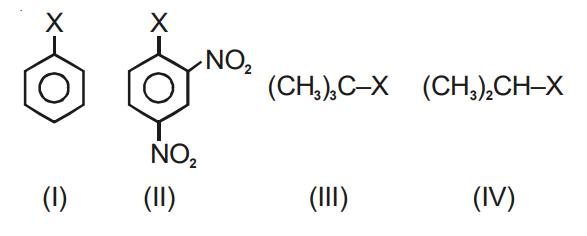 In aryl halides (I and II) the C–X bond has partial double bond character due to resonance and the carbon is $sp^2$ hybridised, so they are much less reactive towards nucleophiles than alkyl halides.
Among the aryl halides, the two electron-withdrawing $-NO_2$ groups at the ortho and para positions in (II) stabilise the intermediate carbanion, so (II) is more reactive than the unsubstituted halobenzene (I): I < II.
The alkyl halides (III and IV) react readily; taking the reaction through the carbocation ($S_N1$) pathway, the tertiary halide (III) forms the more stable tertiary carbocation and is more reactive than the secondary halide (IV): IV < III.
Combining these: I < II < IV < III
2009 AIPMT 1 question
-
Which of the following reactions is an example of nucleophilic substitution reaction?In a nucleophilic substitution, a nucleophile attacks the carbon bearing the halogen and replaces the halide ion.
RX + KOH → ROH + KX: the nucleophile $OH^-$ replaces $X^-$ on carbon. This is nucleophilic substitution.
RX + Mg → RMgX is the formation of a Grignard reagent (insertion of the metal into the C–X bond).
2RX + 2Na → R–R + 2NaX is the Wurtz reaction (a coupling reaction involving the metal).
RX + $H_2$ → RH + HX is a reduction.
Hence the nucleophilic substitution reaction is RX + KOH → ROH + KX.