Looking for classes? Ksquare Career Institute, Bengaluru →

Electrophilic substitution
Appears in
Concepts tested here
- Activating and deactivating groups
- Bromination of m-xylene
- Nitration of nitrobenzene
All Questions
2014 AIPMT 1 question
-
What products are formed when the following compound is treated with $Br_2$ in the presence of $FeBr_3$?
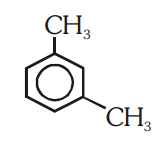
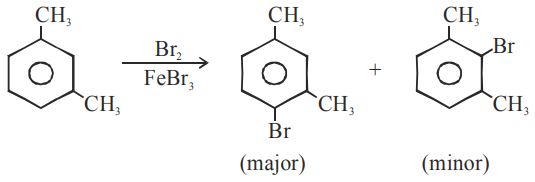
Attack at the two positions that are ortho to one $CH_3$ and para to the other gives the same compound, the major product.
Attack at the position between the two $CH_3$ groups is much less favoured because of high steric hindrance, so that product forms in a very small amount.
Products: 4-bromo-1,3-dimethylbenzene and 2-bromo-1,3-dimethylbenzene.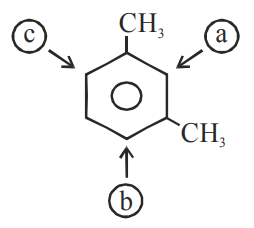
2013 NEET 1 question
-
Nitrobenzene on reaction with conc. $HNO_3/H_2SO_4$ at 80–100$^\circ C$ forms which one of the following products?
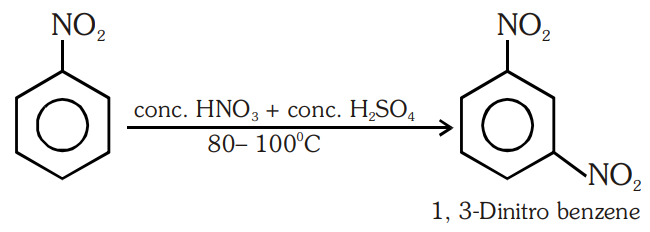
The mixture of conc. $HNO_3$ and conc. $H_2SO_4$ gives $NO_2^+$, which acts as the electrophile.
In nitrobenzene the $-NO_2$ group is meta-directing, so $NO_2^+$ attacks the meta position, giving 1,3-dinitrobenzene.
2012 AIPMT-PRE 1 question
-
Among the following compounds the one that is most reactive towards electrophilic nitration is:Electrophilic nitration is faster when the ring is electron rich.
In toluene the $-CH_3$ group releases electrons (+I effect and hyperconjugation); it is ortho-para directing and activates the ring.
$-COOH$ and $-NO_2$ are electron-withdrawing and deactivate the ring.
Reactivity: toluene > benzene > benzoic acid > nitrobenzene