Looking for classes? Ksquare Career Institute, Bengaluru →

Electrophilic addition to alkenes
Appears in
Concepts tested here
- Benzylic carbocation in HBr addition
- Carbocation rearrangement by hydride shift
- Carbocation rearrangement in hydration
All Questions
2015 AIPMT-I 1 question
-
The reaction of $C_6H_5CH=CHCH_3$ with HBr produces$H^+$ adds to the terminal carbon of the double bond to give the more stable benzylic carbocation $C_6H_5\overset{+}{C}HCH_2CH_3$.
$Br^-$ then attacks this carbon.
Product: $C_6H_5CH(Br)CH_2CH_3$
2012 AIPMT-PRE 1 question
-
In the following reaction:
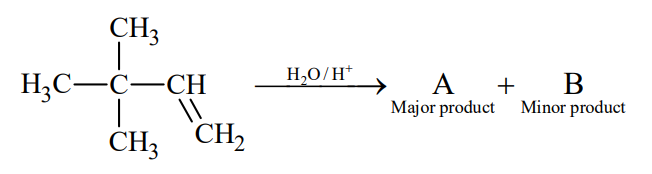
The major product is: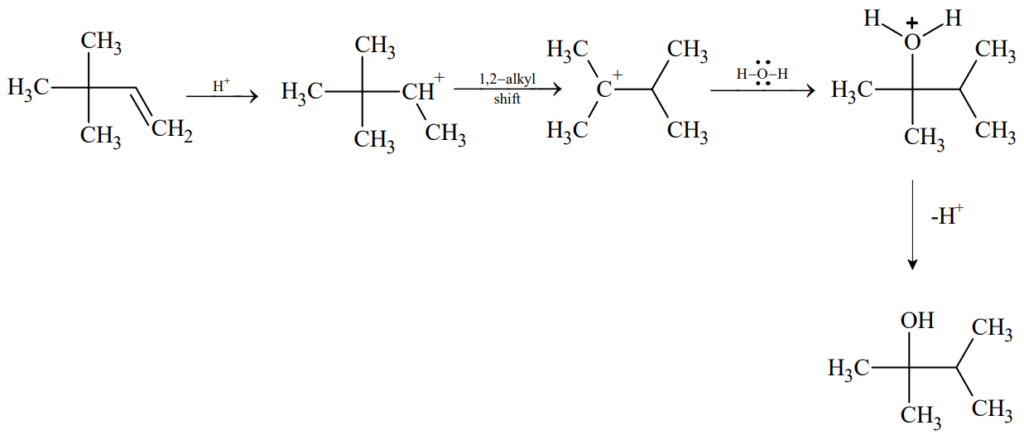
Step 1: $H^+$ adds to the terminal carbon, giving the secondary carbocation $(CH_3)_3C-\overset{+}{C}H-CH_3$.
Step 2: A 1,2-methyl shift converts it into the more stable tertiary carbocation $(CH_3)_2\overset{+}{C}-CH(CH_3)_2$.
Step 3: Water attacks the tertiary carbocation to give the protonated alcohol.
Step 4: Loss of $H^+$ gives $(CH_3)_2C(OH)-CH(CH_3)_2$ (2,3-dimethylbutan-2-ol), the major product.
The unrearranged alcohol $(CH_3)_3C-CH(OH)-CH_3$ is the minor product.
2008 AIPMT 1 question
-
$H_2C=CH-CH(CH_3)-CH_3 + HBr \rightarrow (X)$
Here (X) (predominantly) is :The alkene is 3-methylbut-1-ene. The addition of HBr is an electrophilic addition that proceeds through a carbocation.
Step 1: $H^+$ adds to the terminal $CH_2$ carbon (Markovnikov's rule) to give a secondary carbocation.
$CH_2=CH-CH(CH_3)-CH_3 + H^+ \rightarrow CH_3-\overset{+}{C}H-CH(CH_3)-CH_3$ ($2^\circ$ carbocation, less stable)
Step 2: a 1,2-hydride shift from the adjacent carbon converts it into a more stable tertiary carbocation.
$CH_3-\overset{+}{C}H-CH(CH_3)-CH_3 \xrightarrow{1,2\text{-hydride shift}} CH_3-CH_2-\overset{+}{C}(CH_3)-CH_3$ ($3^\circ$ carbocation, more stable)
Step 3: $Br^-$ attacks the tertiary carbocation.
$CH_3-CH_2-\overset{+}{C}(CH_3)_2 + Br^- \rightarrow CH_3-C(Br)(CH_3)-CH_2CH_3$
The major product (X) is 2-bromo-2-methylbutane, $CH_3-C(Br)(CH_3)-CH_2CH_3$.