Looking for classes? Ksquare Career Institute, Bengaluru →

Chemistry
Organic Chemistry - Some Basic Principles and Techniques
88 questions from 35 papers, each with its answer.
- 88 questions
- 35 papers
- 5% of Chemistry
Hybridisation of carbon
-
The correct order regarding the electronegativity of hybrid orbitals of carbon is :-The electronegativity of a hybrid orbital depends on its percentage of s-character.
An s orbital is closer to the nucleus than a p orbital, so electrons in an orbital with more s-character are held more strongly by the nucleus.
s-character: $sp$ = 50 percent, $sp^2$ = 33.3 percent, $sp^3$ = 25 percent.
Greater the s-character, greater is the electronegativity of the hybrid orbital.
So the order of electronegativity is $sp \gt sp^2 \gt sp^3$.
This explains why the hydrogen of ethyne (sp carbon) is more acidic than that of ethene or ethane.
IUPAC nomenclature
-
The IUPAC name of the compound
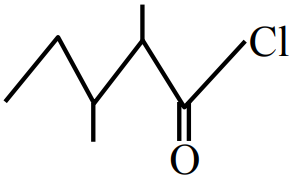 is:-The functional group is the acid chloride group, $-COCl$, so the suffix is '-oyl chloride'.
Select the longest carbon chain that includes the carbon of the $-COCl$ group. It has five carbon atoms, so the parent name is pentanoyl chloride.
Number the chain starting from the carbon of the $-COCl$ group, which is always C-1.
$\overset{5}{C}H_3-\overset{4}{C}H_2-\overset{3}{C}H(CH_3)-\overset{2}{C}H(CH_3)-\overset{1}{C}OCl$
There are methyl substituents on C-2 and C-3.
So the IUPAC name is 2,3-dimethylpentanoyl chloride.
Choosing a four-carbon chain (2-ethyl-3-methylbutanoyl chloride) is wrong because it is not the longest chain, and 3,4-dimethyl numbering starts from the wrong end.
That is every question in Organic Chemistry - Some Basic Principles and Techniques for this filter.
Want a score?
Answers here are not saved. Practise as a test to be marked and see your progress.
Practise as a test