Looking for classes? Ksquare Career Institute, Bengaluru →

Redox Reactions
Oxidation Number
11 questions from 10 papers, each with its answer.
- questions
- 11
- papers
- 10
- years asked, 2017–2026
- 4 of 10
- of Redox Reactions
- 36.67%
Appears in
Concepts tested
- Oxidation number 2
- Calculating oxidation numbers
- Calculating oxidation states of sulphur
- Change in oxidation number
- change in oxidation number of carbon
- Oxidation state of nitrogen
- oxidation-state-nitrogen
- Peroxo linkages in CrO5
- Sum of oxidation numbers is zero
- Zero oxidation state in carbonyls
All Questions
2026 Re-NEET 1 question
-
The correct decreasing order of oxidation state of the underlined atom in each molecule is$\underline{N}_2O_5$: $2x+5(-2)=0 \Rightarrow x=+5$. $\underline{Al}_2O_3$: $2x+3(-2)=0 \Rightarrow x=+3$. $H_2\underline{S}$: $2(+1)+x=0 \Rightarrow x=-2$. So $N_2O_5>Al_2O_3>H_2S$.
2020 1 question
-
What is the change in oxidation number of carbon in the following reaction? $CH_4(g)+4Cl_2(g)\rightarrow CCl_4(l)+4HCl(g)$In $CH_4$: x + 4(+1) = 0 ⇒ x = –4 In $CCl_4$: x + 4(–1) = 0 ⇒ x = +4 So the oxidation number of carbon changes from –4 to +4.
2019 Odisha 1 question
-
The oxidation state of Cr in $CrO_6$ is:
2018 1 question
-
The correct order of N-compounds in its decreasing order of oxidation states is
N is +5, +2, 0 and –3 in $HNO_3$, NO, $N_2$ and $NH_4Cl$.
Oxidation state of N: $HNO_3$ (+5), NO (+2), $N_2$ (0), $NH_4Cl$ (–3) So the decreasing order is $HNO_3$, NO, $N_2$, $NH_4Cl$.
2015 AIPMT-I 1 question
-
Which of the following processes does not involve oxidation of iron?In $Fe(CO)_5$, CO is a neutral ligand, so iron stays in the 0 oxidation state — the same as in metallic Fe.
In rusting, reaction with $CuSO_4$ and reaction with steam, iron is oxidised.
2014 AIPMT 1 question
-
In acidic medium, $H_2O_2$ changes $Cr_2O_7^{2-}$ to $CrO_5$ which has two (–O–O–) bonds. Oxidation state of Cr in $CrO_5$ is:$CrO_5$ has two peroxy linkages: four O atoms are in the −1 state and one is in the −2 state.
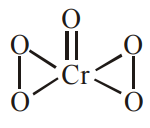
$x + 4(-1) + (-2) = 0 \Rightarrow x = +6$
2012 AIPMT-PRE 2 questions
-
In which of the following compounds, nitrogen exhibits highest oxidation state?$NH_2OH$: $x + 2(+1) + (-2) + 1 = 0 \Rightarrow x = -1$
$N_2H_4$: $2x + 4 = 0 \Rightarrow x = -2$
$NH_3$: $x + 3 = 0 \Rightarrow x = -3$
$N_3H$: $3x + 1 = 0 \Rightarrow x = -\frac{1}{3}$
$-\frac{1}{3}$ is the highest of these, so nitrogen has its highest oxidation state in $N_3H$. -
A mixture of potassium chlorate, oxalic acid and sulphuric acid is heated. During the reaction which element undergoes maximum change in the oxidation number?$KClO_3 + H_2C_2O_4 + H_2SO_4 \rightarrow K_2SO_4 + KCl + CO_2 + H_2O$
Cl: +5 in $ClO_3^-$ → −1 in $Cl^-$, a change of 6 units.
C: +3 in oxalic acid → +4 in $CO_2$, a change of 1 unit.
S (+6) and H (+1) do not change.
So chlorine undergoes the maximum change.
2009 AIPMT 1 question
-
Oxidation numbers of P in $PO_4^{3-}$, of S in $SO_4^{2-}$ and that of Cr in $Cr_2O_7^{2-}$ are respectivelyTake the oxidation number of O as −2; the sum of oxidation numbers equals the charge on the ion.
$PO_4^{3-}$: $x + 4(-2) = -3$, so $x = +5$
$SO_4^{2-}$: $x + 4(-2) = -2$, so $x = +6$
$Cr_2O_7^{2-}$: $2x + 7(-2) = -2$, so $2x = +12$ and $x = +6$
The oxidation numbers are +5, +6 and +6.
2003 AIPMT 1 question
-
The oxidation states of sulphur in the anions $SO_3^{2-}$, $S_2O_4^{2-}$ and $S_2O_6^{2-}$ follow the order -Take O = –2 and let x be the oxidation state of S.
$SO_3^{2-}$: $x + 3(-2) = -2 \Rightarrow x = +4$
$S_2O_4^{2-}$ (dithionite): $2x + 4(-2) = -2 \Rightarrow 2x = 6 \Rightarrow x = +3$
$S_2O_6^{2-}$ (dithionate): $2x + 6(-2) = -2 \Rightarrow 2x = 10 \Rightarrow x = +5$
Order: +3 $\lt$ +4 $\lt$ +5
So $S_2O_4^{2-} \lt SO_3^{2-} \lt S_2O_6^{2-}$.
2000 AIPMT 1 question
-
Oxidation numbers of A, B and C are +2, +5 and –2 respectively. Possible formula of compound is :In a neutral compound, the sum of oxidation numbers is zero.
For $A_3(BC_4)_2$: $3(+2) + 2[(+5) + 4(-2)] = 6 + 2(-3) = 0$. Correct.
$A_2(BC_2)_2$: $4 + 2(5 - 4) = 6$; $A_2(BC_3)_2$: $4 + 2(5 - 6) = 2$; $A_3(B_2C)_2$: $6 + 2(10 - 2) = 22$. None of these is zero.
(This is like $Ca_3(PO_4)_2$.)
So the possible formula is $A_3(BC_4)_2$.