Looking for classes? Ksquare Career Institute, Bengaluru →

States of Matter
Gas Laws – Boyle's Law
3 questions from 3 papers, each with its answer.
- questions
- 3
- papers
- 3
- years asked, 2017–2026
- 3 of 10
- of States of Matter
- 8.57%
Appears in
Concepts tested
- Gas laws - Boyle's law
- graphs of P, V and 1/V
- P vs V isotherms
All Questions
2023 1 question
-
Which amongst the following options is correct graphical representation of Boyle's Law?
$P=nRT\cdot\frac{1}{V}$ gives a straight line through the origin on a P vs $\frac{1}{V}$ plot.
$PV=nRT$ $P=nRT\cdot(1/V)$ Plot of $P$ vs $(1/V)$ would be a straight line passing through origin having slope $=nRT$. At high temperatures, $P$ vs $(1/V)$ would have greater slope.
2022 Phase 2 1 question
-
A vessel contains 3.2 g of dioxygen gas at STP (273.15 K and 1 atm pressure). The gas is now transferred to another vessel at constant temperature, where pressure becomes one third of the original pressure. The volume of new vessel in L is: (Given - molar volume at STP is 22.4 L)Moles of $O_2=\frac{3.2}{32}=0.1$ mol. Volume at STP $=0.1\times22.4=2.24$ L. By Boyle's law, $P_1V_1=P_2V_2 \Rightarrow 1\times2.24=\frac{1}{3}V_2 \Rightarrow V_2=6.72$ L.
2021 1 question
-
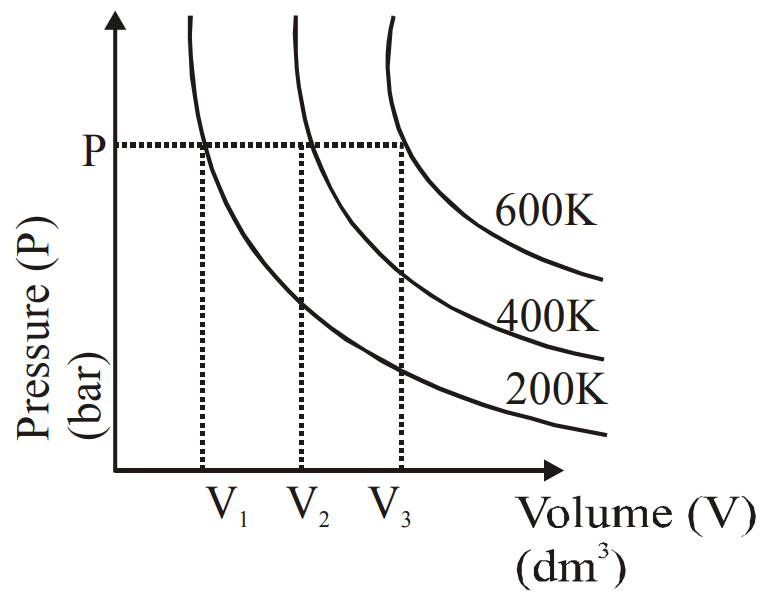
Choose the correct option for graphical representation of Boyle's law, which shows a graph of pressure vs. volume of a gas at different temperatures.According to Boyle's law, $P \propto \frac{1}{V}$ at constant temperature, so each isotherm is a rectangular hyperbola.
At a given pressure, $V \propto T$, so the isotherm for the higher temperature lies farther from the axes: 600 K above 400 K above 200 K.