Looking for classes? Ksquare Career Institute, Bengaluru →

Physics
Current Electricity
130 questions from 38 papers, each with its answer.
- 130 questions
- 38 papers
- 7.37% of Physics
Cells, emf and internal resistance
-
Two cells, having the same e.m.f., are connected in series through an external resistance $R$. Cells have internal resistances $r_1$ and $r_2$ ($r_1 \gt r_2$) respectively. When the circuit is closed, the potential difference across the first cell is zero. The value of $R$ is :-The two cells of emf $E$ each are in series, so the total emf is $2E$ and the total resistance is $r_1 + r_2 + R$.
Current in the circuit: $I = \dfrac{E + E}{r_1 + r_2 + R} = \dfrac{2E}{r_1 + r_2 + R}$
Terminal potential difference across the first cell: $V_1 = E - Ir_1$
According to the question, $E - Ir_1 = 0 \Rightarrow I = \dfrac{E}{r_1}$
$\therefore \dfrac{E}{r_1} = \dfrac{2E}{r_1 + r_2 + R}$
$\Rightarrow r_1 + r_2 + R = 2r_1$
$\Rightarrow R = r_1 - r_2$
Electrical Power in Resistor Networks
-
Power dissipated across the $8\,\Omega$ resistor in the circuit shown here is 2 watt. The power dissipated in watt units across the $3\,\Omega$ resistor is :-
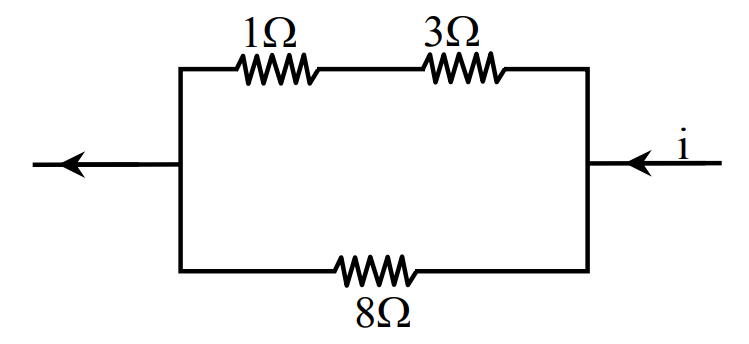 For the $8\,\Omega$ resistor, $P = \dfrac{V^2}{R} \Rightarrow V = \sqrt{PR}$
Voltage drop across $8\,\Omega$ $= \sqrt{2 \times 8} = 4$ V
The branch containing $1\,\Omega$ and $3\,\Omega$ in series is in parallel with the $8\,\Omega$ resistor, so the voltage across this branch is also 4 V.
This 4 V is divided between $1\,\Omega$ and $3\,\Omega$ in the ratio of their resistances (1 : 3).
Therefore the voltage drop across $3\,\Omega$ $= 4 \times \dfrac{3}{1 + 3} = 3$ V
Hence the power dissipated in $3\,\Omega$ $= \dfrac{(3)^2}{3}$
$= 3$ watt
Kirchhoff's Laws and Potential Divider
-
In the circuit shown, if a conducting wire is connected between points A and B, the current in this wire will-
(Two branches are connected in parallel across the source V. The upper branch has $4\,\Omega$ and $4\,\Omega$ in series with A as their junction; the lower branch has $1\,\Omega$ and $3\,\Omega$ in series with B as their junction.)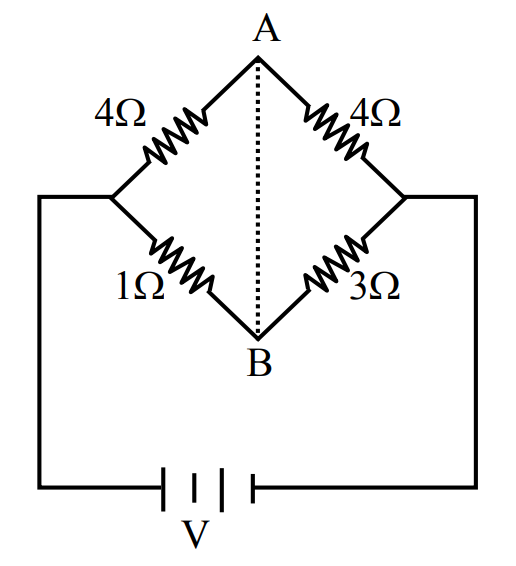 Before the wire is connected, find the potentials of A and B. Let the left end of both branches be at potential $V$ and the right end at zero.
Current in the upper branch $= \dfrac{V}{4 + 4} = \dfrac{V}{8}$, so $V_A = V - \dfrac{V}{8} \times 4 = \dfrac{V}{2}$
Current in the lower branch $= \dfrac{V}{1 + 3} = \dfrac{V}{4}$, so $V_B = V - \dfrac{V}{4} \times 1 = \dfrac{3V}{4}$
$V_A - V_B = \left(V - \dfrac{V}{8} \times 4\right) - \left(V - \dfrac{V}{4} \times 1\right) = -\dfrac{V}{2} + \dfrac{V}{4} = -\dfrac{V}{4}$
$\Rightarrow V_B \gt V_A$, whatever the value of $V$.
Current flows from the higher potential to the lower potential, so in the connecting wire it will flow from B to A.
That is every question in Current Electricity for this filter.
Want a score?
Answers here are not saved. Practise as a test to be marked and see your progress.
Practise as a test