Looking for classes? Ksquare Career Institute, Bengaluru →

Physics
Ray Optics and Optical Instruments
89 questions from 36 papers, each with its answer.
- 89 questions
- 36 papers
- 5.05% of Physics
Optical bench - index correction
-
Which of the following measurements require 'index correction'?Index correction (also known as bench correction) is applied in the optical bench experiment, which is used to find the focal length of lenses.
Apparent depth
-
Consider three media P, Q and R with refractive indices 1, 1.25 and 1.5 respectively. The medium Q having a thickness of 5 cm is placed between extended media P and R as shown in the figure. An object O is placed at the centre of medium Q. If viewed from medium P near the normal direction, the apparent depth of O is $h_1$. For similar observation from medium R, the apparent depth is $h_2$. The value of $|h_1-h_2|$, in cm, is:
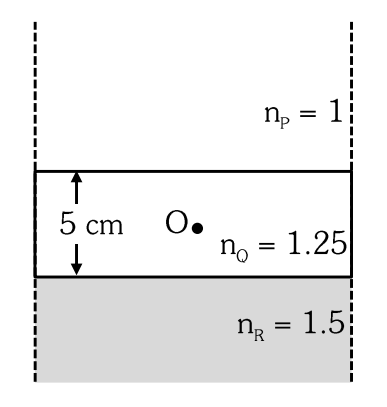 The object is 2.5 cm from each face of Q. Observer I (in P): $\frac{d'}{d}=\frac{\mu_P}{\mu_Q} \Rightarrow d'=2.5\times\frac{1}{1.25}=2$ cm $=h_1$. Observer II (in R): $d'=2.5\times\frac{1.5}{1.25}=3$ cm $=h_2$. $|h_1-h_2|=1$ cm.
Combination of lenses
-
The lens combination as shown in the figure, consists of two lenses, $L_1$ and $L_2$, of the focal lengths +10 cm and -10 cm, respectively. The position of the image formed is:
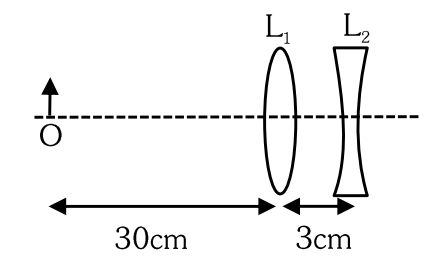 First lens: u = -30 cm, f = +10 cm, so $v=\frac{uf}{u+f}=\frac{-30\times10}{-30+10}=15$ cm. This image lies 12 cm beyond the concave lens (placed 3 cm away) and acts as a virtual object for it. Second lens: u = +12 cm, f = -10 cm, so $v=\frac{12\times(-10)}{12-10}=-60$ cm (virtual image). The negative sign means the image is 60 cm to the left of the concave lens.
That is every question in Ray Optics and Optical Instruments for this filter.
Want a score?
Answers here are not saved. Practise as a test to be marked and see your progress.
Practise as a test