Looking for classes? Ksquare Career Institute, Bengaluru →

Biological Classification
Kingdom Fungi
13 questions from 11 papers, each with its answer.
- questions
- 13
- papers
- 11
- years asked, 2017–2026
- 1 of 10
- of Biological Classification
- 11.11%
Appears in
Concepts tested
- Aflatoxins from Aspergillus
- Cell wall composition
- Classes of fungi
- Deuteromycetes
- Edible ascomycetes
- features of fungi
- Fungal diseases of plants
- Fungal pathogens
- Glycogen as reserve food
- Growth requirements of moulds
- Hallucinogenic fungi
- Members of Basidiomycetes
- Rust fungi
All Questions
2019 1 question
-
Which of the following statements is incorrect?
2015 AIPMT-I 1 question
-
Which one of the following matches is correct?Alternaria is a deuteromycete (imperfect fungus) in which sexual reproduction is absent.
Phytophthora belongs to Phycomycetes; its mycelium is aseptate.
Mucor belongs to Zygomycetes; it reproduces by conjugation.
Agaricus belongs to Basidiomycetes; it is saprotrophic, not parasitic.
2015 AIPMT-II 2 questions
-
Choose the wrong statement:
-
The imperfect fungi which are decomposers of litter and help in mineral cycling belong to:
2014 AIPMT 1 question
-
Which one of the following fungi contains hallucinogens?Amanita muscaria (fly agaric) is a poisonous mushroom that contains hallucinogenic compounds.
Morchella is an edible morel, Neurospora is used in genetics and Ustilago causes smut.
2011 AIPMT-MAINS 1 question
-
The pathogen $Microsporum$ responsible for ringworm disease in humans belongs to the same Kingdom of organisms as that ofRingworm is caused by fungi of the genera $Microsporum$, $Trichophyton$ and $Epidermophyton$.
So $Microsporum$ belongs to the Kingdom Fungi.
$Rhizopus$, the bread mould, is also a fungus (a phycomycete).
$Ascaris$, $Taenia$ and $Wuchereria$ are helminths belonging to Kingdom Animalia.
Hence $Microsporum$ belongs to the same kingdom as $Rhizopus$.
2010 AIPMT-MAINS 1 question
-
Black (stem) rust of wheat is caused byRust diseases are caused by basidiomycete fungi of the genus $Puccinia$.
$Puccinia\ graminis\ tritici$ causes black (stem) rust of wheat.
$Alternaria\ solani$ causes early blight of potato.
$Ustilago\ nuda$ causes loose smut of wheat and barley.
$Xanthomonas\ oryzae$ is a bacterium that causes bacterial blight of rice.
Hence black rust of wheat is caused by $Puccinia\ graminis$.
2008 AIPMT 1 question
-
Cellulose is the major component of cell walls of :The cell wall of true fungi is made of chitin (fungal cellulose) and other polysaccharides.
Pythium belongs to the Oomycetes (water moulds), a group traditionally placed in Phycomycetes. Unlike other fungi, the cell wall of oomycetes is mainly made of cellulose and glucans, with little or no chitin.
Pythium causes the damping-off disease of seedlings.
Saccharomyces (yeast) is an ascomycete fungus; its cell wall has glucans, mannans and chitin, not cellulose.
Pseudomonas and Xanthomonas are bacteria; their cell walls are made of peptidoglycan (murein).
So cellulose is the major component of the cell wall of Pythium.
2007 AIPMT-PRE 2 questions
-
Which pair of the following belongs to BasidiomycetesThe class Basidiomycetes includes those fungi that produce their basidia and basidiospores on or in a fruiting body called the basidiocarp.
Commonly known forms are mushrooms, bracket fungi, puffballs, stinkhorns and bird's nest fungi; rusts and smuts also belong here.
Bird's nest fungi and puffballs are both basidiomycetes, so this pair is correct.
Claviceps, Peziza and Morchella are members of Ascomycetes (sac fungi), which produce ascospores inside asci.
So every other pair contains one ascomycete: puffballs with Claviceps, Peziza with stinkhorns, and Morchella with mushrooms.
The pair belonging to Basidiomycetes is bird's nest fungi and puffballs. -
Ergot of rye is caused by a species of
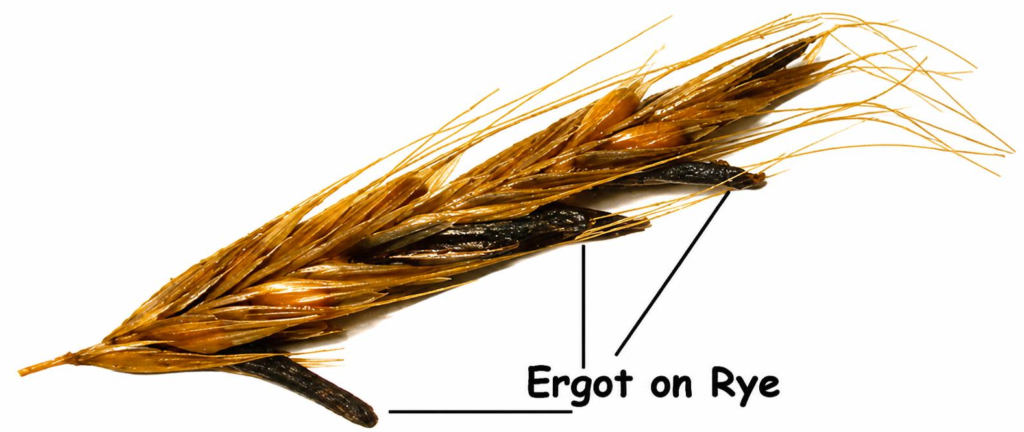
Ergot of rye is a plant disease caused by the fungus Claviceps purpurea, a member of Ascomycetes.
The fungus infects the ovaries of the rye flowers. The so-called ergot that replaces the grain of the rye is a dark, purplish sclerotium, from which the sexual stage of the life cycle forms after overwintering.
The sclerotia contain poisonous alkaloids; eating bread made from infected grain causes the disease ergotism. The hallucinogenic drug LSD is also derived from ergot alkaloids.
Uncinula causes powdery mildew of grapes.
Ustilago causes smut diseases of cereals.
Phytophthora infestans causes late blight of potato.
So ergot of rye is caused by a species of Claviceps.
2006 AIPMT-PRE 1 question
-
Which of the following environmental conditions are essential for optimum growth of Mucor on a piece of bread ?
A. Temperature of about $25^\circ C$
B. Temperature of about $5^\circ C$
C. Relative humidity of about 5%
D. Relative humidity of about 95%
E. A shady place
F. A brightly illuminated place
Choose the answer from the following optionsMucor is a saprophytic fungus (a mould of the class Phycomycetes) that grows on moist, stale bread and other decaying organic matter.
Temperature: fungi grow best at moderately warm temperatures of about 25 to $30^\circ C$. At about $5^\circ C$ (refrigerator temperature) growth is very slow, which is why food is preserved in a refrigerator. So A is required, not B.
Humidity: fungi need plenty of moisture for the germination of spores and the growth of hyphae, so a high relative humidity of about 95 percent is required. At 5 percent humidity the bread would dry up and the fungus would not grow. So D is required, not C.
Light: fungi have no chlorophyll and do not need light; bright light and the accompanying dryness are unfavourable, so they grow best in a shady or dark place. So E is required, not F.
So the essential conditions are A, D and E only.
2002 AIPMT 1 question
-
Which of the following secretes toxins during storage conditions of crop plants : -During storage of grains and seeds in warm, humid conditions, the mould Aspergillus flavus grows on groundnut, maize and other crops.
It secretes aflatoxins, which are highly toxic and carcinogenic (they damage the liver and cause liver cancer) to humans and animals.
Penicillium spoils stored fruits and is known for antibiotics, while Fusarium and Colletotrichum are mainly field pathogens.
So Aspergillus secretes toxins during storage of crop plants.
2000 AIPMT 1 question
-
Stored food in fungi :Fungi store their reserve food as glycogen (and oil droplets), like animals.
Chitin is a structural component of their cell walls, not a food reserve. Starch is the reserve food of green plants.
So the stored food in fungi is glycogen.