Looking for classes? Ksquare Career Institute, Bengaluru →

Human endocrine system
Appears in
Concepts tested here
- Hormones and their effects
- Hormones and their functions
- Hormones, sources and functions
All Questions
2011 AIPMT-PRE 2 questions
-
Match the source gland with its respective hormone as well as the function.Vasopressin (ADH) is synthesised in the hypothalamus but is stored in and released from the posterior pituitary; it stimulates reabsorption of water in the distal tubules of the nephron and so reduces loss of water in urine. This row is fully correct.
Thyroxine from the thyroid regulates the basal metabolic rate; blood calcium is regulated by thyrocalcitonin (and parathyroid hormone).
Oxytocin does cause contraction of the uterus during child birth, but it is released from the posterior pituitary, not the anterior pituitary.
The corpus luteum secretes mainly progesterone, which supports pregnancy.
Hence the correct match is posterior pituitary – vasopressin – stimulates resorption of water in the distal tubules. -
Given below is an incomplete table about certain hormones, their source glands and one major effect of each on the body in humans. Identify the correct option for the three blanks A, B and C.
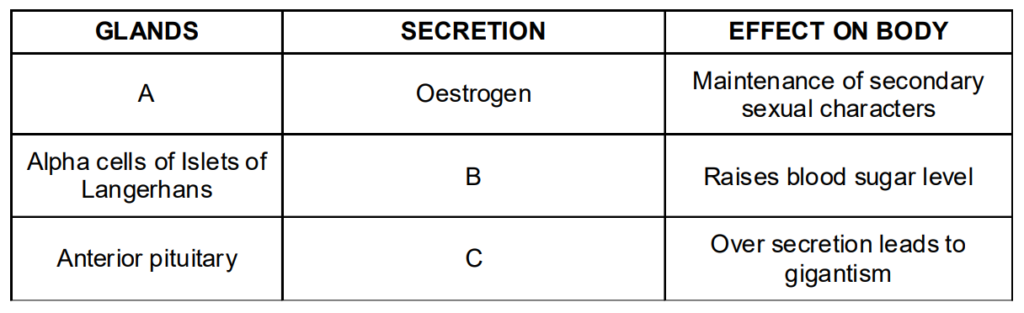 A: oestrogen that maintains the female secondary sexual characters is secreted by the growing follicles of the ovary, so A is the ovary.
B: the alpha cells of the islets of Langerhans secrete glucagon, which stimulates glycogenolysis and gluconeogenesis and so raises the blood sugar level (hyperglycemic hormone). Insulin is secreted by the beta cells and lowers blood sugar. So B is glucagon.
C: the anterior pituitary secretes growth hormone; its over-secretion stimulates abnormal growth of the body leading to gigantism. Calcitonin is from the thyroid and vasopressin is released from the posterior pituitary. So C is growth hormone.
Hence A is ovary, B is glucagon and C is growth hormone.
2010 AIPMT-MAINS 1 question
-
Select the correct matching of a hormone, its source and function.Norepinephrine (noradrenaline) and adrenaline are secreted by the adrenal medulla; they increase alertness, pupillary dilation, the heart beat, the strength of heart contraction and the rate of respiration (emergency hormones). This row is fully correct.
Vasopressin (ADH) is released from the posterior pituitary, but it stimulates reabsorption of water in the kidney and so reduces loss of water through urine.
Glucagon does stimulate glycogenolysis, but it is secreted by the alpha cells, not the beta cells, of the islets of Langerhans.
Prolactin does regulate the growth of mammary glands and milk formation, but it is secreted by the anterior pituitary.
Hence the correct match is norepinephrine – adrenal medulla – increases heart beat, rate of respiration and alertness.