Looking for classes? Ksquare Career Institute, Bengaluru →

Biology
Chemical Coordination and Integration
85 questions from 36 papers, each with its answer.
- 85 questions
- 36 papers
- 2.41% of Biology
Topics in this chapter
Most asked
Squares are the last ten exam years: filled means it was asked that year.
- 1Mechanism of Hormone Action7 questionsPractise Mechanism of Hormone Action
- 2Pituitary gland4 questionsPractise Pituitary gland
- 3Human endocrine system4 questionsPractise Human endocrine system
- 4Adrenal medulla3 questionsPractise Adrenal medulla
- 5Adrenal gland3 questionsPractise Adrenal gland
All topics
In syllabus order. Each goes to its questions below.
- 1. Adrenal Gland - Adrenal Medulla 1 question
- 2. Hypothalamus and Neurohypophysis 1 question
- 3. Hormones of Heart, Kidney and GI Tract 1 question
- 4. Endocrine Glands and Hormones 2 questions
- 5. Steroid vs Peptide Hormones 1 question
- 6. Endocrine Disorders - Goiter, Acromegaly, Cushing's, Cretinism 1 question
- 7. Hormones of Heart, Kidney and Gastrointestinal Tract 2 questions
- 8. Endocrine Glands and Hormones – Thyroid 1 question
- 9. Endocrine Glands – Parathyroid Gland 1 question
- 10. Disorders of Endocrine Glands 2 questions
- 11. Endocrine Glands – Pancreas and Adrenal Cortex 1 question
- 12. Hormones of the Pancreas – Action of Insulin 1 question
- 13. Mechanism of Hormone Action 7 questions
- 14. Hormones and their functions 2 questions
- 15. Functions of hormones 1 question
- 16. Sources and actions of various hormones 1 question
- 17. Neurohypophysis (posterior pituitary) hormones 1 question
- 18. Chemical nature of hormones 2 questions
- 19. Structure of insulin 1 question
- 20. Endocrine glands and hormone functions 1 question
- 21. Parathyroid hormone functions 1 question
- 22. Hormones during pregnancy 1 question
- 23. Pineal gland - melatonin 1 question
- 24. Parathyroid hormone 1 question
- 25. Pituitary gland 4 questions
- 26. Pancreas - islets of Langerhans 1 question
- 27. Classification of hormones by chemical nature 1 question
- 28. Hormones regulating bone and calcium – osteoporosis 1 question
- 29. Endocrine glands – corpus luteum 1 question
- 30. Hypothalamic hormones – GnRH 1 question
- 31. Growth hormone – disorders 1 question
- 32. Gonadal hormones – inhibin 1 question
- 33. Hormones – amino acid derivatives 1 question
- 34. Antagonistic hormones 1 question
- 35. Thyroid disorders – Graves' disease 1 question
- 36. Pancreatic hormones – insulin 1 question
- 37. Pituitary gland – neurohypophysis 1 question
- 38. Adrenal medulla 3 questions
- 39. Hormones and blood sugar 1 question
- 40. Hormones 1 question
- 41. Adrenal gland 3 questions
- 42. Thyroid gland 3 questions
- 43. Endocrine system 1 question
- 44. Pineal gland 2 questions
- 45. Human endocrine system 4 questions
- 46. Pancreas 1 question
- 47. Hormones of the Pituitary 1 question
- 48. Parathyroid Gland 2 questions
- 49. Testis and Androgens 1 question
- 50. Homeostasis and Feedback Regulation 1 question
- 51. Neuroendocrine Coordination 1 question
- 52. Adrenal Cortex 1 question
- 53. Disorders of the Thyroid Gland 1 question
- 54. Mechanism of Hormone Action: Types of Hormones 1 question
- 55. Hormones of the Gastrointestinal Tract 1 question
- 56. Hormone Deficiency Disorders 2 questions
- 57. Hormones of the Ovary 1 question
- 58. Adrenal Medulla Hormones 1 question
- 59. Disorders of Pituitary Gland 1 question
Adrenal Gland - Adrenal Medulla
-
Consider the following statements regarding function of adrenal medullary hormones:
A. It causes pupilary constriction
B. It is a hyperglycemic hormone
C. It causes piloerection
D. It increases strength of heart contraction
Choose the correct answer from the options given below:Adrenaline causes pupillary dilation (not constriction), glycogenolysis (hyperglycemia), piloerection, and increased cardiac inotropy/chronotropy.
Catecholamines (adrenaline and noradrenaline) stimulate the fight-or-flight response: pupillary dilation (A is false), breakdown of glycogen leading to increased blood glucose (B is true), piloerection / raising of hairs (C is true), and increased force and rate of myocardial contraction (D is true).
Hypothalamus and Neurohypophysis
-
Which of the following hormones released from the pituitary is actually synthesized in the hypothalamus?
ADH (vasopressin) and oxytocin are synthesized in hypothalamic nuclei and released by posterior pituitary.
The neurohypophysis (posterior pituitary) does not synthesize hormones; it stores and releases oxytocin and vasopressin (Anti-Diuretic Hormone, ADH), which are synthesized by supraoptic and paraventricular nuclei of the hypothalamus.
Hormones of Heart, Kidney and GI Tract
-
Match List-I with List-II.
Pick the matching item from Column II for each row.
Column I
- A. Heart
- B. Kidney
- C. Gastro-intestinal tracts
- D. Adrenal Cortex
Column II
- I. Erythropoietin
- II. Aldosterone
- III. Atrial natriuretic factor
- IV. Secretin
Correct answer: A → III, B → I, C → IV, D → II
A-III, B-I, C-IV, D-II.
Atrial wall of heart secretes ANF (III). Juxtaglomerular cells of kidney secrete erythropoietin (I). GI mucosa secretes secretin (IV). Adrenal cortex (zona glomerulosa) secretes aldosterone (mineralocorticoid) (II).
Endocrine Glands and Hormones
-
Match List-I with List-II.
Pick the matching item from Column II for each row.
Column I
- A. Progesterone
- B. Relaxin
- C. Melanocyte stimulating hormone
- D. Catecholamines
Column II
- I. Pars intermedia
- II. Ovary
- III. Adrenal Medulla
- IV. Corpus luteum
Correct answer: A → IV, B → II, C → I, D → III
A-IV, B-II, C-I, D-III.
Progesterone is secreted by the corpus luteum (IV). Relaxin is secreted by the ovary/placenta in late pregnancy (II). MSH is secreted by pars intermedia of the pituitary (I). Catecholamines are synthesized and secreted by the adrenal medulla (III). -
Select the answer which correctly matches the endocrine gland with the hormone it secretes and its function/deficiency symptom:The thyroid gland secretes thyroxine; lack of iodine in the diet causes hypothyroidism and enlargement of the gland (goitre).
Corpus luteum secretes progesterone, oxytocin comes from the posterior pituitary and GH from the anterior pituitary.
Steroid vs Peptide Hormones
-
Which of the following is not a steroid hormone?Glucagon is a peptide (protein) hormone secreted by the $\alpha$-cells of the pancreas. Progesterone, cortisol and testosterone are steroid hormones.
Endocrine Disorders - Goiter, Acromegaly, Cushing's, Cretinism
-
Match List-I with List-II regarding endocrine disorders and their features.
Pick the matching item from Column II for each row.
Column I
- A. Exophthalmic goiter
- B. Acromegaly
- C. Cushing's syndrome
- D. Cretinism
Column II
- I. Excess secretion of cortisol, moon face & hyperglycemia
- II. Hypo-secretion of thyroid hormone and stunted growth.
- III. Hyper secretion of thyroid hormone & protruding eye balls.
- IV. Excessive secretion of growth hormone.
Correct answer: A → III, B → IV, C → I, D → II
Exophthalmic goitre – hypersecretion of thyroid hormone and protruding eyeballs Acromegaly – excessive secretion of growth hormone (in adults) Cushing's syndrome – excess secretion of cortisol, moon face and hyperglycaemia Cretinism – hyposecretion of thyroid hormone (in infancy) and stunted growth Correct match: A-III, B-IV, C-I, D-II.
Hormones of Heart, Kidney and Gastrointestinal Tract
-
Match List-I with List-II.
Pick the matching item from Column II for each row.
Column I
- A. CCK
- B. GIP
- C. ANF
- D. ADH
Column II
- I. Kidney
- II. Heart
- III. Gastric gland
- IV. Pancreas
Correct answer: A → IV, B → III, C → II, D → I
CCK acts on the pancreas, GIP on gastric glands, ANF is from the heart and ADH acts on the kidney.
Cholecystokinin (CCK), a hormone secreted by I-cells of the upper small intestine. It acts on both pancreas and gall bladder and stimulates the secretion of pancreatic enzymes and bile juice, respectively. Gastric inhibitory peptide (GIP) is secreted by K-cells of the small intestine. It acts to decrease gastrin and gastrin dependent acid secretion from the parietal cells of the stomach (gastric glands). Atrial natriuretic factor (ANF) is a peptide hormone secreted by atrial wall of our heart. It decreases blood pressure. Anti-diuretic hormone (ADH) causes the kidneys to return more water to the blood and thus decrease the urine volume. -
Erythropoietin hormone which stimulates R.B.C. formation is produced by:
Endocrine Glands and Hormones – Thyroid
-
Which of the following are NOT under the control of thyroid hormone? A. Maintenance of water and electrolyte balance B. Regulation of basal metabolic rate C. Normal rhythm of sleep-wake cycle D. Development of immune system E. Support the process of R.B.Cs formation Choose the correct answer from the options given below:
Sleep-wake rhythm is controlled by melatonin and immune system development by the thymus, not thyroid hormone.
Thyroid hormones play an important role in the regulation of the basal metabolic rate. These hormones also support the process of red blood cell formation. Thyroid hormones control the metabolism of carbohydrates, proteins and fats. Maintenance of water and electrolyte balance is also influenced by thyroid hormones. Thyroid gland also secretes a protein hormone called thyrocalcitonin (TCT) which regulates the blood calcium levels. Melatonin plays a very important role in regulation of system of our body. It maintains sleep wake cycle, body temperature, etc. Thymus helps in development of the immune system.
Endocrine Glands – Parathyroid Gland
-
Which of the following are not the effects of Parathyroid hormone? A. Stimulates the process of bone resorption B. Decrease $Ca^{2+}$ level in blood C. Reabsorption of $Ca^{2+}$ by renal tubules D. Decrease the absorption of $Ca^{2+}$ from digested food E. Increases metabolism of carbohydrates Choose the most appropriate answer from the options given below:
Disorders of Endocrine Glands
-
Match the following columns and select the correct option.
Pick the matching item from Column II for each row.
Column I
- A. Pituitary gland
- B. Thyroid gland
- C. Adrenal gland
- D. Pancreas
Column II
- I. Grave's disease
- II. Diabetes mellitus
- III. Diabetes insipidus
- IV. Addison's disease
Correct answer: A → III, B → I, C → IV, D → II
-
Match the following hormones with the respective disease:
Pick the matching item from Column II for each row.
Column I
- A. Insulin
- B. Thyroxin
- C. Corticoids
- D. Growth Hormone
Column II
- I. Addison's disease
- II. Diabetes insipidus
- III. Acromegaly
- IV. Goitre
- V. Diabetes mellitus
Correct answer: A → V, B → IV, C → I, D → III
Endocrine Glands – Pancreas and Adrenal Cortex
-
Select the correct statement.Glucocorticoids stimulate gluconeogenesis, lipolysis and proteolysis, increasing blood sugar level – correct. Glucagon is associated with hyperglycaemia, and insulin acts on hepatocytes and adipocytes and is associated with hypoglycaemia.
Hormones of the Pancreas – Action of Insulin
-
Which of the following glucose transporters is insulin-dependent?
Mechanism of Hormone Action
-
FSH which interacts with membrane bound receptors does not enter the target cell.Reason: Binding of FSH to its receptors generates second messenger (cyclic AMP) for its biochemical and physiological responses.FSH is a peptide (lipid-insoluble) hormone, so it cannot pass through the membrane and acts through membrane-bound receptors - the assertion is correct. Binding of such hormones to membrane receptors generates second messengers (cAMP) - the reason is also correct, but it does not explain why FSH does not enter the cell (that is due to its lipid insolubility).
-
How does steroid hormone influence the cellular activities?
-
Identify A, B and C in the diagrammatic representation of the mechanism of hormone action. [add image]
-
Which one of the following pairs of hormones are the examples of those that can easily pass through the cell membrane of the target cell and bind to a receptor inside it (mostly in the nucleus)?Steroid hormones such as cortisol and testosterone are lipid soluble. They pass through the cell membrane and bind to intracellular receptors, mostly in the nucleus, and regulate gene expression.
Insulin, glucagon, somatostatin and oxytocin are peptide or protein hormones; they bind to membrane-bound receptors and act through second messengers. -
What is correct to say about the hormone action in humans?FSH is a protein hormone; it cannot enter the cell, so it first binds to specific membrane-bound receptors on the ovarian cell membrane and acts through a second messenger.
FSH stimulates follicular growth and estrogen secretion, not progesterone. Glucagon is secreted by α-cells. Thymosin secretion decreases with ageing as the thymus degenerates. -
A sequential expression of a set of human genes occurs when a steroid molecule binds to theSteroid hormones are lipid soluble, so they pass easily through the plasma membrane of the target cell.
Inside the cell they bind to specific intracellular receptors, mostly nuclear receptors, to form a hormone-receptor complex.
This complex binds to a specific regulatory DNA sequence of the genome (the hormone response element).
The binding switches on the transcription of a particular set of genes one after another, so that mRNA and then proteins are produced. In this way steroid hormones regulate gene expression and chromosome function.
The steroid does not bind to mRNA, tRNA or the ribosome; these take part later in translation.
So the sequential expression of a set of genes occurs when the steroid molecule binds to the DNA sequence. -
Which one of the following is not a second messenger in hormone action ?Peptide, protein and catecholamine hormones cannot enter the target cell; they bind to membrane-bound receptors on its surface.
The hormone is the first messenger. Its binding to the receptor generates a second messenger inside the cell, which carries the message further and regulates cellular metabolism.
The common second messengers are cyclic AMP (cAMP), cyclic GMP (cGMP), inositol triphosphate ($IP_3$) and calcium ions ($Ca^{2+}$).
Sodium ions are important for the membrane potential and the nerve impulse, but they do not act as a second messenger in hormone action.
So the one that is not a second messenger is sodium.
Hormones and their functions
-
Match List I with List II:
Pick the matching item from Column II for each row.
Column I
- i. Cortisol
- ii. Aldosterone
- iii. Cholecystokinin
- iv. Progesterone
Column II
- a. Stimulates the formation of alveoli in mammary glands
- b. Produces anti-inflammatory reactions
- c. Stimulates reabsorption of $Na^+$ and water from renal tubule
- d. Stimulates secretion of pancreatic enzymes and bile juice
Correct answer: i → b, ii → c, iii → d, iv → a
-
Match List-I with List-II.
Pick the matching item from Column II for each row.
Column I
- A. Excess growth hormone
- B. Luteinizing hormone
- C. Vasopressin
- D. Oxytocin
Column II
- I. Reabsorption of water and electrolytes in kidney
- II. Contraction of uterus during child birth
- III. Acromegaly
- IV. Ovulation
Correct answer: A → III, B → IV, C → I, D → II
Reference: NCERT Class XI, pages 241, 242.
Functions of hormones
-
Match List-I with List-II and choose the correct answer from the options given below:
Pick the matching item from Column II for each row.
Column I
- A. Epinephrine
- B. Thyroxine
- C. Oxytocin
- D. Glucagon
Column II
- I. Hyperglycemia
- II. Smooth muscle contraction
- III. Basal metabolic rate
- IV. Emergency hormone
Correct answer: A → IV, B → III, C → II, D → I
Epinephrine is known as the emergency hormone (A-IV); Thyroxine regulates the basal metabolic rate (B-III); Oxytocin causes smooth muscle contraction (C-II); Glucagon causes hyperglycemia (D-I).
Sources and actions of various hormones
-
Identify the wrong statements: A. Erythropoietin is produced by juxtaglomerular cells of the kidney B. Leydig cells produce Androgens C. Atrial Natriuretic factor, a peptide hormone is secreted by the seminiferous tubules of the testes D. Cholecystokinin is produced by gastrointestinal tract E. Gastrin acts on intestinal wall and helps in the production of pepsinogen. Choose the most appropriate answer from the options given below:Atrial Natriuretic Factor (ANF) is actually secreted by the atria of the heart, not the seminiferous tubules of the testes — so statement C is wrong. Gastrin acts on the gastric glands (not the intestinal wall) and stimulates secretion of HCl and pepsinogen — so statement E is also wrong.
Neurohypophysis (posterior pituitary) hormones
-
Hormones stored and released from neurohypophysis areOxytocin and Vasopressin (ADH) are synthesised by the hypothalamus and stored/released from the neurohypophysis (posterior pituitary).
Chemical nature of hormones
-
Match the following columns and select the correct option:
Pick the matching item from Column II for each row.
Column I
- a. Pituitary hormone
- b. Epinephrine
- c. Endorphins
- d. Cortisol
Column II
- i. Steroid
- ii. Neuropeptides
- iii. Peptides, proteins
- iv. Biogenic amines
Correct answer: a → iii, b → iv, c → ii, d → i
Pituitary hormone is of the peptides/proteins type (a-iii); Epinephrine is a biogenic amine (b-iv); Endorphins are neuropeptides (c-ii); Cortisol is a steroid (d-i). -
Chemically hormones are :-Hormones belong to different chemical groups:
Proteins and peptides: insulin, glucagon, pituitary and hypothalamic hormones.
Steroids: cortisol, aldosterone, testosterone, estradiol, progesterone.
Biogenic amines (amino acid derivatives): epinephrine, norepinephrine and thyroxine. (Iodothyronines are sometimes listed separately.)
So chemically hormones are proteins, steroids and biogenic amines.
Structure of insulin
-
Select incorrect statement, regarding chemical structure of insulin.Mature insulin consists of only two polypeptide chains, A and B (linked by disulphide bridges), not three chains — so the statement that it consists of three chains (A, B and C) is incorrect. Insulin is synthesised as a prohormone (proinsulin) containing an extra C-peptide segment, which is removed before the mature hormone is formed.
Endocrine glands and hormone functions
-
Which of the following statements are correct with respect to the hormone and its function? (A) Thyrocalcitonin (TCT) regulates the blood calcium level. (B) In males, FSH and androgens regulate spermatogenesis. (C) Hyperthyroidism can lead to goitre. (D) Glucocorticoids are secreted in Adrenal Medulla. (E) Parathyroid hormone is regulated by circulating levels of sodium ions. Choose the most appropriate answer from the options given below:Thyrocalcitonin (TCT) regulates blood calcium levels (A is correct), and FSH along with androgens regulates spermatogenesis in males (B is correct). Hypothyroidism (not hyperthyroidism) typically leads to goitre (C is incorrect as stated). Glucocorticoids are secreted from the Adrenal Cortex, not the Adrenal Medulla (D is incorrect). Parathyroid hormone is regulated by circulating levels of calcium ions, not sodium ions (E is incorrect). So A and B only.
Parathyroid hormone functions
-
Given below are two statements: Statement I: Parathyroid hormone acts on bones and stimulates the process of bone resorption. Statement II: Parathyroid hormone along with Thyrocalcitonin plays a significant role in carbohydrate metabolism. In the light of the above statements, choose the correct answer from the options given below:Parathyroid hormone (PTH) does act on bones to stimulate bone resorption, increasing blood calcium levels (Statement I is true). PTH and thyrocalcitonin together play a significant role in calcium metabolism (regulating blood calcium levels), not carbohydrate metabolism — so Statement II is false.
Hormones during pregnancy
-
During pregnancy the level of thyroxine is increased in the maternal blood.Reason: Pregnancy is characterised by metabolic changes in the mother.During pregnancy the metabolic rate of the mother increases to meet the needs of the mother and the developing foetus; this is brought about by an increase in thyroxine. Both statements are correct and the reason explains the assertion.
Pineal gland - melatonin
-
Artificial light, extended work-time and reduced sleep time disrupt the activity of
Parathyroid hormone
-
Which of the following conditions will stimulate parathyroid gland to release parathyroid hormone?
Pituitary gland
-
Which of the following statements related to pituitary gland are correct? (a) It is divided anatomically into adenohypophysis and neurohypophysis (b) It secretes follicle stimulating hormone (c) It secretes melanocyte stimulating hormone (d) It does not secrete prolactin Choose the correct answer from the options given below:Reference: NCERT Class XI, page 241.
-
Which one of the following hormones though synthesised elsewhere, is stored and released by the master gland?
-
Which of the following is an accumulation and release centre of neurohormones ?Neurohormones are hormones produced by neurosecretory cells (modified neurons).
Oxytocin and vasopressin (ADH) are synthesised by the neurosecretory cells of the hypothalamus.
They are transported along the axons of these cells to the posterior lobe of the pituitary (neurohypophysis, pars nervosa).
The posterior pituitary does not synthesise any hormone; it only stores (accumulates) these neurohormones and releases them into the blood when required.
So the hypothalamus is the site of synthesis, while the posterior pituitary is the accumulation and release centre.
The anterior and intermediate lobes synthesise and secrete their own hormones.
So the accumulation and release centre of neurohormones is the posterior pituitary lobe. -
MSH is secreted by :The pituitary has an anterior lobe (pars distalis), an intermediate lobe (pars intermedia) and a posterior lobe (pars nervosa).
The intermediate (middle) lobe secretes melanocyte stimulating hormone (MSH), which acts on melanocytes and regulates skin pigmentation.
So MSH is secreted by the middle lobe of the pituitary.
Pancreas - islets of Langerhans
-
Which one of the following statements is incorrect?Reference: NCERT Class XI, page 245.
Classification of hormones by chemical nature
-
Which of the following is an amino acid derived hormone?
Epinephrine is a tyrosine-derived catecholamine; the others are steroids.
Epinephrine is derived from the amino acid tyrosine by the removal of the carboxyl group. It is a catecholamine.
Hormones regulating bone and calcium – osteoporosis
-
Which of the following hormones can play a significant role in osteoporosis?
Low estrogen and excess PTH both cause bone loss.
Estrogen promotes the activity of osteoblasts and inhibits osteoclasts. In an ageing female, osteoporosis occurs due to deficiency of estrogen. Parathormone promotes mobilisation of calcium from bone into blood. Excessive activity of parathormone causes demineralisation, leading to osteoporosis.
Endocrine glands – corpus luteum
-
A temporary endocrine gland in the human body is
Corpus luteum forms after ovulation and degenerates later.
The corpus luteum is a temporary endocrine structure formed in the ovary after ovulation. It releases hormones like progesterone and oestrogen.
Hypothalamic hormones – GnRH
-
GnRH, a hypothalamic hormone, needed in reproduction, acts on
GnRH → anterior pituitary → LH and FSH.
The hypothalamus secretes GnRH, which stimulates the anterior pituitary gland to secrete gonadotropins (FSH and LH).
Growth hormone – disorders
-
Hypersecretion of Growth Hormone in adults does not cause further increase in height, because
Closed growth plates prevent further lengthening of bones.
The epiphyseal plate is responsible for growth of bone in length; it closes after adolescence, so hypersecretion of growth hormone in adults does not increase height.
Gonadal hormones – inhibin
-
Identify the correct statement on 'inhibin'.
Inhibin selectively suppresses FSH.
The ovary secretes estradiol, progesterone and inhibin. Inhibin is secreted by granulosa cells of ovarian follicles and the corpus luteum.
Its target is the anterior pituitary, where it inhibits the secretion of FSH.
Hormones – amino acid derivatives
-
The amino acid, tryptophan is the precursor for the synthesis of
Tryptophan → serotonin → melatonin.
Thyroxine and tri-iodothyronine are derived from tyrosine (with iodine). Melatonin and serotonin are derived from tryptophan.
Antagonistic hormones
-
Which of the following pairs of hormones are not antagonistic (having opposite effects) to each other?
Relaxin and inhibin act on unrelated targets.
Relaxin is secreted by the ovary during pregnancy; it helps parturition, softens the pubic symphysis and relaxes the cervix. Inhibin decreases the secretion of FSH and LH. They do not have opposite effects.
Thyroid disorders – Graves' disease
-
Graves' disease is caused due to:
Pancreatic hormones – insulin
-
Name a peptide hormone which acts mainly on hepatocytes, adipocytes and enhances cellular glucose uptake and utilization.
Pituitary gland – neurohypophysis
-
The posterior pituitary gland is not a 'true' endocrine gland because:
Adrenal medulla
-
A chemical signal that has both endocrine and neural roles isEpinephrine is secreted by the adrenal medulla in emergencies when sympathetic nerve impulses reach it.
It acts as a hormone and produces effects like sympathetic stimulation; the adrenal medulla and sympathetic system work as one integrated system. -
Feeling the tremors of an earthquake a scared resident of seventh floor of a multistoreyed building starts climbing down the stairs rapidly. Which hormone initiated this action?Adrenaline (epinephrine) is secreted by the adrenal medulla, along with noradrenaline, in response to stress of any kind and during emergency situations.
It is commonly called the emergency hormone or the hormone of fright, fight or flight (3F hormone).
Its secretion is stimulated by the sympathetic nervous system, not by the pituitary as in the case of the adrenal cortex.
It increases alertness, dilates the pupils, and increases the heart beat, the strength of heart contraction and the rate of breathing; it dilates the coronary artery and the bronchioles.
It also stimulates the breakdown of glycogen, raising the blood glucose, and the breakdown of lipids and proteins, so that extra energy is available to the muscles.
These changes prepare the scared person to run down the stairs rapidly.
So the hormone that initiated this action is adrenaline. -
Which hormone causes dilation of blood vessels, increased oxygen consumption and glycogenolysis ?Adrenaline (epinephrine) is secreted by the adrenal medulla during stress and emergency; it is called the emergency hormone or the hormone of fight or flight.
It dilates the blood vessels of the skeletal muscles, heart and liver, so that more blood reaches them, and it dilates the bronchioles.
It increases the heart beat, the rate of respiration and the metabolic rate, so the consumption of oxygen increases.
It stimulates the breakdown of glycogen (glycogenolysis) in the liver and muscles, raising the blood glucose level.
Glucagon also causes glycogenolysis, but it does not dilate blood vessels or increase oxygen consumption in this way.
Insulin lowers blood glucose by promoting glycogenesis, and ACTH stimulates the adrenal cortex.
So the hormone is adrenalin.
Hormones and blood sugar
-
Which one of the following hormones is not involved in sugar metabolism?
Hormones
-
Identify the hormone with its correct matching of source and function:Melatonin is secreted by the pineal gland and regulates the 24-hour (diurnal) rhythm, including the sleep-wake cycle.
Atrial natriuretic factor comes from the atrial wall and lowers blood pressure.
Adrenal gland
-
Fight-or-flight reactions cause activation of:In stress or emergency the adrenal medulla secretes adrenaline (epinephrine) and noradrenaline (norepinephrine), the fight-or-flight hormones.
-
A person entering an empty room suddenly finds a snake right in front on opening the door. Which one of the following is likely to happen in his neuro-hormonal control system?In an emergency the sympathetic nervous system is activated and stimulates the adrenal medulla.
The adrenal medulla secretes adrenaline (epinephrine) and noradrenaline (norepinephrine), the fight-or-flight hormones.
These hormones come from the medulla, not the cortex. -
Injury to adrenal cortex is not likely to affect the secretion of which one of the following?The adrenal gland has two parts: the outer adrenal cortex and the central adrenal medulla.
The adrenal cortex secretes corticoids: glucocorticoids (mainly cortisol), mineralocorticoids (mainly aldosterone) and small amounts of androgenic steroids (androstenedione, dehydroepiandrosterone).
The adrenal medulla secretes the catecholamines adrenaline (epinephrine) and noradrenaline (norepinephrine).
So an injury to the cortex affects cortisol, aldosterone and the androgens, but not adrenaline.
Hence the secretion of adrenaline is not likely to be affected.
Thyroid gland
-
A pregnant female delivers a baby who suffers from stunted growth, mental retardation, low intelligence quotient and abnormal skin. This is the result of:Iodine deficiency in the diet of a pregnant woman causes hypothyroidism, which leads to defective development of the baby: stunted growth (cretinism), mental retardation, low IQ and abnormal skin.
-
Toxic agents present in food which interfere with thyroxine synthesis lead to the development ofCertain substances in food (goitrogens, e.g., in cabbage and related vegetables) interfere with the uptake of iodine and the synthesis of thyroxine.
The fall in thyroxine removes the negative feedback on the pituitary, so more TSH is secreted; TSH makes the thyroid gland enlarge. This enlargement due to under-production of thyroxine is simple goitre.
Thyrotoxicosis and toxic (exophthalmic) goitre are conditions of over-secretion of thyroid hormones, i.e., hyperthyroidism.
Cretinism results from deficiency of thyroid hormones during pregnancy and infancy and causes stunted growth and mental retardation in the child.
Hence such toxic agents lead to simple goitre. -
A health disorder that results from the deficiency of thyroxine in adults and is characterised by (i) a low metabolic rate, (ii) increase in body weight and (iii) tendency to retain water in tissues isDeficiency of thyroid hormones is called hypothyroidism in general; its specific forms have separate names.
In adults, deficiency of thyroxine causes myxoedema: low basal metabolic rate, gain in body weight, puffy appearance due to retention of water (accumulation of mucopolysaccharides under the skin), lethargy and low body temperature.
Cretinism is the result of thyroid hormone deficiency in infants and children: stunted growth, mental retardation, low intelligence quotient and abnormal skin.
Simple goitre is the enlargement of the thyroid gland due to deficiency of iodine in the diet.
Since the question specifies adults and these three symptoms, the disorder is myxoedema.
Endocrine system
-
Which of the following statements is correct in relation to the endocrine system?Hormones are non-nutrient chemicals produced in trace amounts that act as intercellular messengers.
Releasing and inhibiting hormones come from the hypothalamus, and the gut, heart, kidney and liver also produce hormones.
Pineal gland
-
The 24 hour (diurnal) rhythm of our body such as the sleep-wake cycle is regulated by the hormoneThe pineal gland, located on the dorsal side of the forebrain, secretes the hormone melatonin.
Melatonin plays a very important role in the regulation of the 24-hour (diurnal) rhythm of the body; it helps in maintaining the normal rhythm of the sleep-wake cycle and body temperature.
It also influences metabolism, pigmentation, the menstrual cycle and defence capability.
Adrenaline is the emergency hormone of the adrenal medulla, calcitonin lowers blood calcium, and prolactin regulates the growth of mammary glands and milk formation.
Hence the sleep-wake cycle is regulated by melatonin. -
Melatonin is secreted by :The pineal gland, on the dorsal side of the forebrain, secretes melatonin.
Melatonin regulates the 24-hour (diurnal) rhythms of the body, such as the sleep–wake cycle and body temperature, and also influences metabolism, pigmentation and menstrual cycle.
So melatonin is secreted by the pineal body.
Human endocrine system
-
Match the source gland with its respective hormone as well as the function.Vasopressin (ADH) is synthesised in the hypothalamus but is stored in and released from the posterior pituitary; it stimulates reabsorption of water in the distal tubules of the nephron and so reduces loss of water in urine. This row is fully correct.
Thyroxine from the thyroid regulates the basal metabolic rate; blood calcium is regulated by thyrocalcitonin (and parathyroid hormone).
Oxytocin does cause contraction of the uterus during child birth, but it is released from the posterior pituitary, not the anterior pituitary.
The corpus luteum secretes mainly progesterone, which supports pregnancy.
Hence the correct match is posterior pituitary – vasopressin – stimulates resorption of water in the distal tubules. -
Given below is an incomplete table about certain hormones, their source glands and one major effect of each on the body in humans. Identify the correct option for the three blanks A, B and C.
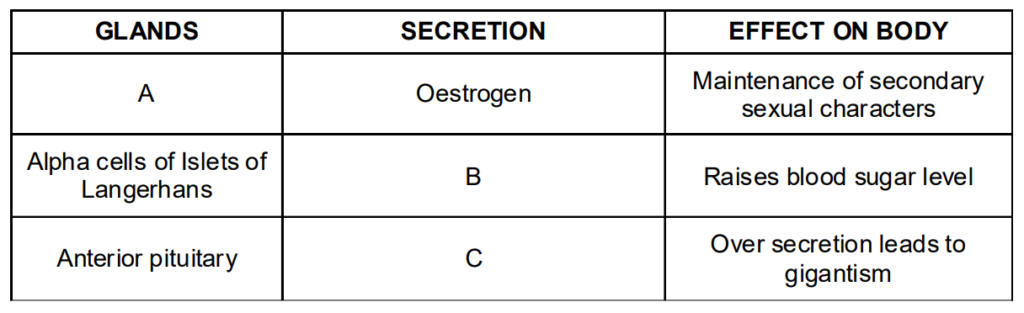 A: oestrogen that maintains the female secondary sexual characters is secreted by the growing follicles of the ovary, so A is the ovary.
B: the alpha cells of the islets of Langerhans secrete glucagon, which stimulates glycogenolysis and gluconeogenesis and so raises the blood sugar level (hyperglycemic hormone). Insulin is secreted by the beta cells and lowers blood sugar. So B is glucagon.
C: the anterior pituitary secretes growth hormone; its over-secretion stimulates abnormal growth of the body leading to gigantism. Calcitonin is from the thyroid and vasopressin is released from the posterior pituitary. So C is growth hormone.
Hence A is ovary, B is glucagon and C is growth hormone. -
Select the correct matching of a hormone, its source and function.Norepinephrine (noradrenaline) and adrenaline are secreted by the adrenal medulla; they increase alertness, pupillary dilation, the heart beat, the strength of heart contraction and the rate of respiration (emergency hormones). This row is fully correct.
Vasopressin (ADH) is released from the posterior pituitary, but it stimulates reabsorption of water in the kidney and so reduces loss of water through urine.
Glucagon does stimulate glycogenolysis, but it is secreted by the alpha cells, not the beta cells, of the islets of Langerhans.
Prolactin does regulate the growth of mammary glands and milk formation, but it is secreted by the anterior pituitary.
Hence the correct match is norepinephrine – adrenal medulla – increases heart beat, rate of respiration and alertness. -
Which one of the following pairs of organs includes only the endocrine glands?Endocrine glands are ductless glands that pour their secretions (hormones) directly into the blood.
The parathyroid glands secrete only parathyroid hormone, and the adrenal glands secrete only hormones (corticoids from the cortex and catecholamines from the medulla). Both are purely endocrine glands.
The testes and ovaries have a dual function: besides secreting sex hormones they produce gametes (sperms and ova), so they are not exclusively endocrine.
The pancreas is a composite (heterocrine) gland: its acini secrete pancreatic juice through a duct (exocrine part), while the islets of Langerhans secrete insulin and glucagon (endocrine part).
So every other pair contains at least one organ that is not purely endocrine.
The pair that includes only endocrine glands is parathyroid and adrenal.
Pancreas
-
Which one of the following pairs is incorrectly matched?The islets of Langerhans contain α-cells, which secrete glucagon, and β-cells, which secrete insulin.
So the source of glucagon is the alpha cells, not the beta cells; this pair is incorrectly matched.
Deficiency of insulin leads to diabetes mellitus (correct).
Somatostatin is secreted by the delta cells of the islets (correct).
The corpus luteum (ovary) secretes relaxin in the later phase of pregnancy (correct).
Hence the incorrectly matched pair is glucagon – beta cells.
Hormones of the Pituitary
-
In human adult females oxytocin:Oxytocin is synthesised by the neurosecretory cells of the hypothalamus and is transported along axons to the posterior pituitary (neurohypophysis), from where it is released.
It acts on the smooth muscles of the body and stimulates their contraction.
In females it stimulates a vigorous contraction of the uterus at the time of childbirth (parturition), which helps in the expulsion of the baby. It is therefore called the birth hormone.
It also causes the ejection of milk from the mammary glands.
It is not secreted by the anterior pituitary, and it does not stimulate the secretion of vasopressin.
The growth of the mammary glands is brought about by oestrogen, progesterone and prolactin, not by oxytocin.
So oxytocin causes strong uterine contractions during parturition.
Parathyroid Gland
-
The blood calcium level is lowered by the deficiency of:Parathormone (parathyroid hormone, PTH) is secreted by the parathyroid glands and increases the $Ca^{2+}$ level in the blood; it is a hypercalcemic hormone.
It acts on bones and stimulates bone resorption (demineralisation), stimulates the reabsorption of $Ca^{2+}$ by the renal tubules and increases $Ca^{2+}$ absorption from the digested food.
So when parathormone is deficient, the blood calcium level falls (hypocalcaemia), which can lead to tetany.
Calcitonin (thyrocalcitonin) from the thyroid gland lowers the blood calcium level; its deficiency would raise blood calcium rather than lower it.
Thyroxine regulates the basal metabolic rate and has no direct role in lowering or raising blood calcium.
So the blood calcium level is lowered by the deficiency of parathormone. -
A person is having problems with calcium and phosphorus metabolism in his body. Which one of following glands may not be functioning properly?The parathyroid glands secrete parathyroid hormone (PTH, parathormone), which regulates the levels of calcium and phosphate in the body.
PTH increases the blood $Ca^{2+}$ level: it stimulates bone resorption, increases the reabsorption of $Ca^{2+}$ by the renal tubules and increases $Ca^{2+}$ absorption from the digested food, while it increases the excretion of phosphate.
If the parathyroids do not function properly, the blood calcium level falls and phosphate rises; this increases the excitability of nerves and muscles, causing cramps and convulsions (tetany).
The parotid is a salivary gland and the pancreas regulates blood glucose.
The thyroid secretes calcitonin, which lowers blood calcium, but the principal regulator of calcium and phosphorus metabolism is the parathyroid.
So the gland that may not be functioning properly is the parathyroid.
Testis and Androgens
-
Compared to a bull a bullock is docile because ofA bullock is a castrated bull, i.e. a male whose testes have been removed.
The Leydig (interstitial) cells of the testes secrete androgens, mainly testosterone.
Testosterone is responsible for the male secondary sexual characters, and it also acts on the central nervous system to produce male sexual behaviour and aggressiveness.
After castration the main source of testosterone is lost, so the bullock has much lower levels of testosterone in its blood.
As a result it loses its aggressiveness and becomes docile, which makes it suitable as a draught animal.
Its docility is not due to changes in cortisone, adrenaline or thyroxine.
So a bullock is docile because of lower levels of blood testosterone.
Homeostasis and Feedback Regulation
-
Which of the following is an example of negative feedback loop in humans?In a negative feedback loop, a change in a controlled condition brings about responses that oppose the change and return the condition to its set point.
Body temperature is controlled by the thermoregulatory centre in the hypothalamus.
When it is too cold, the hypothalamus brings about constriction of the skin blood vessels (vasoconstriction), which reduces heat loss, and contraction of skeletal muscles (shivering), which produces heat.
The body temperature rises back to normal, and the responses then stop. This is a negative feedback loop.
When it is too hot, the correct responses are sweating and dilation (not constriction) of the skin blood vessels, so that statement is wrong as written.
Secretion of tears and salivation at the sight of food are reflex actions, not feedback loops.
So the example of a negative feedback loop is the constriction of skin blood vessels and contraction of skeletal muscles when it is too cold.
Neuroendocrine Coordination
-
Which one of the following statements is correct ?The nervous system and the endocrine system jointly coordinate and integrate the activities of the body, and each influences the other.
The nervous system regulates the endocrine glands: the neurosecretory cells of the hypothalamus produce releasing and inhibiting hormones that control the pituitary, and nerve impulses stimulate the adrenal medulla to release adrenaline.
The endocrine glands regulate neural activity: thyroxine is necessary for the normal development and working of the nervous system, adrenaline increases alertness, and sex hormones influence behaviour.
So the control works in both directions.
The statements that describe the control as one-way, or as absent, are wrong.
The correct statement is that endocrine glands regulate neural activity, and the nervous system regulates endocrine glands.
Adrenal Cortex
-
A steroid hormone which regulates glucose metabolism is -The adrenal cortex secretes steroid hormones called corticoids.
The corticoids that are involved in carbohydrate metabolism are called glucocorticoids; in humans, cortisol is the main glucocorticoid.
Cortisol stimulates gluconeogenesis, lipolysis and proteolysis, and inhibits the cellular uptake and utilisation of amino acids, so it raises the blood glucose level.
It is also involved in maintaining the cardiovascular system and kidney functions, and it produces anti-inflammatory reactions and suppresses the immune response.
Corticosterone and 11-deoxycorticosterone act mainly as mineralocorticoids in humans, regulating the balance of water and electrolytes.
Cortisone is a less active form derived from cortisol.
So the steroid hormone that regulates glucose metabolism is cortisol.
Disorders of the Thyroid Gland
-
Which of the following is not a hereditary disease -Cretinism is caused by the deficiency of thyroid hormones (hypothyroidism) during foetal life or early childhood, often due to iodine deficiency in the mother's diet.
It is characterised by stunted growth, mental retardation, low intelligence quotient and abnormal skin.
It is a hormonal (endocrine) deficiency disorder, not a disease inherited through defective genes.
Haemophilia is an X-linked recessive hereditary disorder.
Cystic fibrosis and thalassaemia are autosomal recessive hereditary disorders.
So the one that is not a hereditary disease is cretinism.
Mechanism of Hormone Action: Types of Hormones
-
Which one of the following hormones is a modified amino acid ?Hormones are chemically of several types: peptides and proteins, steroids, iodothyronines and amino acid derivatives.
Epinephrine (adrenaline), secreted by the adrenal medulla, is a catecholamine made from the amino acid tyrosine. So it is a modified amino acid.
Progesterone and estrogen are steroid hormones derived from cholesterol. Prostaglandins are derived from the fatty acid arachidonic acid.
So the hormone that is a modified amino acid is epinephrine.
Hormones of the Gastrointestinal Tract
-
Duodenum has characteristic Brunner's glands which secrete two hormones called -The duodenum is the first part of the small intestine. Its submucosa contains Brunner's glands, and its mucosa contains endocrine cells.
The duodenal mucosa produces two important gastrointestinal hormones:
Secretin: stimulates the pancreas to secrete a watery juice rich in bicarbonate, which neutralises the acidic chyme.
Cholecystokinin (CCK): stimulates the pancreas to secrete enzymes and the gall bladder to contract and release bile.
Prolactin, parathormone, estradiol and progesterone are produced by the pituitary, parathyroid and ovaries, not by the duodenum.
So the two duodenal hormones are secretin and cholecystokinin. (Strictly, Brunner's glands secrete an alkaline mucus, while these hormones come from endocrine cells of the duodenal mucosa; the question links them to the duodenum.)
Hormone Deficiency Disorders
-
Which one of the following pairs correctly matches a hormone with a disease resulting from its deficiency :-Luteinizing hormone (LH) from the anterior pituitary causes the rupture of the mature Graafian follicle (ovulation), through the LH surge in mid cycle. Its deficiency leads to failure of ovulation; correctly matched.
Deficiency of insulin causes diabetes mellitus, while diabetes insipidus is due to deficiency of ADH (vasopressin).
Deficiency of thyroxine causes cretinism (in children) and myxoedema (in adults), while tetany is due to deficiency of parathyroid hormone (low blood calcium).
So the correct pair is luteinizing hormone – failure of ovulation. -
Which one of the following pairs correctly matches a hormone with a disease resulting from its deficiency : -Parathyroid hormone (PTH) raises the blood calcium level. Its deficiency lowers blood $Ca^{2+}$ (hypocalcaemia), which causes increased excitability of nerves and muscles and spasms of muscles. This is tetany. Correctly matched.
Gigantism is due to excess (not deficiency) of growth hormone in childhood; relaxin is a hormone of pregnancy.
Cretinism is due to deficiency of thyroxine in childhood, not prolactin.
Diabetes insipidus is due to deficiency of ADH (vasopressin); insulin deficiency causes diabetes mellitus.
So the correct pair is parathyroid hormone – tetany.
Hormones of the Ovary
-
When both ovaries of rat are removed then which hormone is decreased in blood : -The ovaries are the primary female sex organs and also endocrine glands. They secrete estrogen (by the growing follicles) and progesterone (by the corpus luteum).
If both ovaries are removed (ovariectomy), these hormones are no longer produced, so the estrogen level in blood falls sharply.
Oxytocin and prolactin come from the pituitary, and gonadotrophin releasing factor comes from the hypothalamus; GnRH and gonadotrophins actually rise when the ovaries are removed, because there is no negative feedback from estrogen.
So estrogen is decreased in blood.
Adrenal Medulla Hormones
-
Adrenaline directly affects : -Adrenaline (epinephrine) is secreted by the adrenal medulla in emergencies (fight or flight).
It acts directly on the SA node (pacemaker) of the heart, increasing the rate and strength of the heartbeat.
It also raises blood glucose, dilates the pupils and bronchi, and increases alertness.
So adrenaline directly affects the S.A. node.
Disorders of Pituitary Gland
-
Acromegaly is caused by : -STH (somatotropic hormone, or growth hormone) is secreted by the anterior pituitary.
Excess of growth hormone in childhood, before the growth plates close, causes gigantism (very tall stature).
Excess of growth hormone in adults, after the long bones have stopped growing, causes acromegaly: enlargement of bones of the face, hands and feet, and thickening of soft tissues.
Thyroxine deficiency causes cretinism and myxoedema, and thyroxine excess causes Graves' disease.
So acromegaly is caused by excess of S.T.H.
That is every question in Chemical Coordination and Integration.
Want a score?
Answers here are not saved. Practise as a test to be marked and see your progress.
Practise as a testQuestions per paper
Asked in 16 of the last 16 papers (2017–2026).
- 2026: 1 question
- 2026 Re-NEET: 3 questions
- 2025: 4 questions
- 2024: 2 questions
- 2024 Re-NEET: 2 questions
- 2023: 2 questions
- 2023 Manipur: 3 questions
- 2022: 1 question
- 2022 Phase 2: 2 questions
- 2021: 1 question
- 2020: 2 questions
- 2020 Phase-2: 2 questions
- 2019: 3 questions
- 2019 Odisha: 3 questions
- 2018: 2 questions
- 2017: 3 questions
Concepts tested
- Hormones and their functions 2
- Mechanism of hormone action 2
- Melatonin 2
- Neurohypophysis 2
- Actions of adrenaline
- Adrenal medulla
- Adrenaline acts on heart pacemaker
- Aldosterone
- Amino acid derived hormones
- amino-acid-derived-hormone
- Catecholamine Actions
- Chemical nature of hormones
- Classes of hormones
- corpus-luteum-temporary
- Cretinism
- Definition of hormones
- Disorders of thyroid
- Duodenal hormones secretin and CCK