Looking for classes? Ksquare Career Institute, Bengaluru →

Structural Organisation in Animals
Connective tissue
8 questions from 7 papers, each with its answer.
- questions
- 8
- papers
- 7
- years asked, 2017–2026
- 1 of 10
- of Structural Organisation in Animals
- 8.7%
Appears in
Concepts tested
- Secretions of mast cells 2
- Areolar tissue
- Cartilage
- Connective tissue
- Functions of areolar tissue
- Matrix in connective tissue
- Types of connective tissue
All Questions
2022 Phase 2 1 question
-
Choose the correct statements: (a) Bones support and protect softer tissues and organs (b) Weight bearing function is served by limb bones (c) Ligament is the site of production of blood (d) Adipose tissue is specialised to store fats. (e) Tendons attach one bone to another. Choose the most appropriate answer from the options given below(c) is false: blood cells are produced in the bone marrow, not ligaments. (e) is false: ligaments join bone to bone, while tendons attach muscle to bone. (a), (b) and (d) are correct.
2014 AIPMT 1 question
-
Choose the correctly matched pair:Areolar tissue is a loose connective tissue found beneath the skin.
Tendon is dense regular connective tissue, adipose tissue is loose connective tissue and cartilage is a specialised connective tissue.
2012 AIPMT-MAINS 1 question
-
Given below is the diagrammatic sketch of a certain type of connective tissue. Identify the parts labelled A, B, C and D, and select the right option about them.
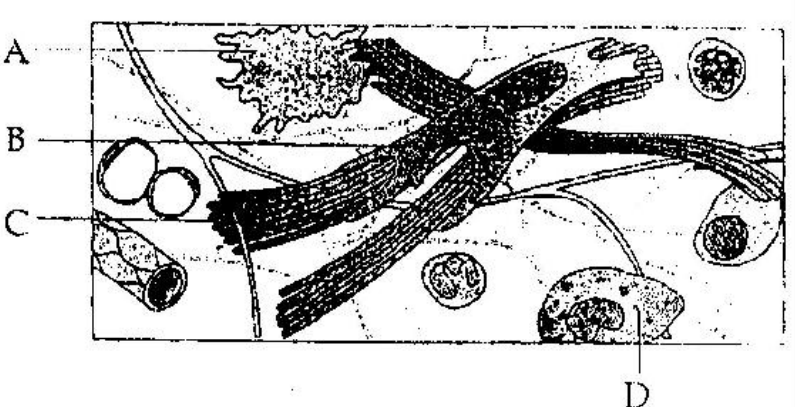 The sketch is of areolar tissue, a loose connective tissue present beneath the skin, with cells and fibres loosely arranged in a semi-fluid ground substance.
A is a macrophage: a large irregular cell that engulfs foreign particles.
B is a fibroblast: a flattened, spindle-shaped cell with processes that produces and secretes the fibres.
C represents collagen fibres: wavy bundles of fibres running through the matrix.
D is a mast cell: a rounded cell packed with granules that releases histamine and heparin.
So A is macrophage, B is fibroblast, C is collagen fibres and D is mast cell.
2009 AIPMT 1 question
-
The kind of tissue that forms the supportive structure in our pinna (external ears) is also found inThe pinna is supported by cartilage, a specialised connective tissue whose matrix is solid but pliable and resists compression.
In adults, cartilage is present in the tip of the nose, the outer ear joints, between adjacent bones of the vertebral column, and in the limbs and hands.
The vertebrae and ear ossicles are bones, and nails are made of the protein keratin.
Hence the same tissue is found in the tip of the nose.
2006 AIPMT-PRE 2 questions
-
Areolar connective tissue joins -Areolar tissue is a loose connective tissue, in which the cells and fibres are loosely arranged in a semi-fluid ground substance.
It contains fibroblasts (which produce the fibres), macrophages and mast cells.
It is present beneath the skin, where it joins the integument (skin) with the underlying muscles; it also serves as a support framework for epithelium.
Bones are joined with muscles by tendons, which are dense regular connective tissue.
Bones are joined with bones by ligaments, which are also dense regular connective tissue.
So areolar connective tissue joins the integument with muscles. -
Mast cells secrete -Mast cells are large cells found in areolar connective tissue, especially near the blood vessels.
Their cytoplasm is packed with granules that contain histamine, heparin and serotonin.
Histamine is a vasodilator: it dilates the blood vessels and increases their permeability, and it is released during inflammation and allergic reactions.
Heparin is an anticoagulant and serotonin is a vasoconstrictor.
Myoglobin is the oxygen-storing pigment of muscles, and haemoglobin is the respiratory pigment of red blood cells; hippuric acid is an excretory product.
So mast cells secrete histamine.
2004 AIPMT 1 question
-
Mast cells of connective tissue contain -Mast cells are found in areolar connective tissue, especially along blood vessels.
Their granules contain heparin (an anticoagulant that prevents clotting of blood inside the vessels), histamine (a vasodilator involved in inflammation and allergic reactions) and serotonin.
Calcitonin is a thyroid hormone, melanin is made by melanocytes, and vasopressin (from the posterior pituitary) and relaxin (from the ovary and placenta) are hormones.
So mast cells contain heparin and histamine.
2003 AIPMT 1 question
-
Which one of the following contains the largest quantity of extracellular material :-Connective tissues are characterised by a large amount of extracellular material (matrix with fibres) in which the cells are scattered.
Areolar tissue is a loose connective tissue with a semi-fluid ground substance containing collagen and elastic fibres, and cells such as fibroblasts, macrophages and mast cells. Most of its volume is extracellular material.
Epithelium has closely packed cells with very little intercellular material. Muscle and nerve tissues are mostly made of cells (fibres), with little extracellular material.
So areolar tissue contains the largest quantity of extracellular material.