Looking for classes? Ksquare Career Institute, Bengaluru →

Structural Organisation in Animals
Animal Tissues
2 questions from 2 papers, each with its answer.
- questions
- 2
- papers
- 2
- years asked, 2017–2026
- 1 of 10
- of Structural Organisation in Animals
- 2.17%
Appears in
Concepts tested
- Epithelial tissue
- tissue types and examples
All Questions
2022 1 question
-
Match List-I with List-II.
Pick the matching item from Column II for each row.
Column I
- A. Bronchioles
- B. Goblet cell
- C. Tendons
- D. Adipose Tissue
Column II
- I. Dense Regular Connective Tissue
- II. Loose Connective Tissue
- III. Glandular Tissue
- IV. Ciliated Epithelium
Correct answer: A → IV, B → III, C → I, D → II
2012 AIPMT-MAINS 1 question
-
The four sketches (A, B, C and D) given below represent four different types of animal tissues. Which one of these is correctly identified in the options given, along with its correct location and function?
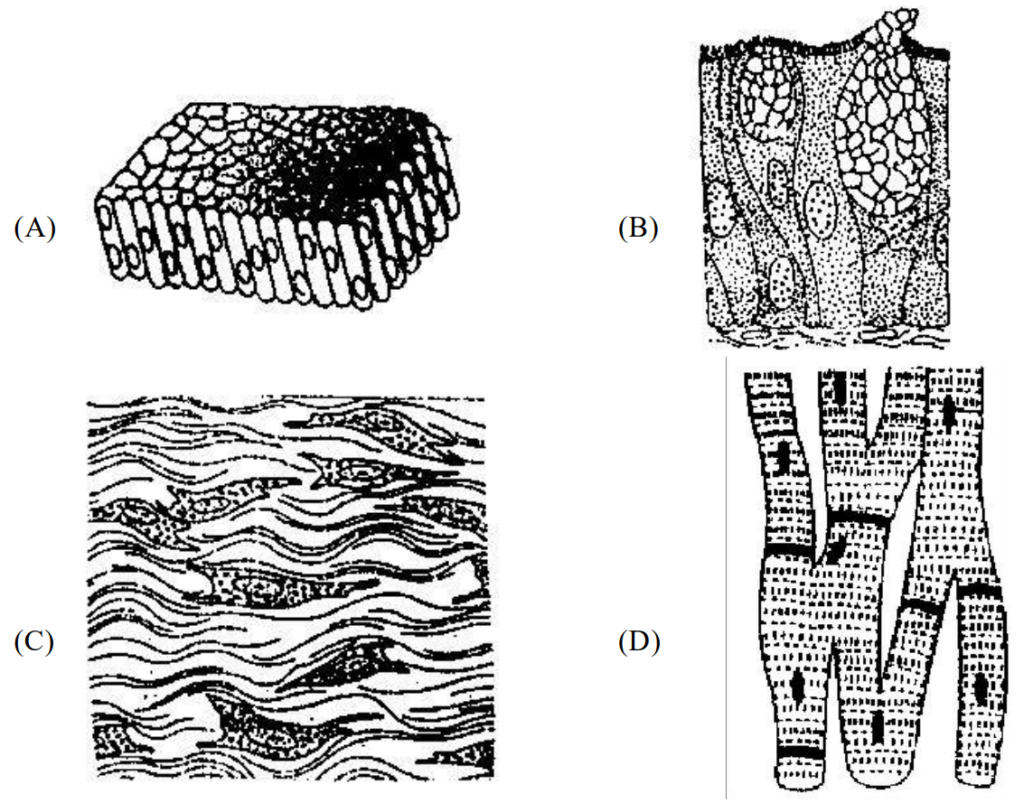 Sketch (B) shows glandular epithelium (columnar cells specialised for secretion, including unicellular goblet cells); it occurs in the lining of the intestine and its function is secretion. This row is fully correct.
Sketch (A): columnar epithelium lines the stomach and intestine; the tubules of the nephron are lined by cuboidal epithelium, so the location is wrong.
Sketch (C): the structure that attaches skeletal muscles to bones is a tendon (dense regular connective tissue), not cartilage, so the row is wrong.
Sketch (D): smooth muscle is found in the walls of blood vessels, stomach and intestine; the heart is made of cardiac muscle, so the row is wrong.
Hence the correct identification is (B) glandular epithelium, found in the intestine, with the function of secretion.