Looking for classes? Ksquare Career Institute, Bengaluru →

Chemistry
Aldehydes, Ketones and Carboxylic Acids
91 questions from 38 papers, each with its answer.
- 91 questions
- 38 papers
- 5.17% of Chemistry
Preparation of Aldehydes
-
Consider the following reaction:
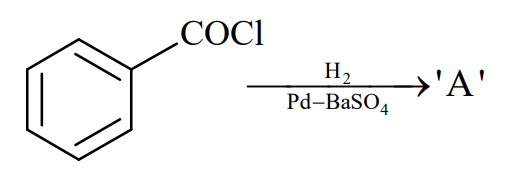
'A'. The product 'A' isAn acid chloride is reduced by $H_2$ over palladium supported on $BaSO_4$ to an aldehyde. This is the Rosenmund reduction.
$BaSO_4$ poisons the catalyst so that the aldehyde is not reduced further to the alcohol.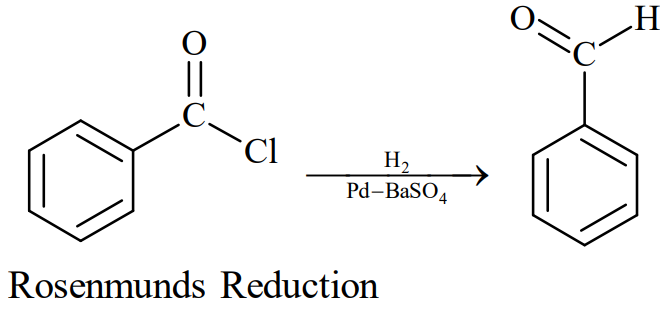
So A is benzaldehyde, $C_6H_5CHO$.
Tests for carbonyl compounds
-
Which of the following compounds will give a yellow precipitate with iodine and alkali?A yellow precipitate of iodoform ($CHI_3$) is given by compounds having the $CH_3-CO-$ group attached to C or H.
Acetophenone has this group: $C_6H_5COCH_3 \xrightarrow{I_2/NaOH} C_6H_5COONa + CHI_3\downarrow$
In methyl acetate and acetamide the $CH_3CO-$ group is attached to O or N, so they do not give the test.
As per the key the answer is acetophenone.
Nucleophilic addition reactions
-
Consider the reaction: $RCHO + NH_2NH_2 \rightarrow RCH=N-NH_2$. What sort of reaction is it?Hydrazine has a lone pair on nitrogen and acts as a nucleophile.
Step 1 (nucleophilic addition): $NH_2NH_2$ attacks the carbonyl carbon of RCHO to give $RCH(OH)-NH-NH_2$.
Step 2 (elimination): a molecule of water is lost to give the hydrazone $RCH=N-NH_2$.
So it is a nucleophilic addition–elimination reaction.
That is every question in Aldehydes, Ketones and Carboxylic Acids for this filter.
Want a score?
Answers here are not saved. Practise as a test to be marked and see your progress.
Practise as a test