Looking for classes? Ksquare Career Institute, Bengaluru →

Chemistry
Coordination Compounds
104 questions from 38 papers, each with its answer.
- 104 questions
- 38 papers
- 5.91% of Chemistry
Isomerism in Coordination Compounds
-
The complex, $[Pt(Py)(NH_3)BrCl]$ will have how many geometrical isomers?
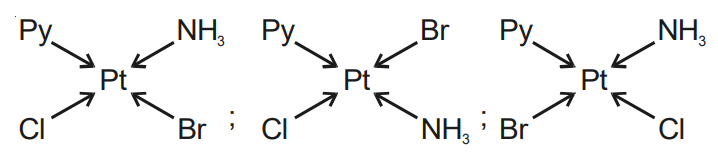
Pt(II) forms square planar complexes; this complex is of the type [Mabcd] with four different monodentate ligands (Py, $NH_3$, Br, Cl).
Fix one ligand, say Py, at one corner. The position trans to it can be occupied by any one of the other three ligands.
Isomer 1: Py trans to $NH_3$ (Br trans to Cl).
Isomer 2: Py trans to Br ($NH_3$ trans to Cl).
Isomer 3: Py trans to Cl ($NH_3$ trans to Br).
So a square planar complex [Mabcd] has 3 geometrical isomers.
Valence bond theory
-
Of the following complex ions, which is diamagnetic in nature?$[Ni(CN)_4]^{2-}$: $Ni^{2+}$ is $3d^8$. $CN^-$ is a strong field ligand and pairs up the 3d electrons, leaving one 3d orbital empty; the hybridisation is $dsp^2$ (square planar) and there are no unpaired electrons, so it is diamagnetic.
$[NiCl_4]^{2-}$: $Ni^{2+}$ is $3d^8$. $Cl^-$ is a weak field ligand, no pairing occurs; hybridisation is $sp^3$ (tetrahedral) with 2 unpaired electrons, so it is paramagnetic.
$[CoF_6]^{3-}$: $Co^{3+}$ is $3d^6$. $F^-$ is a weak field ligand; hybridisation is $sp^3d^2$ with 4 unpaired electrons, so it is paramagnetic.
$[CuCl_4]^{2-}$: $Cu^{2+}$ is $3d^9$ with 1 unpaired electron, so it is paramagnetic.
Hence the diamagnetic ion is $[Ni(CN)_4]^{2-}$.
Magnetic properties of complexes
-
The d-electron configurations of $Cr^{2+}$, $Mn^{2+}$, $Fe^{2+}$ and $Co^{2+}$ are $d^4$, $d^5$, $d^6$ and $d^7$ respectively. Which one of the following will exhibit minimum paramagnetic behaviour? (At. nos. Cr = 24, Mn = 25, Fe = 26, Co = 27)$H_2O$ is a weak field ligand, so all these octahedral complexes are high spin and the electrons are not forced to pair.
$Cr^{2+}$ ($d^4$): $t_{2g}^3e_g^1$, 4 unpaired electrons.
$Mn^{2+}$ ($d^5$): $t_{2g}^3e_g^2$, 5 unpaired electrons.
$Fe^{2+}$ ($d^6$): $t_{2g}^4e_g^2$, 4 unpaired electrons.
$Co^{2+}$ ($d^7$): $t_{2g}^5e_g^2$, 3 unpaired electrons.
Paramagnetism increases with the number of unpaired electrons ($\mu = \sqrt{n(n+2)}$ BM).
$[Co(H_2O)_6]^{2+}$ has the fewest unpaired electrons and shows minimum paramagnetic behaviour.
That is every question in Coordination Compounds for this filter.
Want a score?
Answers here are not saved. Practise as a test to be marked and see your progress.
Practise as a test