Looking for classes? Ksquare Career Institute, Bengaluru →

Chemistry
Start Practice Clear paper filter
-
The correct order of solubility of the given salts in water at 298 K is AgBr: $K_{sp}=5.0\times10^{-13}$; $Zn(OH)_2$: $K_{sp}=1.0\times10^{-15}$; $Hg_2Cl_2$: $K_{sp}=1.3\times10^{-18}$AgBr: $K_{sp}=s^2 \Rightarrow s_1=\sqrt{5\times10^{-13}}=7.1\times10^{-7}$ M. $Zn(OH)_2$: $K_{sp}=4s^3 \Rightarrow s_2=\left(\frac{1.0\times10^{-15}}{4}\right)^{1/3}=6.3\times10^{-6}$ M. $Hg_2Cl_2\rightarrow Hg_2^{2+}+2Cl^-$: $K_{sp}=4s^3 \Rightarrow s_3=\left(\frac{1.3\times10^{-18}}{4}\right)^{1/3}=6.9\times10^{-7}$ M. Order of solubility: $Zn(OH)_2>AgBr>Hg_2Cl_2$.
-
For a salt XY, which is a strong electrolyte, the plot of $\Lambda_m$ versus $\sqrt{c}$ has a slope of -90.0 S cm$^2$ mol$^{-3/2}$ L$^{1/2}$ at 298 K. At 0.01 M concentration of XY, the value of $\Lambda_m$ is 145.0 S cm$^2$ mol$^{-1}$. The limiting molar conductivity of $Y^-$ ion ($\lambda^0_{Y^-}$, in S cm$^2$ mol$^{-1}$) at 298 K will be (Given: $\lambda^0_{X^+}=74.0$ S cm$^2$ mol$^{-1}$)Debye-Huckel-Onsager equation: $\Lambda_m=\Lambda_m^0-A\sqrt{c}$. The slope of $\Lambda_m$ vs $\sqrt{c}$ is $-A=-90$, so A = 90. At c = 0.01 M: $145=\Lambda_m^0-90\times\sqrt{10^{-2}}=\Lambda_m^0-9 \Rightarrow \Lambda_m^0=154$ S cm$^2$ mol$^{-1}$. $\Lambda_m^0(XY)=\lambda^0(X^+)+\lambda^0(Y^-) \Rightarrow \lambda^0(Y^-)=154-74=80$ S cm$^2$ mol$^{-1}$.
-
For an elementary chemical reaction, the Arrhenius plot is given below.
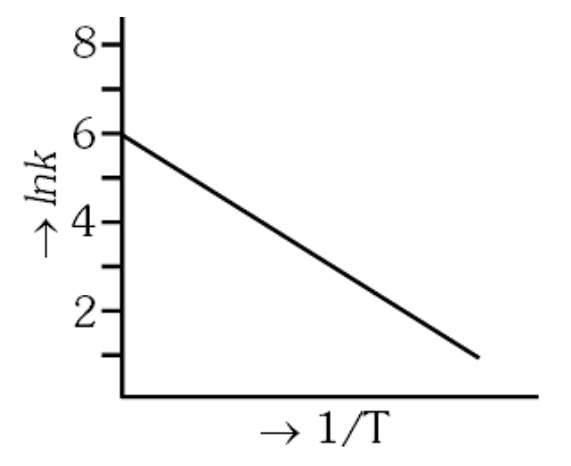 If the energy of activation is 6.64 kJ mol$^{-1}$ and R = 8.3 J K$^{-1}$ mol$^{-1}$, the temperature at which the rate constant becomes $e^2$ min$^{-1}$, is$\ln k=\ln A-\frac{E_a}{RT}$. From the graph, $\ln A=6$ (intercept). For $k=e^2$: $2=6-\frac{6.64\times1000}{8.3\times T} \Rightarrow \frac{6640}{8.3\times T}=4 \Rightarrow T=200$ K.
 -
Consider the reversible processes for 1.0 mol of an ideal gas as shown in the figure.
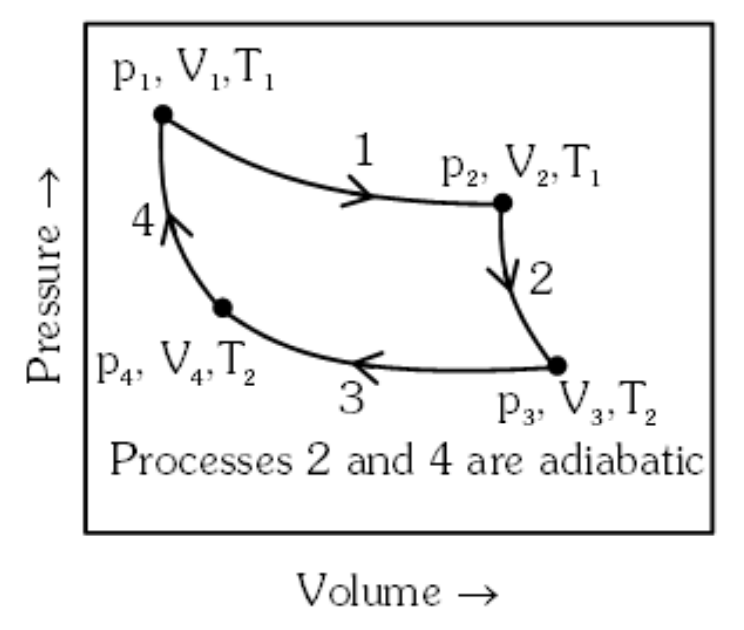 $w_1$, $w_2$, $w_3$ and $w_4$ represent work done (in calories) in the processes 1, 2, 3 and 4, respectively; $\Delta U_2$ and $\Delta U_4$ are changes in the internal energy for the processes 2 and 4, respectively. [use R = 2 cal K$^{-1}$ mol$^{-1}$] The correct option isProcess 1 (isothermal, reversible): $w_1=-nRT_1\ln\frac{V_2}{V_1}=-2T_1\ln\frac{V_2}{V_1}$. Process 3 (isothermal, reversible): $w_3=-2T_2\ln\frac{V_4}{V_3}$. So $w_1+w_3=-2T_1\ln\frac{V_2}{V_1}-2T_2\ln\frac{V_4}{V_3}$. Process 2 (adiabatic expansion): $w_2=\Delta U_2=C_V(T_2-T_1)$. Process 4 (adiabatic compression): $w_4=\Delta U_4=C_V(T_1-T_2)$, so $w_2+w_4=\Delta U_2+\Delta U_4=0$.
 -
Given below are two statements: Statement I: trans-But-2-ene upon treatment with $Br_2$ in $CCl_4$ gives the following product.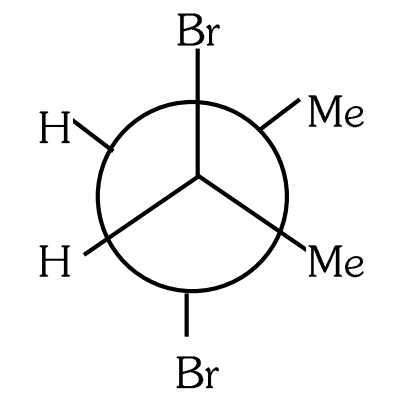 Statement II: cis-But-2-ene upon treatment with alkaline $KMnO_4$ gives the following product.
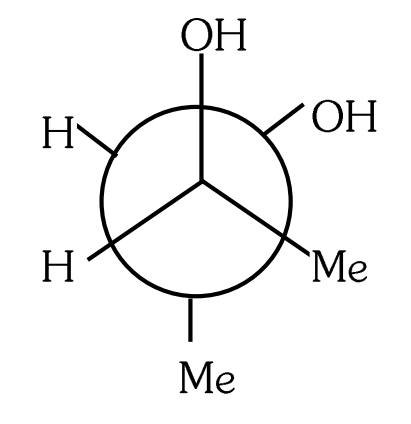 In the light of the above statements, choose the most appropriate answer from the options given below.Anti addition of $Br_2$ to trans-but-2-ene gives the meso compound (2,3-dibromobutane). The product drawn in Statement I, on rotation to its staggered form, is optically active, so it is not the meso product - Statement I is incorrect. Syn dihydroxylation of cis-but-2-ene with alkaline $KMnO_4$ gives the meso diol (butane-2,3-diol); the product drawn in Statement II is the optically inactive meso form - Statement II is correct.
 -
Consider the following reaction sequences and choose the correct option.
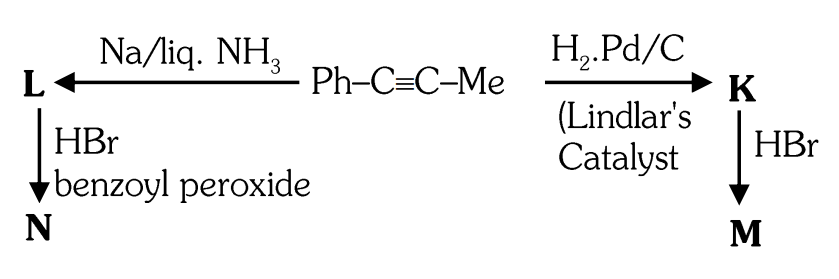
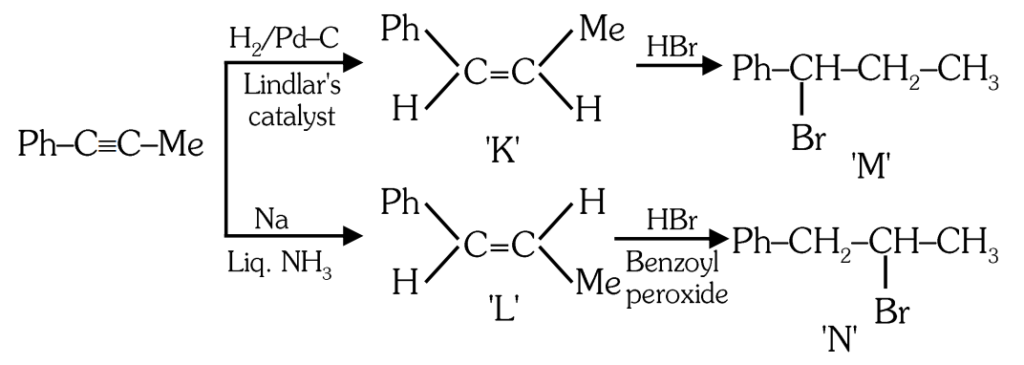 $Ph-C\equiv C-Me\xrightarrow{H_2,\ Pd/C\ (Lindlar's\ catalyst)}$ cis-$PhCH=CHMe$ (K); $\xrightarrow{Na/liq.\ NH_3}$ trans-$PhCH=CHMe$ (L). So K and L are geometrical isomers. K + HBr gives $Ph-CH(Br)-CH_2-CH_3$ (M); L + HBr/benzoyl peroxide gives $Ph-CH_2-CH(Br)-CH_3$ (N), which are position isomers, not stereoisomers.
 -
The compound that CANNOT be obtained from the aldol condensation reaction shown below, is
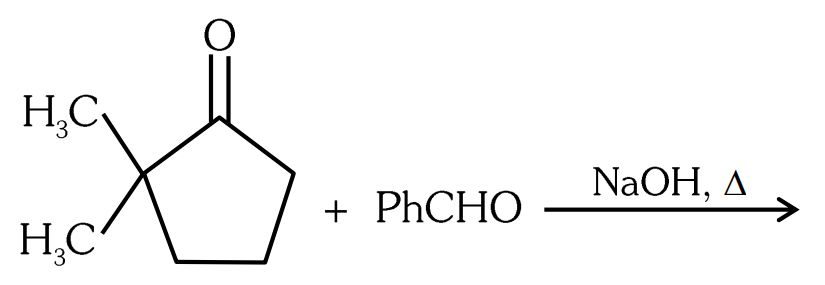 An aldol condensation product must be an $\alpha,\beta$-unsaturated carbonyl compound. In option (1) the ring double bond is at the $\beta,\gamma$ position relative to the C=O, so it cannot be formed by aldol condensation.