Looking for classes? Ksquare Career Institute, Bengaluru →

Chemistry
Start Practice Clear paper filter
Showing 1–25 of 50 questions
-
10 g of hydrogen and 64 g of oxygen were filled in a steel vessel and exploded. Amount of water produced in this reaction will beReaction: $2H_2 + O_2 \rightarrow 2H_2O$
Moles of $H_2$ = $\frac{10}{2} = 5$ mol; moles of $O_2$ = $\frac{64}{32} = 2$ mol
2 mol of $O_2$ needs $2\times2 = 4$ mol of $H_2$; 5 mol of $H_2$ is available, so $H_2$ is in excess and $O_2$ is the limiting reagent.
1 mol of $O_2$ gives 2 mol of $H_2O$, so 2 mol of $O_2$ gives $2\times2 = 4$ mol of $H_2O$.
Amount of water produced = 4 mol (1 mol of $H_2$ is left over) -
Oxidation numbers of P in $PO_4^{3-}$, of S in $SO_4^{2-}$ and that of Cr in $Cr_2O_7^{2-}$ are respectivelyTake the oxidation number of O as −2; the sum of oxidation numbers equals the charge on the ion.
$PO_4^{3-}$: $x + 4(-2) = -3$, so $x = +5$
$SO_4^{2-}$: $x + 4(-2) = -2$, so $x = +6$
$Cr_2O_7^{2-}$: $2x + 7(-2) = -2$, so $2x = +12$ and $x = +6$
The oxidation numbers are +5, +6 and +6. -
Maximum number of electrons in a subshell of an atom is determined by the followingA subshell with azimuthal quantum number l has $(2l + 1)$ orbitals, one for each value of $m_l$ from −l to +l.
Each orbital can hold a maximum of 2 electrons with opposite spins (Pauli exclusion principle).
Maximum number of electrons in a subshell = $2(2l + 1) = 4l + 2$
Check: s (l = 0) holds 2, p (l = 1) holds 6, d (l = 2) holds 10, f (l = 3) holds 14.
($2n^2$ is the maximum number of electrons in a shell, not a subshell.) -
Which of the following is not permissible arrangement of electrons in an atom?Rules: l can take values 0 to (n − 1); m can take values from −l to +l; s is $+\frac{1}{2}$ or $-\frac{1}{2}$.
n = 3, l = 2, m = –2: l = 2 is allowed for n = 3, and m = –2 lies within −2 to +2. Permissible.
n = 4, l = 0, m = 0: allowed (4s orbital). Permissible.
n = 5, l = 3, m = 0: l = 3 is allowed for n = 5, and m = 0 lies within −3 to +3. Permissible.
n = 3, l = 2, m = –3: for l = 2, m can only be −2, −1, 0, +1, +2; the value −3 is not possible.
Hence the arrangement n = 3, l = 2, m = –3, s = $-\frac{1}{2}$ is not permissible.
Note: the source prints the first and the fourth options identically; the first has been restored to m = –2, as in the original paper. -
From the following bond energies:
H–H bond energy: 431.37 kJ $mol^{-1}$
C=C bond energy: 606.10 kJ $mol^{-1}$
C–C bond energy: 336.49 kJ $mol^{-1}$
C–H bond energy: 410.50 kJ $mol^{-1}$
Enthalpy for the reaction,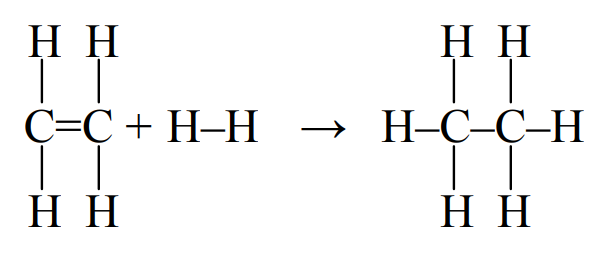 will be$\Delta H$ = (sum of bond energies of bonds broken) − (sum of bond energies of bonds formed)
Bonds broken (reactants): 1 C=C + 4 C–H + 1 H–H = $606.10 + 4(410.50) + 431.37 = 2679.47$ kJ
Bonds formed (product, ethane): 1 C–C + 6 C–H = $336.49 + 6(410.50) = 2799.49$ kJ
$\Delta H = 2679.47 - 2799.49$
$\Delta H = -120.02 \approx -120.0$ kJ $mol^{-1}$ -
The ionization constant of ammonium hydroxide is $1.77\times10^{-5}$ at 298 K. Hydrolysis constant of ammonium chloride is$NH_4Cl$ is a salt of a weak base ($NH_4OH$) and a strong acid (HCl); the cation hydrolyses: $NH_4^+ + H_2O \rightleftharpoons NH_4OH + H^+$
For such a salt: $K_h = \frac{K_w}{K_b}$
$K_h = \frac{1.0\times10^{-14}}{1.77\times10^{-5}}$
$K_h = 5.65\times10^{-10}$ -
Given:
(i) $Cu^{2+} + 2e^- \rightarrow Cu$, $E^\circ$ = 0.337 V
(ii) $Cu^{2+} + e^- \rightarrow Cu^+$, $E^\circ$ = 0.153 V
Electrode potential $E^\circ$ for the reaction, $Cu^+ + e^- \rightarrow Cu$, will beElectrode potentials are not additive, but Gibbs energies are: $\Delta G^\circ = -nFE^\circ$
(i) $Cu^{2+} + 2e^- \rightarrow Cu$: $\Delta G_1^\circ = -2F(0.337) = -0.674F$
(ii) $Cu^{2+} + e^- \rightarrow Cu^+$: $\Delta G_2^\circ = -1F(0.153) = -0.153F$
Required reaction = (i) − (ii): $Cu^+ + e^- \rightarrow Cu$, so $\Delta G_3^\circ = \Delta G_1^\circ - \Delta G_2^\circ = -0.674F + 0.153F = -0.521F$
$\Delta G_3^\circ = -1\times F\times E^\circ$, so $E^\circ = 0.521$ V
$E^\circ \approx 0.52$ V -
What is the $[OH^-]$ in the final solution prepared by mixing 20.0 mL of 0.050 M HCl with 30.0 mL of 0.10 M $Ba(OH)_2$?Millimoles of $H^+$ from HCl = $20.0\times0.050 = 1.0$ mmol
Each $Ba(OH)_2$ gives 2 $OH^-$: millimoles of $OH^-$ = $30.0\times0.10\times2 = 6.0$ mmol
$H^+ + OH^- \rightarrow H_2O$: 1.0 mmol of $H^+$ neutralises 1.0 mmol of $OH^-$
$OH^-$ left = 6.0 − 1.0 = 5.0 mmol
Total volume = 20.0 + 30.0 = 50.0 mL
$[OH^-] = \frac{5.0}{50.0} = 0.10$ M -
The energy absorbed by each molecule ($A_2$) of a substance is $4.4\times10^{-19}$ J and bond energy per molecule is $4.0\times10^{-19}$ J. The kinetic energy of the molecule per atom will beOf the energy absorbed by a molecule, a part equal to the bond energy is used to break the A–A bond; the rest appears as kinetic energy of the two atoms.
Kinetic energy per molecule = energy absorbed − bond energy = $4.4\times10^{-19} - 4.0\times10^{-19} = 0.4\times10^{-19}$ J
Each $A_2$ molecule gives two atoms, which share this energy equally.
Kinetic energy per atom = $\frac{0.4\times10^{-19}}{2} = 0.2\times10^{-19}$ J
$= 2.0\times10^{-20}$ J -
For the reaction, $N_2 + 3H_2 \rightarrow 2NH_3$, if $\frac{d[NH_3]}{dt} = 2\times10^{-4}$ mol $L^{-1}s^{-1}$, the value of $\frac{-d[H_2]}{dt}$ would beFor $N_2 + 3H_2 \rightarrow 2NH_3$: Rate $= -\frac{d[N_2]}{dt} = -\frac{1}{3}\frac{d[H_2]}{dt} = \frac{1}{2}\frac{d[NH_3]}{dt}$
$-\frac{1}{3}\frac{d[H_2]}{dt} = \frac{1}{2}\frac{d[NH_3]}{dt}$
$-\frac{d[H_2]}{dt} = \frac{3}{2}\frac{d[NH_3]}{dt} = \frac{3}{2}\times2\times10^{-4}$
$-\frac{d[H_2]}{dt} = 3\times10^{-4}$ mol $L^{-1}s^{-1}$ -
For the reaction A + B → products, it is observed that:
(1) On doubling the initial concentration of A only, the rate of reaction is also doubled and
(2) On doubling the initial concentration of both A and B, there is a change by a factor of 8 in the rate of the reaction.
The rate of this reaction is given byLet rate = $k[A]^x[B]^y$.
Observation (1): doubling [A] alone doubles the rate: $2^x = 2$, so x = 1.
Observation (2): doubling both [A] and [B] increases the rate 8 times: $2^x\times2^y = 8$
With x = 1: $2\times2^y = 8$, so $2^y = 4$ and y = 2.
Rate law: rate = $k[A][B]^2$ -
The equivalent conductance of $\frac{M}{32}$ solution of a weak monobasic acid is 8.0 mho $cm^2$ and at infinite dilution is 400 mho $cm^2$. The dissociation constant of this acid isDegree of dissociation: $\alpha = \frac{\Lambda}{\Lambda^\circ} = \frac{8.0}{400} = 0.02$
For a weak monobasic acid HA of concentration C: $K_a = \frac{C\alpha^2}{1 - \alpha} \approx C\alpha^2$ (since $\alpha$ is small)
$C = \frac{1}{32}$ M
$K_a = \frac{1}{32}\times(0.02)^2 = \frac{4\times10^{-4}}{32}$
$K_a = 1.25\times10^{-5}$ -
A 0.0020 m aqueous solution of an ionic compound $Co(NH_3)_5(NO_2)Cl$ freezes at $-0.00732^\circ C$. Number of moles of ions which 1 mole of ionic compound produces on being dissolved in water will be ($K_f = 1.86^\circ C/m$)$\Delta T_f = i\times K_f\times m$
$\Delta T_f = 0 - (-0.00732) = 0.00732^\circ C$
$i = \frac{\Delta T_f}{K_f\times m} = \frac{0.00732}{1.86\times0.0020} = \frac{0.00732}{0.00372}$
$i = 1.97 \approx 2$
So one mole of the compound gives 2 moles of ions; it ionises as $[Co(NH_3)_5(NO_2)]Cl \rightarrow [Co(NH_3)_5(NO_2)]^+ + Cl^-$
Number of moles of ions = 2 -
In the reaction $BrO_3^-(aq) + 5Br^-(aq) + 6H^+ \rightarrow 3Br_2(l) + 3H_2O(l)$, the rate of appearance of bromine ($Br_2$) is related to rate of disappearance of bromide ions as followingFor the given reaction: Rate $= -\frac{1}{5}\frac{d[Br^-]}{dt} = \frac{1}{3}\frac{d[Br_2]}{dt}$
The negative sign appears with $Br^-$ because its concentration decreases with time.
$\frac{1}{3}\frac{d[Br_2]}{dt} = -\frac{1}{5}\frac{d[Br^-]}{dt}$
$\frac{d[Br_2]}{dt} = -\frac{3}{5}\frac{d[Br^-]}{dt}$ -
Lithium metal crystallizes in a body centred cubic crystal. If the length of the side of the unit cell of lithium is 351 pm, the atomic radius of lithium will beIn a body-centred cubic unit cell the atoms touch along the body diagonal.
Body diagonal = $\sqrt{3}a$, and it contains corner atom radius + diameter of the central atom + corner atom radius = 4r
$4r = \sqrt{3}a$, so $r = \frac{\sqrt{3}a}{4}$
$r = \frac{1.732\times351}{4}$
r = 151.98 pm, i.e., about 151.8 pm among the given choices -
The dissociation constants for acetic acid and HCN at $25^\circ C$ are $1.5\times10^{-5}$ and $4.5\times10^{-10}$, respectively. The equilibrium constant for the equilibrium $CN^- + CH_3COOH \rightleftharpoons HCN + CH_3COO^-$ would be(i) $CH_3COOH \rightleftharpoons CH_3COO^- + H^+$; $K_1 = 1.5\times10^{-5}$
(ii) $HCN \rightleftharpoons H^+ + CN^-$; $K_2 = 4.5\times10^{-10}$
Reverse (ii): $H^+ + CN^- \rightleftharpoons HCN$; $K = \frac{1}{K_2}$
Adding (i) and the reversed (ii): $CN^- + CH_3COOH \rightleftharpoons HCN + CH_3COO^-$; $K = \frac{K_1}{K_2}$
$K = \frac{1.5\times10^{-5}}{4.5\times10^{-10}} = 0.333\times10^5$
$K = 3.3\times10^4 \approx 3.0\times10^4$ -
The values of $\Delta H$ and $\Delta S$ for the reaction, $C(graphite) + CO_2(g) \rightarrow 2CO(g)$ are 170 kJ and 170 J $K^{-1}$ respectively. This reaction will be spontaneous atA reaction is spontaneous when $\Delta G = \Delta H - T\Delta S < 0$
With $\Delta H$ and $\Delta S$ both positive, this needs $T\Delta S > \Delta H$, i.e., $T > \frac{\Delta H}{\Delta S}$
$\frac{\Delta H}{\Delta S} = \frac{170\times10^3\ J}{170\ J\,K^{-1}} = 1000$ K
So the reaction is spontaneous only above 1000 K.
Among the given temperatures, only 1110 K is above 1000 K. -
Half-life period of a first-order reaction is 1386 seconds. The specific rate constant of the reaction isFor a first order reaction: $t_{1/2} = \frac{0.693}{k}$
$k = \frac{0.693}{t_{1/2}} = \frac{0.693}{1386}$
$k = 5.0\times10^{-4}\ s^{-1}$
$k = 0.5\times10^{-3}\ s^{-1}$ -
In which of the following molecules/ions $BF_3$, $NO_2^-$, $NH_2^-$ and $H_2O$, the central atom is $sp^2$ hybridized?Steric number = σ bonds + lone pairs on the central atom; 3 means $sp^2$ and 4 means $sp^3$.
$BF_3$: 3 σ bonds + 0 lone pairs = 3, so $sp^2$.
$NO_2^-$: 2 σ bonds + 1 lone pair = 3, so $sp^2$.
$NH_2^-$: 2 σ bonds + 2 lone pairs = 4, so $sp^3$.
$H_2O$: 2 σ bonds + 2 lone pairs = 4, so $sp^3$.
Hence the central atom is $sp^2$ hybridised in $BF_3$ and $NO_2^-$. -
Among the following which is the strongest oxidizing agent?An oxidising agent accepts electrons; the higher its standard reduction potential, the stronger it is.
$E^\circ(X_2/X^-)$: $F_2$ = +2.87 V, $Cl_2$ = +1.36 V, $Br_2$ = +1.09 V, $I_2$ = +0.54 V
Fluorine has the highest value because of its low F–F bond dissociation enthalpy and the very high hydration enthalpy of the small $F^-$ ion, even though its electron gain enthalpy is less negative than that of chlorine.
Oxidising power: $F_2 > Cl_2 > Br_2 > I_2$
Hence the strongest oxidising agent is $F_2$. -
According to MO theory which of the following lists ranks the nitrogen species in terms of increasing bond order?$N_2$ (14 electrons): $\sigma1s^2\ \sigma^*1s^2\ \sigma2s^2\ \sigma^*2s^2\ \pi2p_x^2 = \pi2p_y^2\ \sigma2p_z^2$; bond order = $\frac{10 - 4}{2} = 3$
$N_2^-$ (15 electrons): the extra electron enters an antibonding $\pi^*2p$ orbital; bond order = $\frac{10 - 5}{2} = 2.5$
$N_2^{2-}$ (16 electrons): two extra electrons in antibonding $\pi^*2p$ orbitals; bond order = $\frac{10 - 6}{2} = 2$
Increasing bond order: $N_2^{2-}$ (2) < $N_2^-$ (2.5) < $N_2$ (3) -
In the case of alkali metals, the covalent character decreases in the orderBy Fajans' rules, for a given cation the covalent character of an ionic compound increases with the polarisability of the anion.
The larger the anion, the more loosely its outer electrons are held and the more easily it is polarised (distorted) by the cation.
Size of halide ions: $F^- < Cl^- < Br^- < I^-$
So polarisability and covalent character increase in the order MF < MCl < MBr < MI.
Decreasing order of covalent character: MI > MBr > MCl > MF -
Which of the following oxides is not expected to react with sodium hydroxide?Sodium hydroxide is a base; it reacts with acidic and amphoteric oxides but not with basic oxides.
BeO is amphoteric: $BeO + 2NaOH \rightarrow Na_2BeO_2 + H_2O$
$B_2O_3$ is acidic: $B_2O_3 + 6NaOH \rightarrow 2Na_3BO_3 + 3H_2O$
$SiO_2$ is acidic: $SiO_2 + 2NaOH \rightarrow Na_2SiO_3 + H_2O$
CaO is a basic oxide, so it does not react with another base.
Hence CaO is not expected to react with sodium hydroxide. -
$Al_2O_3$ is reduced by electrolysis at low potentials and high currents. If $4.0\times10^4$ amperes of current is passed through molten $Al_2O_3$ for 6 hours, what mass of aluminium is produced? (Assume 100% current efficiency, at. mass of Al = 27 g $mol^{-1}$)Charge passed: $Q = It = 4.0\times10^4\times6\times3600 = 8.64\times10^8$ C
Moles of electrons = $\frac{Q}{F} = \frac{8.64\times10^8}{96500} = 8953$ mol
Cathode reaction: $Al^{3+} + 3e^- \rightarrow Al$, so 3 mol of electrons deposit 1 mol (27 g) of Al.
Moles of Al = $\frac{8953}{3} = 2984$ mol
Mass of Al = $2984\times27 = 8.06\times10^4$ g
$\approx 8.1\times10^4$ g -
The stability of +1 oxidation state increases in the sequenceGroup 13 elements have the configuration $ns^2np^1$ and can show +1 and +3 oxidation states.
Down the group the $ns^2$ electrons become increasingly reluctant to take part in bonding, because the intervening d and f electrons shield the nuclear charge poorly. This is the inert pair effect.
As a result the +1 state becomes more and more stable on going down the group, while the +3 state becomes less stable.
Stability of the +1 state: Al < Ga < In < Tl (for thallium, +1 is the predominant state).