Looking for classes? Ksquare Career Institute, Bengaluru →

Physics
Current Electricity
130 questions from 38 papers, each with its answer.
- 130 questions
- 38 papers
- 7.37% of Physics
Wheatstone Bridge
-
For the network shown in the figure the value of the current $i$ is -
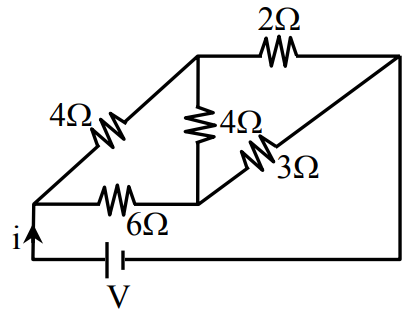 The resistances $4\,\Omega$, $6\,\Omega$, $2\,\Omega$ and $3\,\Omega$ form the four arms of a Wheatstone bridge, with the middle $4\,\Omega$ resistor as the galvanometer arm.
Check the balance: $\dfrac{4}{6} = \dfrac{2}{3}$, so the bridge is balanced and no current flows through the middle $4\,\Omega$ resistor; it can be removed.
The circuit then reduces to two parallel branches: $(4 + 2) = 6\,\Omega$ and $(6 + 3) = 9\,\Omega$.
Equivalent resistance $= \dfrac{6 \times 9}{6 + 9} = \dfrac{54}{15} = \dfrac{18}{5}\,\Omega$
Current drawn from the source: $i = \dfrac{V}{18/5}$
$\Rightarrow i = \dfrac{5V}{18}$
Thermoelectric effect
-
The temperature of inversion of a thermocouple is $620^\circ C$ and the neutral temperature is $300^\circ C$. What is the temperature of cold junction :The thermo emf varies with the temperature $\theta$ of the hot junction as $e = \alpha(\theta - \theta_C) + \beta(\theta^2 - \theta_C^2)$, where $\theta_C$ is the temperature of the cold junction.
At the inversion temperature $e = 0$: dividing by $(\theta - \theta_C)$ gives $\alpha + \beta(\theta_i + \theta_C) = 0 \Rightarrow \theta_i = -\theta_C - \dfrac{\alpha}{\beta}$
At the neutral temperature $\dfrac{de}{d\theta} = 0$: $\alpha + 2\beta\theta_n = 0 \Rightarrow \theta_n = -\dfrac{\alpha}{2\beta}$
$\Rightarrow \theta_i = 2\theta_n - \theta_C \Rightarrow \theta_n = \dfrac{\theta_i + \theta_C}{2}$
$300 = \dfrac{620 + \theta_C}{2}$
$620 + \theta_C = 600$
$\theta_C = -20^\circ C$
Cells in Parallel
-
Two batteries, one of emf 18 volts and internal resistance $2\,\Omega$ and the other of emf 12 volt and internal resistance $1\,\Omega$, are connected as shown. The voltmeter V will record a reading of
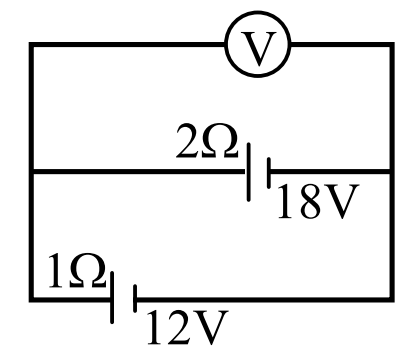 For two cells in parallel (like terminals joined), the equivalent emf is $E_{eq} = \dfrac{\dfrac{E_1}{r_1} + \dfrac{E_2}{r_2}}{\dfrac{1}{r_1} + \dfrac{1}{r_2}} = \dfrac{E_1 r_2 + E_2 r_1}{r_1 + r_2}$
An ideal voltmeter draws no current, so it reads this equivalent emf.
Here $E_1 = 18$ V, $r_1 = 2\,\Omega$, $E_2 = 12$ V, $r_2 = 1\,\Omega$.
Reading of voltmeter $= \dfrac{18 \times 1 + 12 \times 2}{2 + 1} = \dfrac{18 + 24}{3}$
$= \dfrac{42}{3} = 14$ volt
Check: the circulating current between the cells is $\dfrac{18 - 12}{2 + 1} = 2$ A, so the terminal voltage is $18 - 2 \times 2 = 14$ V $= 12 + 2 \times 1$.
That is every question in Current Electricity for this filter.
Want a score?
Answers here are not saved. Practise as a test to be marked and see your progress.
Practise as a test