Looking for classes? Ksquare Career Institute, Bengaluru →

Physics
Current Electricity
130 questions from 38 papers, each with its answer.
- 130 questions
- 38 papers
- 7.37% of Physics
Combination of Resistors
-
A ring is made of a wire having a resistance $R_0 = 12\ \Omega$. Find the points A and B, as shown in the figure, at which a current carrying conductor should be connected so that the resistance R of the sub circuit between these points is equal to $\frac{8}{3}\ \Omega$.
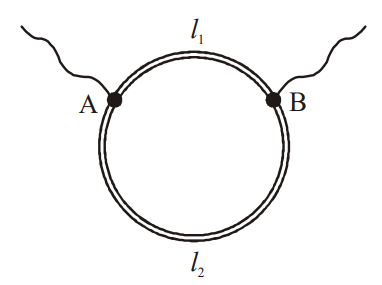 The two arcs have resistances $R_1$ and $R_2$ (proportional to $l_1$ and $l_2$) and are in parallel between A and B.
$R_1 + R_2 = 12$ ...(i)
$\frac{R_1R_2}{R_1 + R_2} = \frac{8}{3} \Rightarrow R_1R_2 = 32$ ...(ii)
Solving: $R_1 = 4\ \Omega$ and $R_2 = 8\ \Omega$
$\frac{l_1}{l_2} = \frac{R_1}{R_2} = \frac{1}{2}$
Kirchhoff's rules
-
In the circuit shown the cells A and B have negligible resistances. For $V_A$ = 12 V, $R_1$ = 500 $\Omega$ and R = 100 $\Omega$ the galvanometer (G) shows no deflection. The value of $V_B$ is
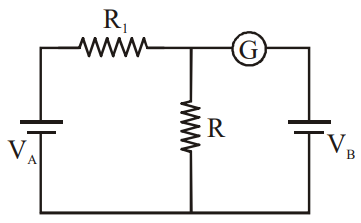 With no current through the galvanometer, cell A drives a current through $R_1$ and R in series.
$i = \frac{12}{500 + 100} = \frac{12}{600} = \frac{1}{50}$ A
Potential difference across R $= 100\times\frac{1}{50} = 2$ V
For null deflection $V_B$ equals this potential difference: $V_B = 2$ V
That is every question in Current Electricity for this filter.
Want a score?
Answers here are not saved. Practise as a test to be marked and see your progress.
Practise as a test