Looking for classes? Ksquare Career Institute, Bengaluru →

Physics
Dual Nature of Radiation and Matter
82 questions from 38 papers, each with its answer.
- 82 questions
- 38 papers
- 4.65% of Physics
de Broglie Wavelength
-
A photon and an electron (mass $m$) have the same energy $E$. The ratio $(\lambda_{\text{photon}} / \lambda_{\text{electron}})$ of their de Broglie wavelengths is ($c$ is the speed of light):
Photon wavelength is $\lambda_p = \frac{hc}{E}$ and electron wavelength is $\lambda_e = \frac{h}{\sqrt{2mE}}$. Their ratio is $\frac{\lambda_p}{\lambda_e} = c\sqrt{\frac{2m}{E}}$.
For a photon: $E = \frac{h c}{\lambda_p} \implies \lambda_p = \frac{h c}{E}$. For a non-relativistic electron of energy $E$: $p = \sqrt{2mE} \implies \lambda_e = \frac{h}{p} = \frac{h}{\sqrt{2mE}}$. Taking the ratio: $\frac{\lambda_{\text{photon}}}{\lambda_{\text{electron}}} = \frac{h c / E}{h / \sqrt{2mE}} = c \frac{\sqrt{2mE}}{E} = c \sqrt{\frac{2m}{E}}$.
Experimental Study of Photoelectric Effect
-
Which of the following options represent the variation of photoelectric current with property of light shown on the x-axis?
Choose the correct answer from the options given below: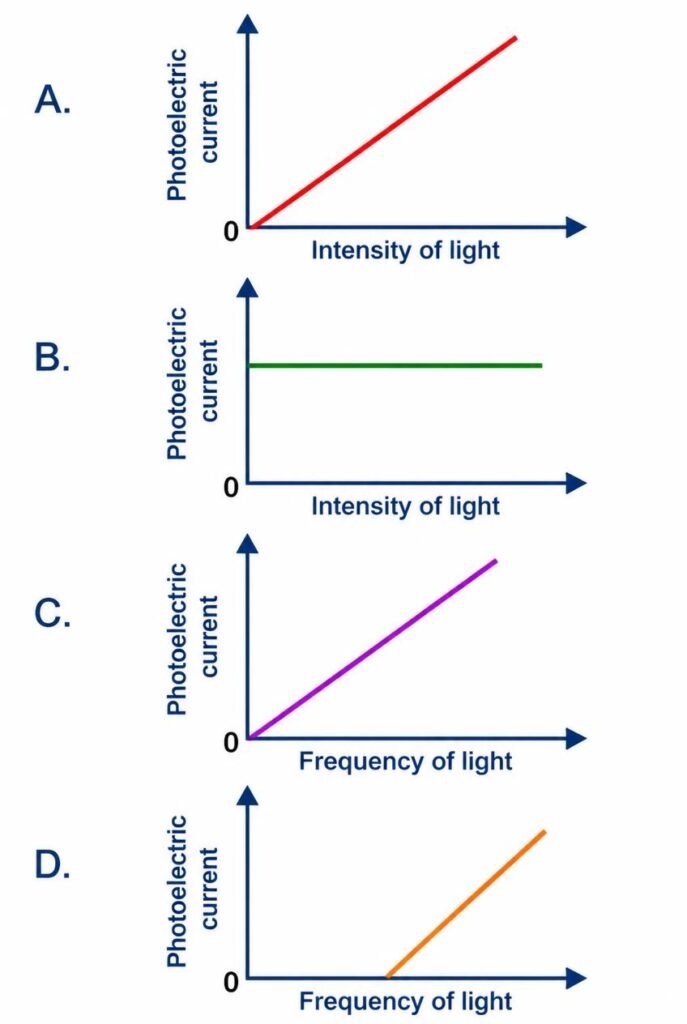
Photoelectric current is directly proportional to the intensity of incident radiation for frequency above threshold, represented by graph A only.
The number of photoelectrons emitted per second (and hence saturation photoelectric current) is directly proportional to the intensity of the incident light (provided $\nu > \nu_0$). Thus, a plot of photoelectric current against intensity is a straight line passing through the origin (Graph A). Photoelectric current does not vary linearly with frequency above threshold (stopping potential does), so C and D are incorrect representations.
That is every question in Dual Nature of Radiation and Matter for this filter.
Want a score?
Answers here are not saved. Practise as a test to be marked and see your progress.
Practise as a test