Looking for classes? Ksquare Career Institute, Bengaluru →

Faraday's law
Appears in
Concepts tested here
- Flux change from i–t graph
- Induced emf and current
- Induced emf in a shrinking loop
All Questions
2012 AIPMT-MAINS 1 question
-
In a coil of resistance 10 $\Omega$, the induced current developed by changing magnetic flux through it, is shown in figure as a function of time. The magnitude of change in flux through the coil in Weber is
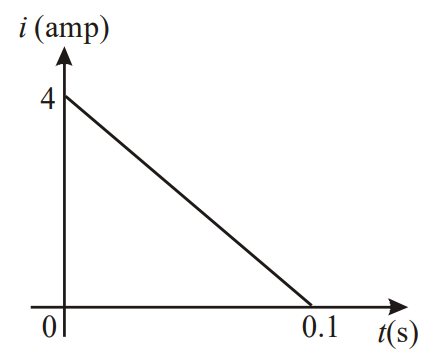 $\left|\frac{d\phi}{dt}\right| = e = iR \Rightarrow d\phi = (iR)\,dt$
$\Delta\phi = R\int i\,dt = R\times$ (area under the i–t graph)
The graph is a triangle with height 4 A and base 0.1 s: area $= \frac{1}{2}\times4\times0.1 = 0.2$ A s
$\Delta\phi = 10\times0.2 = 2$ Wb
2012 AIPMT-PRE 1 question
-
A coil of resistance 400 $\Omega$ is placed in a magnetic field. If the magnetic flux $\phi$ (Wb) linked with the coil varies with time t (sec) as $\phi = 50t^2 + 4$, the current in the coil at t = 2 sec is$|\text{emf}| = \frac{d\phi}{dt} = \frac{d}{dt}(50t^2 + 4) = 100t$
At t = 2 s, emf = 100 × 2 = 200 V
$i = \frac{\text{emf}}{R} = \frac{200}{400} = 0.5$ A
2010 AIPMT-PRE 1 question
-
A conducting circular loop is placed in a uniform magnetic field, B = 0.025 T with its plane perpendicular to the field. The radius of the loop is made to shrink at a constant rate of 1 mm $s^{-1}$. The induced emf when the radius is 2 cm isFlux through the loop: $\phi = BA = B\pi r^2$
Induced emf: $|\varepsilon| = \frac{d\phi}{dt} = B\pi\times2r\frac{dr}{dt}$
B = 0.025 T, r = 2 cm = $2\times10^{-2}$ m, $\frac{dr}{dt} = 1$ mm/s = $1\times10^{-3}$ m/s
$|\varepsilon| = 0.025\times\pi\times2\times2\times10^{-2}\times1\times10^{-3}$
$|\varepsilon| = \pi\times10^{-6}$ V = $\pi\ \mu V$
Note: the source prints 'plane perpendicular to the loop'; it means the plane of the loop is perpendicular to the field.