Looking for classes? Ksquare Career Institute, Bengaluru →

Physics
Electrostatic Potential and Capacitance
76 questions from 37 papers, each with its answer.
- 76 questions
- 37 papers
- 4.31% of Physics
Combination of Capacitors
-
In the following circuit, the equivalent capacitance between terminal $A$ and terminal $B$ is:
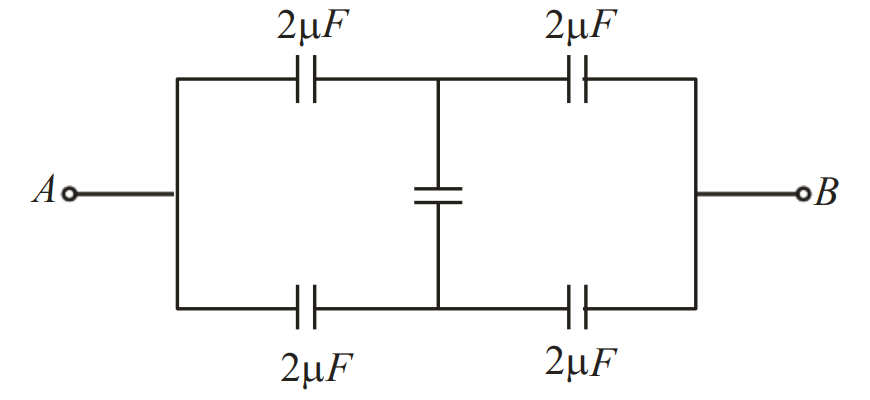
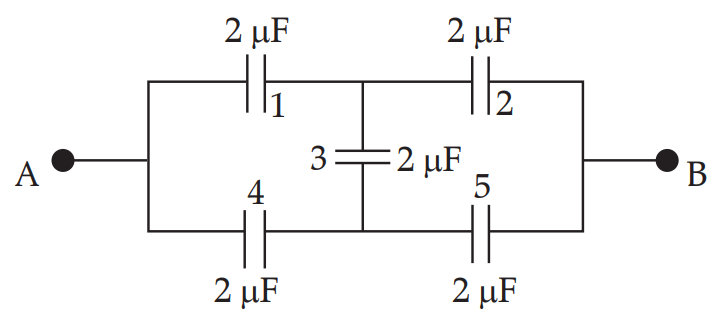
The bridge is balanced (all capacitors equal), so the middle capacitor can be neglected. Upper branch: two 2 $\mu F$ in series $= 1\ \mu F$ Lower branch: two 2 $\mu F$ in series $= 1\ \mu F$ The two branches are in parallel: $C = 1 + 1 = 2\ \mu F$
Electric Dipole Potential
-
Assertion (A): The potential ($V$) at any axial point, at 2 m distance ($r$) from the centre of the dipole of dipole moment vector $\vec{P}$ of magnitude, $4\times10^{-6}$ C m, is $\pm 9\times 10^{3}$ V. (Take $\frac{1}{4\pi\epsilon_0} = 9\times10^{9}$ SI units)Reason (R): $V = \pm \frac{2P}{4\pi\epsilon_0 r^2}$, where $r$ is the distance of any axial point, situated at 2 m from the centre of the dipole.Potential at an axial point due to a dipole: $V = \pm\frac{1}{4\pi\varepsilon_0}\frac{p}{r^2}$ $V = \pm 9 \times 10^9 \times \frac{4 \times 10^{-6}}{(2)^2} = \pm 9 \times 10^3$ V So the Assertion is true. The Reason gives $V = \pm\frac{2p}{4\pi\varepsilon_0 r^2}$, which is not the correct expression (the factor 2 appears in the axial electric field, not the potential). So the Reason is false. Hence A is true but R is false.
Potential due to a Charged Spherical Shell
-
A thin spherical shell is charged by some source. The potential difference between the two points $C$ and $P$ (in $V$) shown in the figure is; (Take $\frac{1}{4\pi\epsilon_0}=9\times10^{9}$ SI units, $R=3$ cm, $q=1\mu C$)
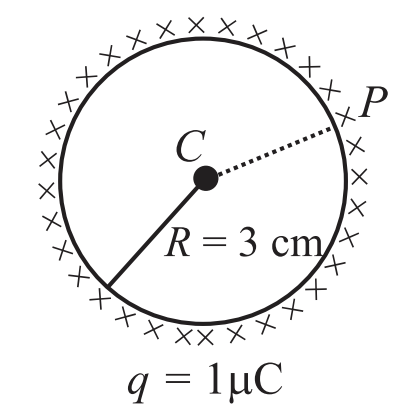 The electric potential due to a uniformly charged spherical shell is constant everywhere inside the shell and equal to its value on the surface. Hence $V_C = V_P$ $\therefore$ Potential difference = 0
Parallel Plate Capacitor connected to a Battery
-
If the plates of a parallel plate capacitor connected to a battery are moved close to each other, then A. the charge stored in it, increases. B. the energy stored in it, decreases. C. its capacitance increases. D. the ratio of charge to its potential remains the same. E. the product of charge and voltage increases. Choose the most appropriate answer from the options given below:$C = \frac{\varepsilon_0 A}{d}$; as d decreases, C increases (C true). The battery remains connected, so V = constant. $q = CV \propto C$, so the charge increases (A true). Energy stored $U = \frac{1}{2}CV^2$ increases as C increases, so B ('energy decreases') is false. $\frac{q}{V} = C$ increases, so D is false. $qV = CV^2$ also increases (E true). So A, C and E only are correct.
That is every question in Electrostatic Potential and Capacitance for this filter.
Want a score?
Answers here are not saved. Practise as a test to be marked and see your progress.
Practise as a test