Looking for classes? Ksquare Career Institute, Bengaluru →

Physics
Laws of Motion
72 questions from 37 papers, each with its answer.
- 72 questions
- 37 papers
- 4.08% of Physics
Motion on an Inclined Plane
-
When an object is shot from the bottom of a long smooth inclined plane kept at an angle $60^\circ$ with horizontal, it can travel a distance $x_1$ along the plane. But when the inclination is decreased to $30^\circ$ and the same object the shot with the same velocity, it can travel $x_2$ distance. Then $x_1:x_2$ will be:On a smooth incline the retardation is $g\sin\theta$, so the stopping distance is $x=\frac{u^2}{2g\sin\theta}$. $x_1=\frac{u^2}{2g\sin60^\circ}$, $x_2=\frac{u^2}{2g\sin30^\circ}$ $\frac{x_1}{x_2}=\frac{\sin30^\circ}{\sin60^\circ}=\frac{1/2}{\sqrt{3}/2}=\frac{1}{\sqrt{3}}$ $x_1:x_2=1:\sqrt{3}$
Friction and Circular Motion
-
A block of mass 10 kg is in contact against the inner wall of a hollow cylindrical drum of radius 1 m. The coefficient of friction between the block and the inner wall of the cylinder is 0.1. The minimum angular velocity needed for the cylinder to keep the block stationary when the cylinder is vertical and rotating about its axis, will be: ($g=10\ m/s^2$)The normal reaction from the wall provides the centripetal force: $N=mr\omega^2$ For equilibrium of the block, limiting friction must balance weight: $f_L=\mu N\ge mg$ $\mu mr\omega^2\ge mg\Rightarrow\omega\ge\sqrt{\frac{g}{\mu r}}$ $\omega_{min}=\sqrt{\frac{10}{0.1\times1}}=10\ rad/s$
Dynamics of Uniform Circular Motion – Vertical Circle
-
A mass $m$ is attached to a thin wire and whirled in a vertical circle. The wire is most likely to break when:At the lowest point: $T-mg=\frac{mu^2}{l}\Rightarrow T=mg+\frac{mu^2}{l}$ Both weight and speed contribute maximally to tension at the lowest point, so the tension is maximum there and the wire is most likely to break when the mass is at the lowest point.
Newton's First Law – Equilibrium of Concurrent Forces
-
A particle moving with velocity $\vec{V}$ is acted by three forces shown by the vector triangle PQR. The velocity of the particle will:
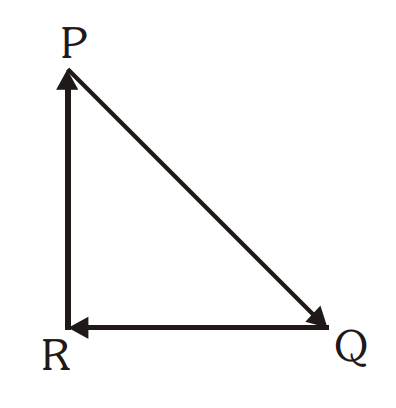 The three forces form a closed triangle taken in the same order, so $\vec{F}_{net}=0$.
$m\frac{d\vec{v}}{dt}=0\Rightarrow\vec{v}=$ constant
So the velocity of the particle remains constant.
That is every question in Laws of Motion for this filter.
Want a score?
Answers here are not saved. Practise as a test to be marked and see your progress.
Practise as a test